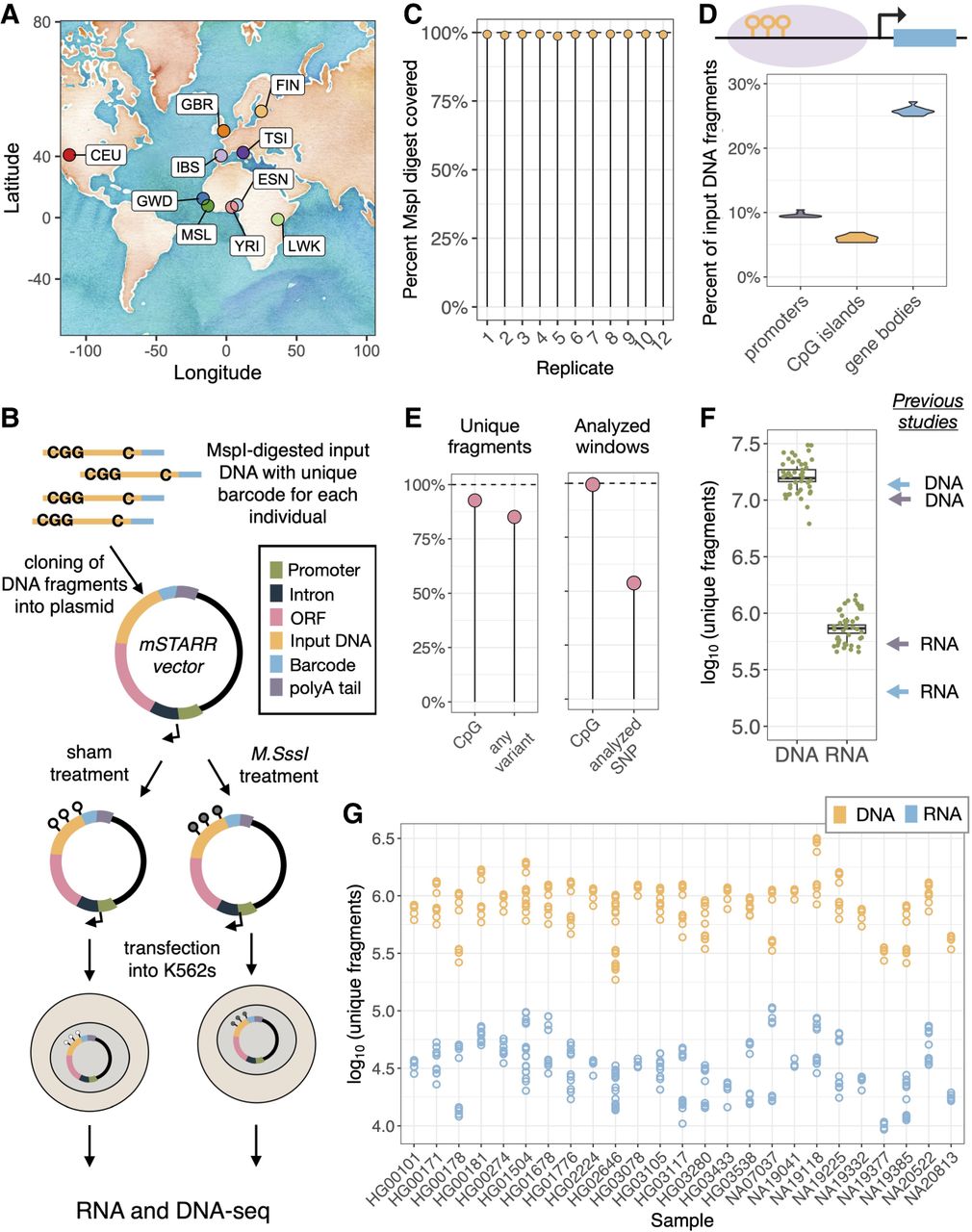
Multiplexed mSTARR-seq assays a diverse input library. (A) Sampling locations of the 25 individuals included in the assay: (CEU) Utah residents (CEPH); (ESN) Esan in Nigeria; (FIN) Finnish in Finland; (GBR) British in England and Scotland; (GWD) Gambian in Western Division in the Gambia; (IBS) Iberian population in Spain; (LWK) Luhya in Webuye, Kenya; (MSL) Mende in Sierra Leone; (TSI) Toscani in Italy; and (YRI) Yoruba in Ibadan, Nigeria. (B) Multiplexed mSTARR-seq design: Sample-specific barcodes are added to MspI-digested input DNA and inserted into the mSTARR vector downstream from a promoter, intron, and open reading frame (ORF). Plasmids are exposed to a methylation treatment or sham control and transfected into K562 cells and incubated for 48 h, and DNA and RNA are extracted and sequenced. (C) Percentage of an in silico MspI digest of the human genome that is represented in the DNA input of each replicate. (D) Percentage of input DNA fragments located within promoters, CpG islands, and gene bodies in each replicate (note these are not mutually exclusive annotations). (E) Percentage of unique DNA fragments that contain at least one CpG site and at least one SNP (left), and the percentage of analyzed windows (n = 525,074) that contain at least one CpG site and at least one analyzable SNP (i.e., biallelic, >0.05 MAF, and was called in our joint genotyping analysis; right). (F) Number of unique DNA and RNA fragments observed in each replicate; the mean number of fragments included in each replicate in Lea et al. (2018) (purple arrows) and Johnston et al. (2024) (blue arrows) is shown for comparison. (G) Number of unique DNA and RNA fragments included in each replicate from each of the 25 individuals included in the assay.