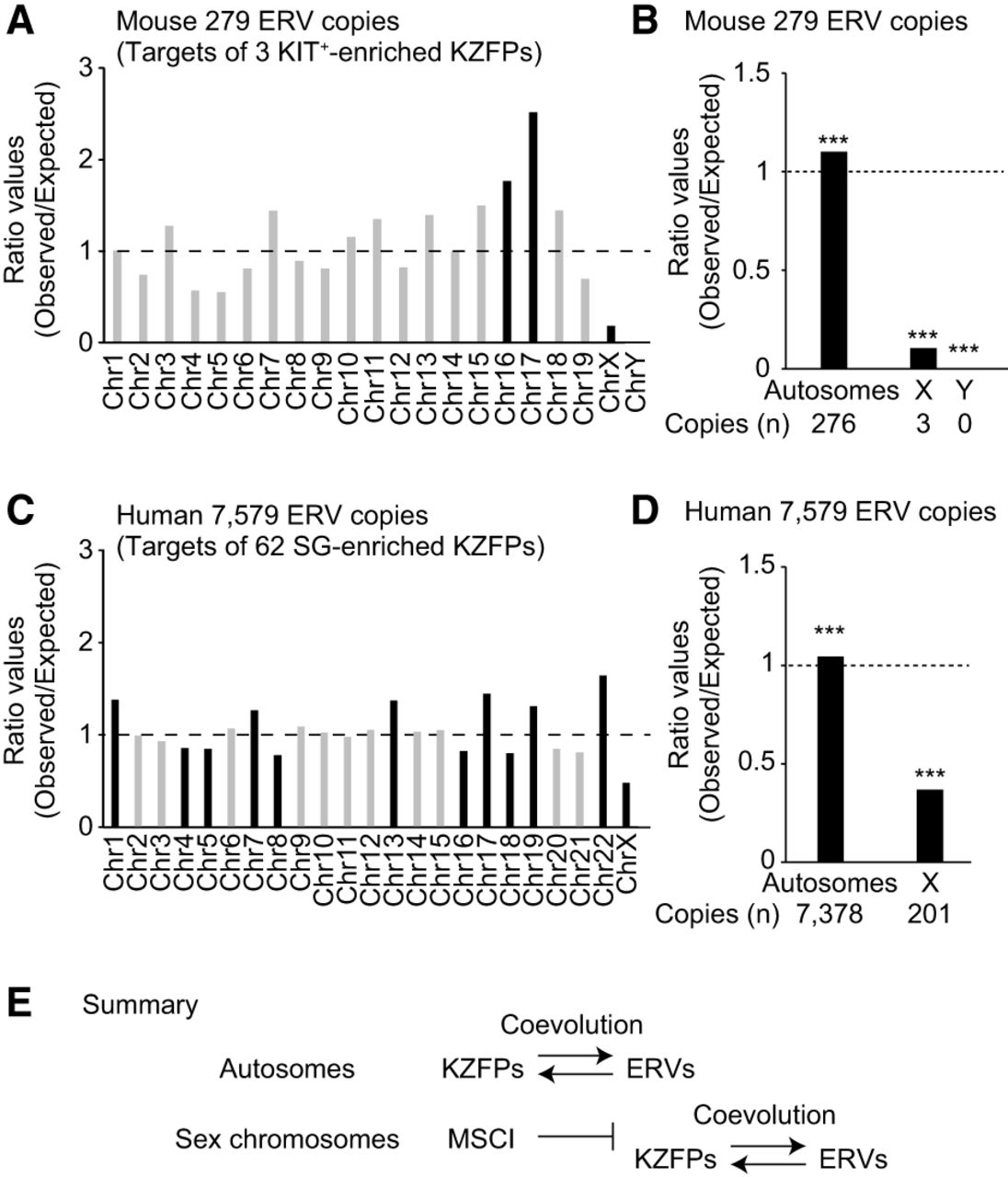
Chromosomal distribution of ERVs targeted by mouse and human spermatogonia-enriched KZFPs. (A) Chromosomal distribution of mouse ERV copies targeted by KIT+-enriched KZFPs. The bar plot represents the ratio values of the observed copy number of ERVs versus the theoretically expected number. The color of each bar represents the statistical significance: black indicates P < 0.05; gray, not significant; binomial test. (B) Distribution of mouse ERV copies targeted by KIT+-enriched KZFPs on autosomes or sex chromosomes. Binomial test. (***) P < 0.001. (C) Chromosomal distribution of human ERV copies targeted by SG-enriched KZFPs. The bar plot is represented the same way as panel A. The Y Chromosome data are absent because the HEK293T cells used in the ChIP-exo experiments to determine human KZFP binding were derived from a female donor and, therefore, lacked Y Chromosomes. (D) Distribution of human ERV copies that are targeted by PriSC-enriched KZFPs on autosomes or sex chromosomes. The bar plot is represented the same as panel B. (E) Summary. MSCI antagonizes the coevolution of KZFPs and ERVs on the sex chromosomes in mammals.