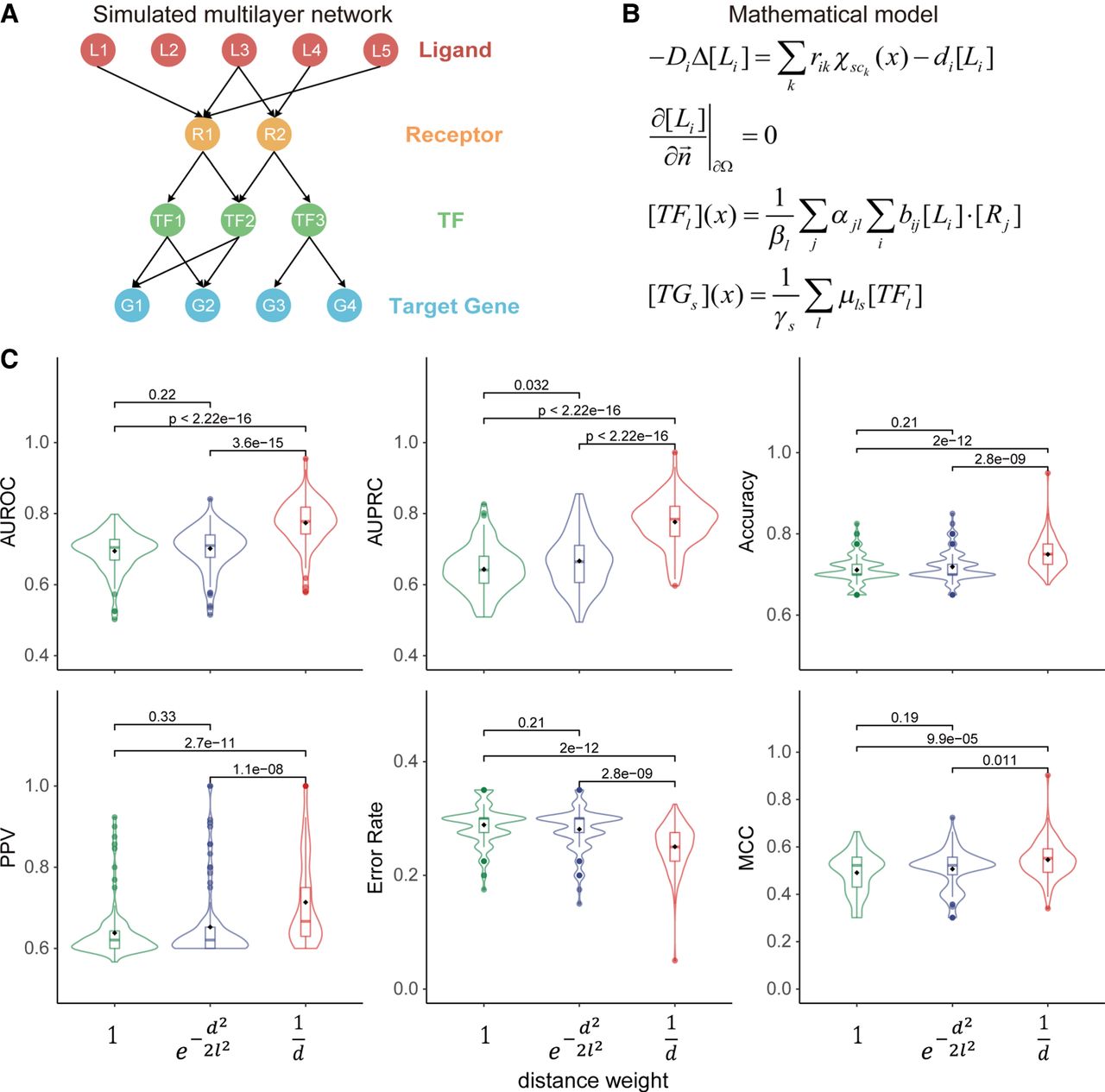
Verifying distance-weighted LR signaling activity in the stMLnet model using synthetic data. The performance of stMLnet in LR-target prediction was compared to those of its variants with modified distance weighting functions in LR activity scoring. The distance weighting functions are the reciprocal function (i.e., 1 / d) as used in stMLnet and radial basis function (i.e., exp(−d2 / 2l2)) that is used in other tools (e.g., MISTy) or constant function (i.e., one) in the two variants, respectively. (A) Ground truth of the multilayer network structure used to generate synthetic data. (B) The mathematical model used for simulation. (C) Based on simulation data set 1, the performances of stMLnet with the reciprocal weighting function and the two variants in predicting L-R-TG regulation were evaluated and compared. The Wilcoxon rank-sum test P-value was used to assess the statistical significance. (AUROC) Area under the ROC curve, (AUPRC) area under the precision/recall curve, (PPV) positive predictive value, (MCC) Matthews correlation coefficient.