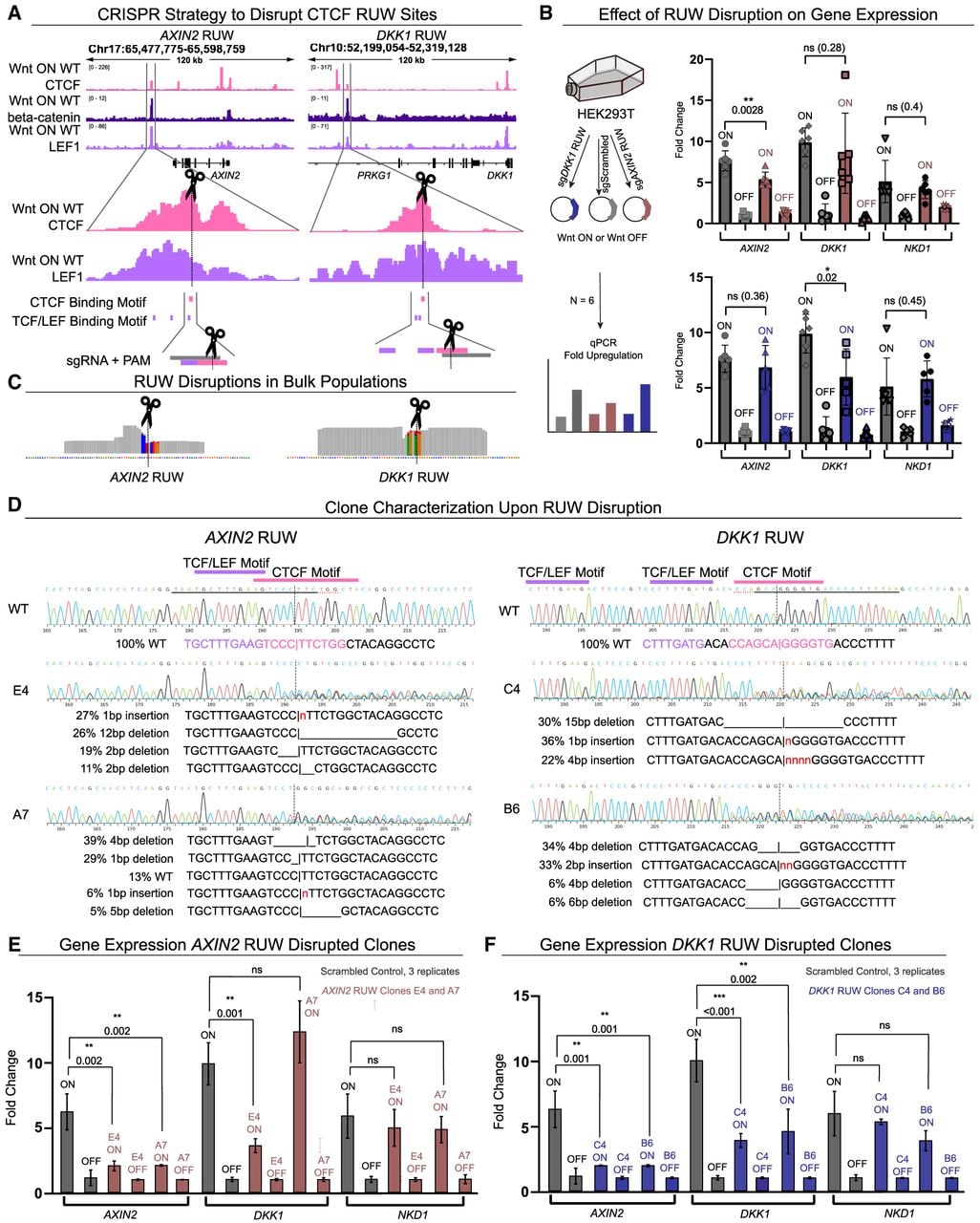
CRISPR-Cas9 disruption of CTCF RUW binding sites. (A) CRISPR-Cas9 strategy to mutate RUW CTCF binding sites near AXIN2 and DKK1. sgRNAs were designed to disrupt the CTCF motif. (B) Gene expression measurement by qPCR showing that RUW disruption significantly and only affects the upregulation of the corresponding gene for AXIN2 (P = 0.0028) and DKK1 (P = 0.02) compared to a scrambled control. Error bars show mean ± SD among independently transfected populations. (C) BAM coverage of RUW sites from sequenced populations with confirmed disruptions in CTCF sites (alteration in PAM sequence + 5 bp upstream). Base pairs with >2% of nonmatching alleles are colored by the representation of each nucleotide. (D) Characterization of derived clones, including Sanger sequencing traces and results from ICE deconvolution of alleles, showing two clones for both AXIN2 and DKK1 RUWs which have disrupted CTCF binding sites but intact TCF/LEF core motifs. (E) qPCR gene expression results of the AXIN2 RUW clones, which show reduced ability to upregulate AXIN2. One clone also shows decreased upregulation of DKK1, whereas NKD1 expression is unaffected. (F) qPCR gene expression results of the DKK1 RUW clones, which show reduced ability to upregulate DKK1. Both clones also show reduced upregulation of AXIN2, whereas NKD1 is unaffected. In E and F, error bars show mean ± SD among technical replicates. Biological replicates (clones) are shown with separate bars. Statistical testing was done with two-tailed t-tests.