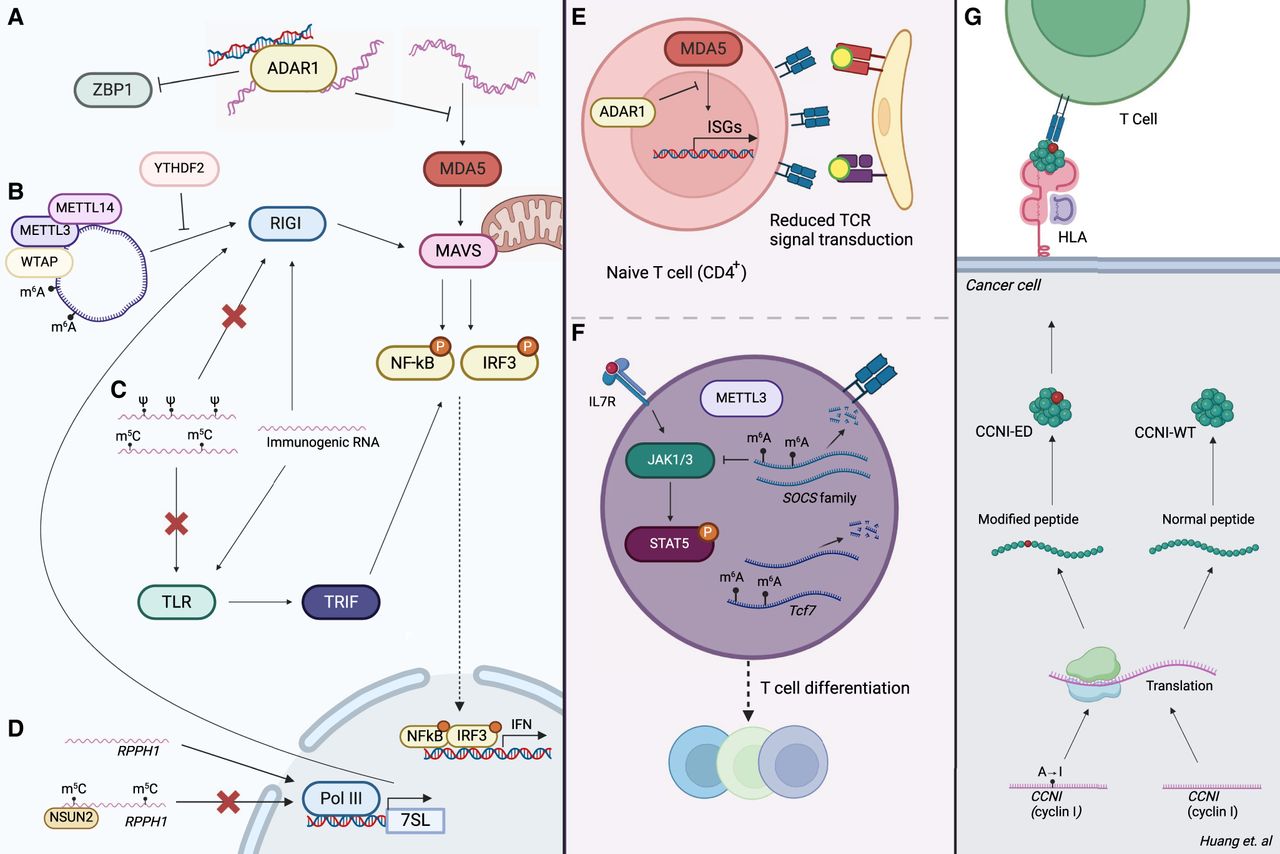
Effects of RNA modifications on innate and adaptive immunity (see text for references). RNA modifications impart various effects on innate immune pathways. (A) A-to-I editing of dsRNA regions by ADAR prevents IFIH1 (also known as MDA5) sensing and subsequent activation of the type I IFN signaling pathway. ADAR also binds Z-RNA, thus inhibiting ZBP1 activation. (B) m6A modifications in circRNAs can function as markers of “self,” preventing RIGI sensing. (C) The presence of pseudouridine and m5C can repress TLR signaling. Pseudouridine has also been shown to inhibit 5-triphosphate mediated RIGI sensing. (D) Depletion of m5C modifications results in increased transcription of Pol III transcripts, including RPPH1. RPPH1 itself facilitates transcription of 7SL RNAs, which are RIGI ligands. RNA modifications play roles in adaptive immunity: (E) Deletion of ADAR results in excessive ISG expression, thus impairing T cell receptor (TCR) signaling. (F) Loss of m6A leads to destabilization of Tcf7 transcripts, consequently impairing naïve T cell differentiation into T follicular helper (Tfh) cells. On the other hand, the absence of m6A stabilizes JAK-STAT signaling inhibitors (SOCS family), leading to subsequent inhibition of T cell homeostatic proliferation and differentiation. (G) An A-to-I editing site in cyclin I (CCNI R75G) leads to the production of an altered peptide (CCNI-ED). When presented by tumor cells, this peptide could be recognized by tumor-infiltrating lymphocytes. Created with BioRender (https://www.biorender.com).