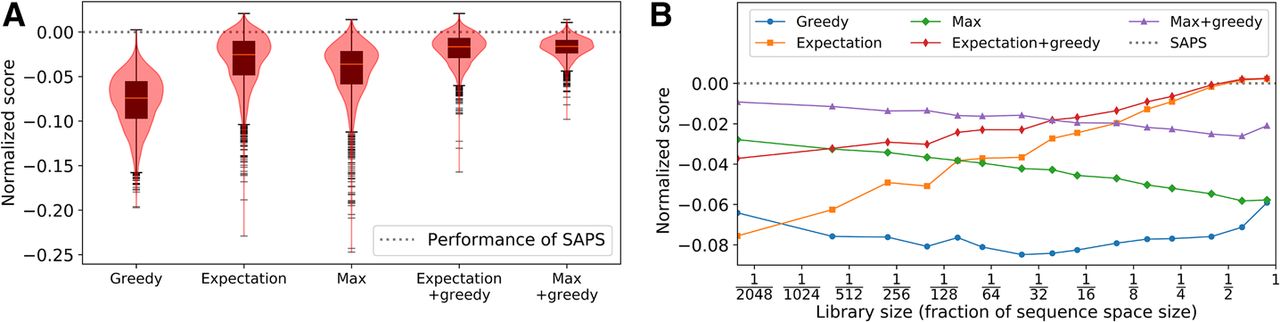
Simulated annealing outperforms other approaches on random Ising models. We evaluate our method against five benchmarks on 400 randomly generated Ising models that operate on varying sequence sizes. For each model, six libraries of varying sizes are generated for a total of 2400 experimental conditions. To normalize over the varying conditions, we scale the scores such that the expected score of a library of the desired size generated uniformly at random is one unit apart from the maximum possible score of any arbitrary library of the desired size. The scores are then shifted such that SAPS achieves a score of zero, which is indicated by the dotted gray line in the figures. We do this because the variability of the optimums between different Ising models is much larger than the difference between the approaches, making it difficult to see that SAPS outperforms the other methods in most instances. (A) Distribution of normalized scores for the approaches we benchmark against using a box plot in conjunction with a violin plot. (B) Mean of the normalized score for each approach as a function of library size.