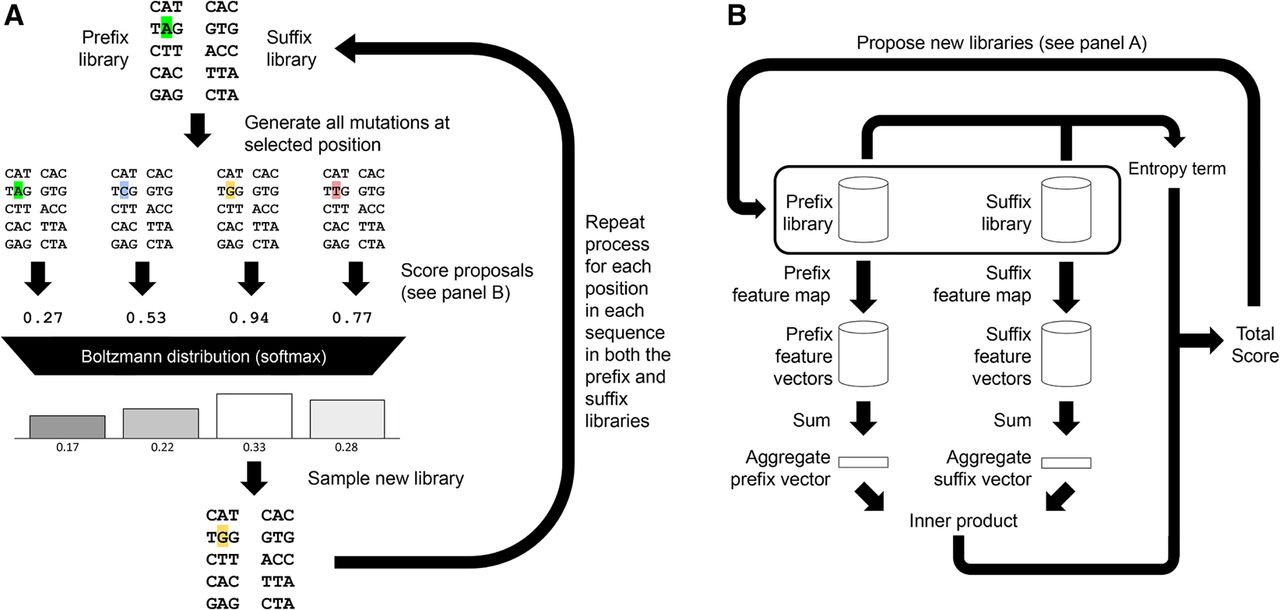
Factorizable library optimization and evaluation. (A) Optimization is achieved through iterative stochastic updates. An update step is performed by selecting a position in a sequence in one of the libraries and generating all possible mutations for that position. The mutated libraries are then scored, and then a Boltzmann distribution over the libraries is generated using the negated scores as energy values. The update is then sampled from the distribution. A full update sweep performs this for all positions in all sequences in both segment libraries. Multiple sweeps are performed, and the temperature of the Boltzmann distribution is lowered over time. For simplicity, the figure depicts this optimization on small DNA libraries. In our application to antibody CDR-H3 library design, we operate on longer length protein sequences composed of amino acids. (B) Evaluation of the objective function of a factorizable library is performed by mapping all the sequences in its prefix and suffix libraries to feature spaces. The feature vectors are then aggregated, and an inner product is taken between them, which by the distributive property produces the total score for the whole factorizable library. A position-based entropy term is evaluated to quantify the diversity of sequences in the library, and a weighted sum of the two is then used to guide optimization.