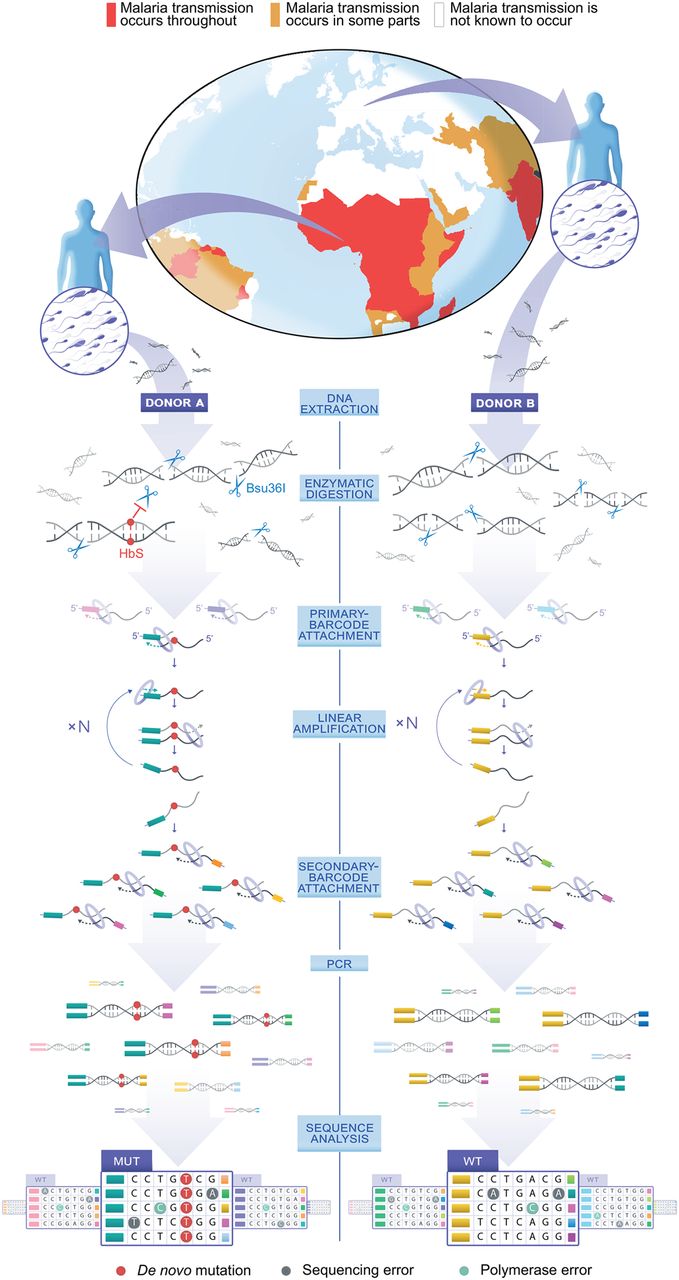
Experiment overview. Sperm samples are obtained from world regions with high or low malaria infection burden (malaria impact map adjusted from the CDC map) (CDC Division of Parasitic Diseases and Malaria 2019). Whole-genome DNA is extracted and an amount equivalent to 60–80 million sperm cells per donor is subjected to Bsu36I digestion. Bsu36I cleaves the DNA at multiple sites, including the HBB and HBD ROIs, which carry a specific recognition sequence. The HbS mutation blocks Bsu36I digestion and is thus enriched over the wild-type (WT). A primary barcode is added directly to each antisense DNA strand that carries the HBB or HBD ROI via a DNA polymerase–assisted fill-in reaction. Because each barcode consists of a random sequence of nucleotides, each of the numerous target fragments has its own unique barcode, illustrated by a unique color on the left end of the representation of each barcoded fragment. Multiple single-strand copies are each generated directly from each uniquely barcoded target fragment by linear amplification. A secondary barcode composed of a random sequence of nucleotides is added to the other end of each of these copies by a single primer extension reaction, illustrated by a unique color on the right end of each barcoded fragment. Thus, only full-length fragments (i.e., mutant or WT ROI sequences that evaded Bsu36I digestion) carry both the primary and the secondary barcodes and can be amplified by PCR for high-throughput sequencing. At the sequence analysis step, sequencing reads representing the PCR products of the linearly amplified copies are grouped together into families (see boxes), where in each family, reads share the same primary barcode sequence. Sporadic sequencing errors or DNA-polymerase errors generated during linear or subsequent amplification steps are unlikely to be repeated in multiple copies and are removed. De novo mutations, such as the HbS mutation, are easily identified by their appearance in multiple reads from distinct linear-amplification events. For a complete description of the library preparation protocol, which includes additional steps, see Supplemental Figures S1–S3.