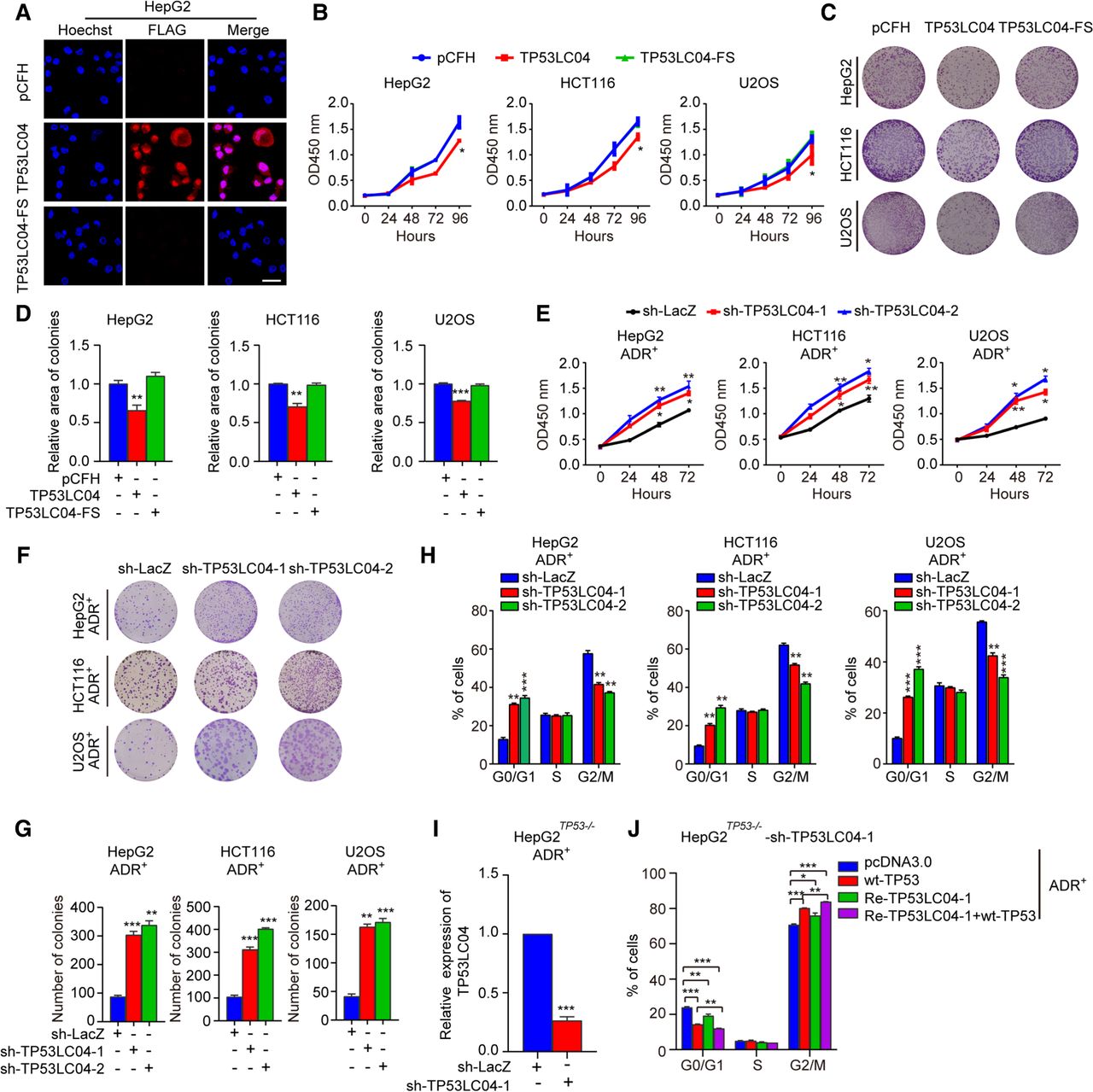
The TP53-inducible TP53LC04 peptide suppresses cell proliferation and regulates cell cycle in human cells. (A) The immunofluorescence assays showing the overexpression and subcellular location of the TP53LC04 peptide in HepG2 cells. HepG2 cells were transfected with the indicated vectors, and then the TP53LC04 peptide was immunostained using the anti-FLAG antibody. Scale bar, 10 μm. (B) CCK-8 assays showing the cell viability in HepG2, HCT116, and U2OS cells transfected with the indicated TP53LC04 vectors. (C,D) Colony formation assays showing the abilities of colony formation in HepG2, HCT116, and U2OS cells transfected with the indicated TP53LC04 vectors. The representative pictures of colonies are shown in C, and the number of colonies are counted in D. (E) CCK-8 assays showing the cell viability in HepG2, HCT116, and U2OS cells stably silenced TP53LC04 with the DNA-damage drug ADR treatment for 24 h. (F,G) Colony formation assays showing the abilities of colony formation in HepG2, HCT116, and U2OS cells stably silenced TP53LC04. The representative pictures of colonies are showed in F, and the number of colonies are counted in G. (H) The proportions of each cell-cycle phase in the indicated cells above. (I) The qPCR assays showing the expression of TP53LC04 in HepG2TP53−/− stably knocked down TP53LC04 with ADR treatment. (J) The proportions of each cell-cycle phase in sh-TP53LC04 HepG2TP53−/− recovering wild-type TP53 and sh-resistant TP53LC04. Data are represented as mean ± SEM. (*) P < 0.05, (**) P < 0.01, and (***) P < 0.001.