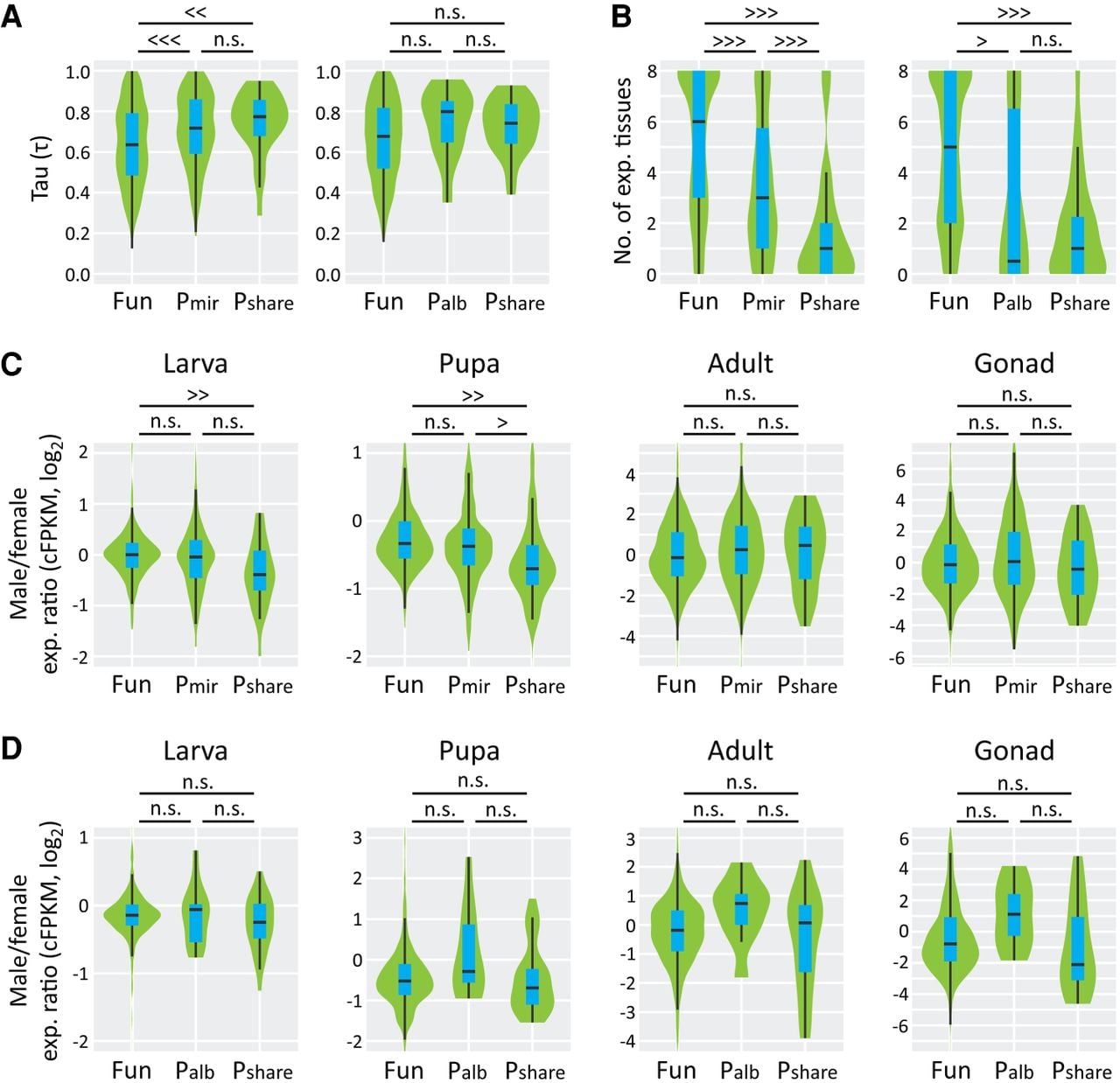
Relationship between parallel pseudogenization on the neo-Y and expression patterns. (A) Relationship between pseudogenization pattern and tissue specificity (τ). τ was computed for orthologs in D. pseudoobscura (left panel) and D. nasuta (right panel), closely related species of D. miranda and D. albomicans, respectively, as proxies of ancestral species. (B) Relationship between the pseudogenization pattern and the number of tissues in which each gene was expressed. A gene was regarded to be expressed in a tissue if cFPKM was one or more in D. pseudoobscura (left panel) and D. nasuta (right panel). (C,D) Relationship between the pseudogenization pattern and the male-to-female gene expression ratio based on the cFPKM value. (Fun) Neo-Y-linked genes functional at least in D. miranda (left panel in A and B and all panels in C) or D. albomicans (right panel in A and B and all panels in D); (Pmir) neo-Y-linked genes nonfunctional in D. miranda but functional in D. albomicans; (Palb) neo-Y-linked genes nonfunctional in D. albomicans but functional in D. miranda; and (Pshare) neo-Y-linked genes nonfunctional in both D. miranda and D. albomicans. Differences between groups were evaluated by a Mann–Whitney U test with correction for multiple testing: (<<< or >>>) Q < 0.001; (<< or >>) Q < 0.01; (< or >) Q < 0.05; (n.s.) Q ≥ 0.05.