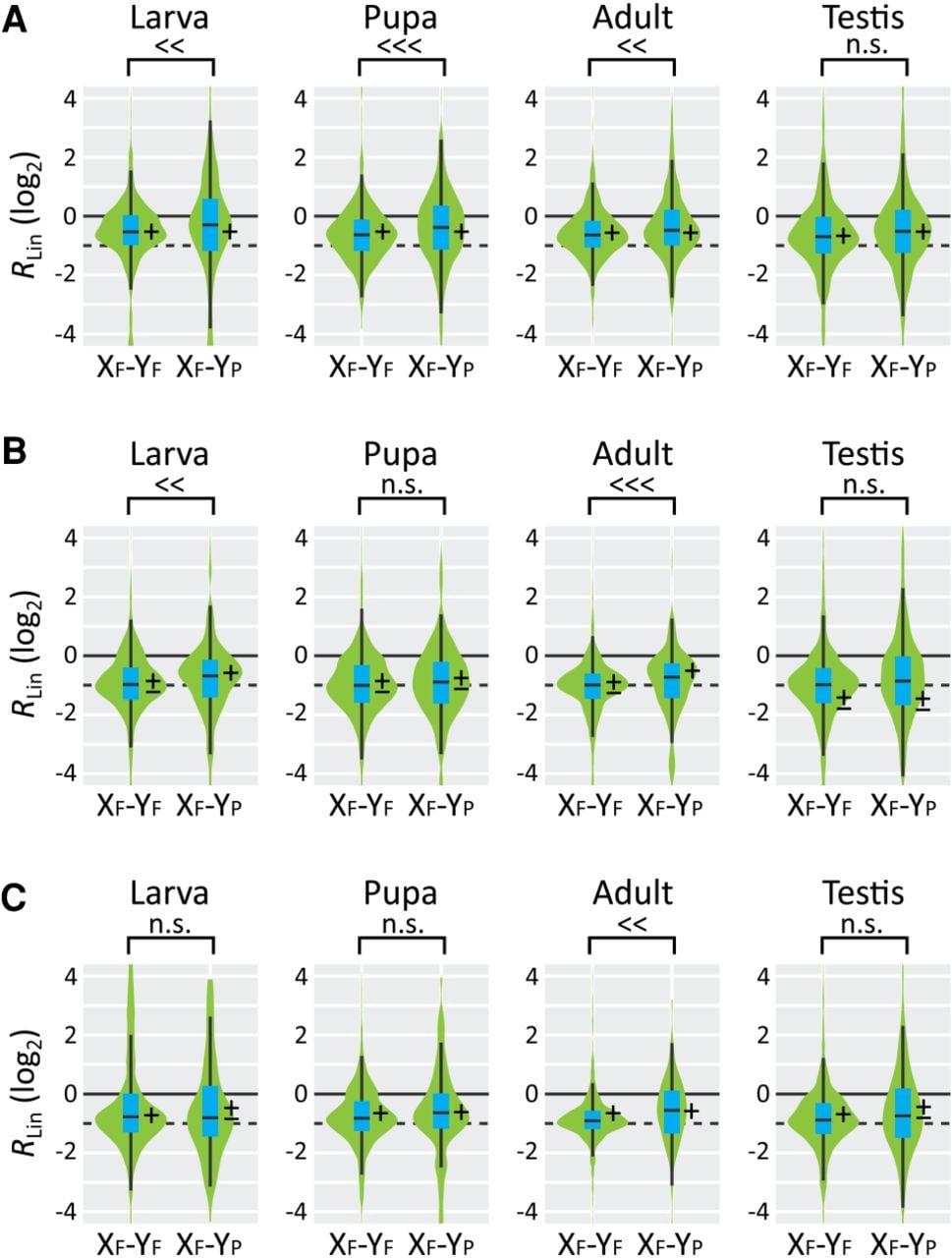
Relationship between the functionality of neo-Y-linked genes and the DC of neo-X-linked homologs in the larva, pupa, adult, and testis of Drosophila miranda (A), D. albomicans (B), and D. americana (C). To compute RLin, corrected fragments per kilobase of exon per million mapped reads (cFPKM; FPKM normalized by median) was used. (XF-YF) A group of genes with functional neo-X-linked and neo-Y-linked homologs; (XF–YP) a group of genes with functional neo-X-linked homologs and pseudogenized neo-Y-linked homologs. In the XF–YF and XF–YP groups, 664 and 435 genes, respectively, were analyzed for D. miranda, 2449 and 218 for D. albomicans, and 1204 and 93 for D. americana. A box plot is also shown on each violin plot. Differences of RLin values between groups were evaluated by Mann–Whitney U test with correction for multiple testing by the Benjamini–Hochberg method (Benjamini and Hochberg 1995) under the null hypothesis RLin (XF–YF) = RLin (XF–YP): (<<<) Q < 0.001; (<<) Q < 0.01; (n.s.) Q ≥ 0.05. The solid line indicates an RLin value of 1.0 (0 in log2), indicating perfect DC, whereas the broken line corresponds to a value of 0.5 (−1 in log2), indicating no DC. (+, −, and ±) Along each plot, they indicate that the median RLin value is >0.5, <0.5, or 0.5, respectively, at the 5% significance level based on a bootstrap test with 10,000 replications with correction for multiple testing.