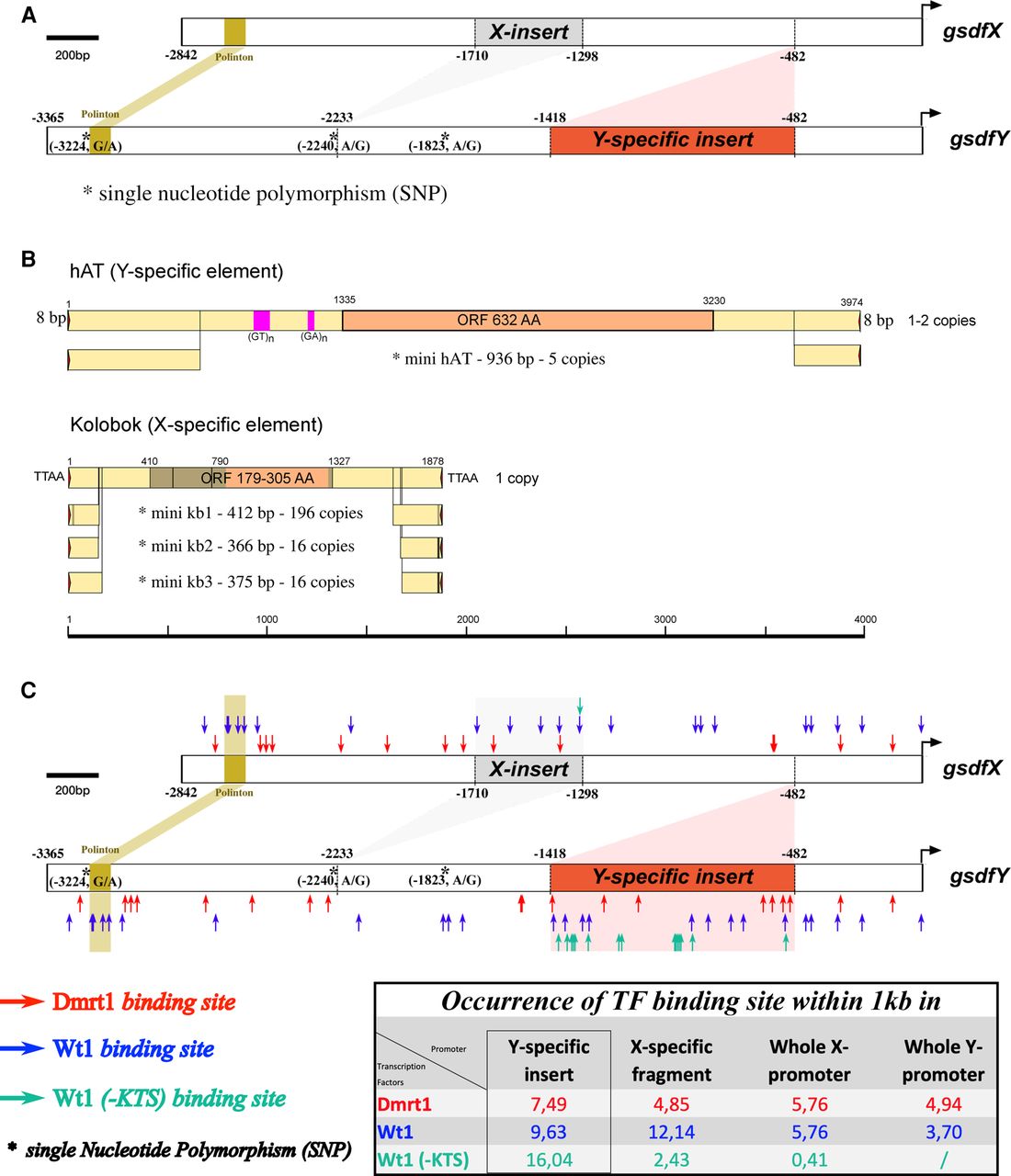
Comparative analysis of the gsdfX and gsdfY promoters and their transcription factor binding sites. (A) The analyzed promoter region of gsdfX in comparison to its gsdfY paralog. Length differences between the two gsdfX and gsdfY promoters are due to Y- and X- specific regions of which unique Y- (936 bp) and X- (412 bp) inserts have been, respectively, added and lost concomitantly during the allelic diversification event. The Y-specific insert is made of a transposable element of the hAT family. (B) Characteristics of Y- and X-specific elements in the gsdf promoter and their relatives. The scale and positions are in nucleotides. For each structure, the copy number identified in the new assembly is indicated. Typical target-site duplication is shown (in size or in sequence) at both ends of the longest elements. For both elements, the copy inserted in the gsdf promoter is an internally deleted version of a longer coding element, present in one or two copies. The ORF is indicated in orange and terminal inverted repeats in pink. For Kolobok, possible extension of the ORF is shown in brown (this would include two frameshift/stop codons). The asterisk indicates the MITE subfamily to which the gsdf-inserted copy belongs. The average number of hits per assembly (with positive hits) is indicated. Please note that the number of detected hits is highly dependent on the assembly quality (N50), so that absence of a hit is not proof that the element is not present in the species. (C) Analysis of the hAT transposable element revealed that its sequence contains an overrepresentation of Dmrt1 and Wt1(-KTS) binding sites compared to the remaining sequences of either the X-specific fragment or the whole X- and Y-promoters.