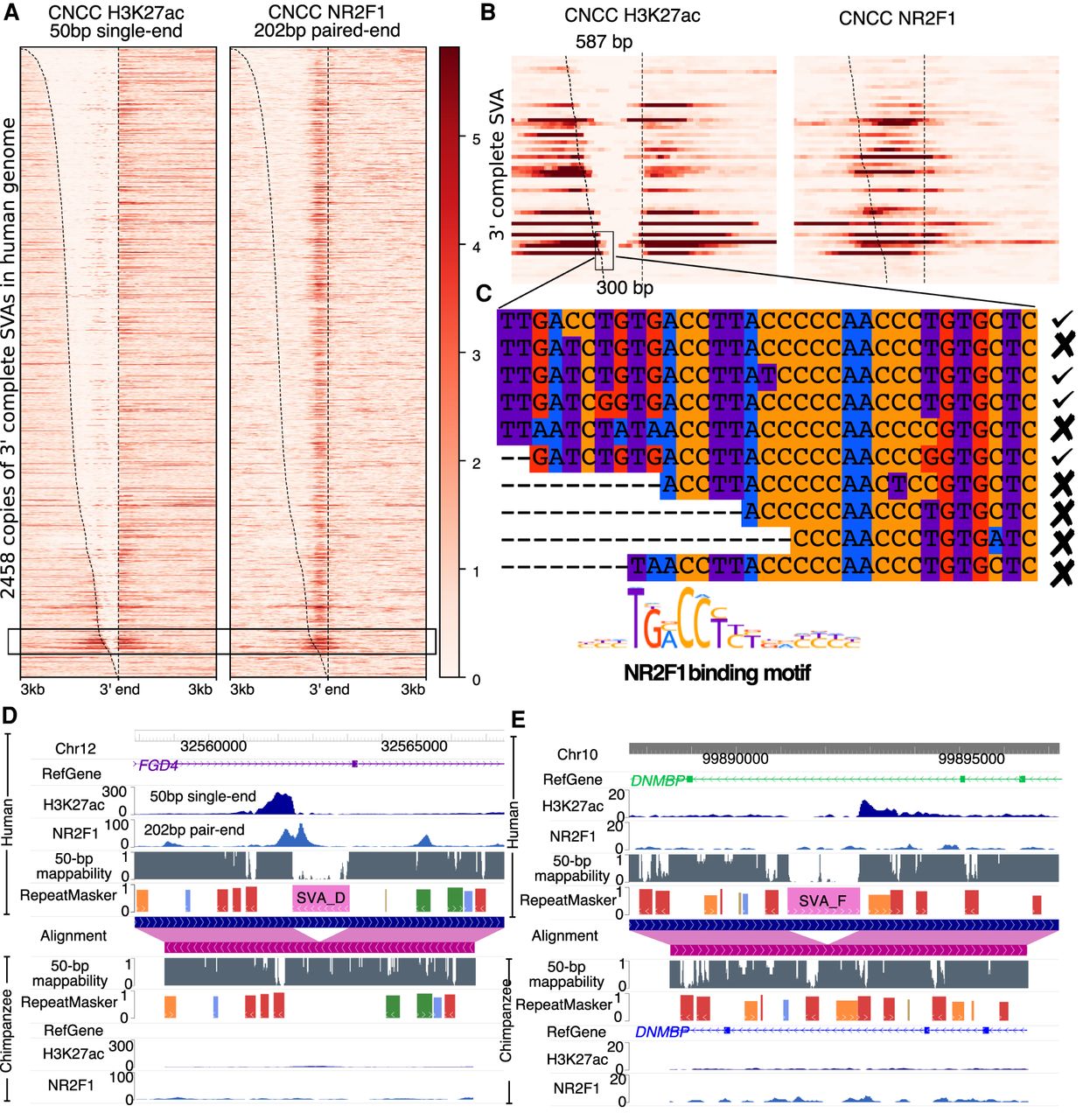
NR2F1 binding profile in CNCCs coincides with the putative SVA enhancer profile. (A) Heatmaps of H3K27ac (50 bp single-end) and NR2F1 (202 bp paired-end) ChIP-seq signal in CNCC over all SVA elements with complete 3′ ends (outlined by dotted line) and 3-kb flanking regions in the human genome sorted by length (top to bottom, longest to shortest). (B) Zoomed-in view of the heatmaps displaying 53 5′-truncated SVA elements from 587 bp to 300 bp boxed in A. High H3K27ac and NR2F1 signal are visible on both ends, and flanking H3K27ac ChIP-seq signal correlates with NR2F1 ChIP-seq signal. (C) Nucleotide sequence alignment of the 10 truncated SVA elements boxed in B. Elements with strong CNCC H3K27ac signals are marked by checkmarks on the right; elements without CNCC H3K27ac signal are marked by a cross. The NR2F1 binding motif is provided at the bottom of the alignment. (D) A human SVA insertion associated with a human-biased enhancer and NR2F1 binding. (E) A human SVA insertion associated with a human-biased enhancer but no NR2F1 binding. Note the low mappability, indicating high repetitiveness, over the SVA insertions and the difference in NR2F1 ChIP-seq peaks between E and F.