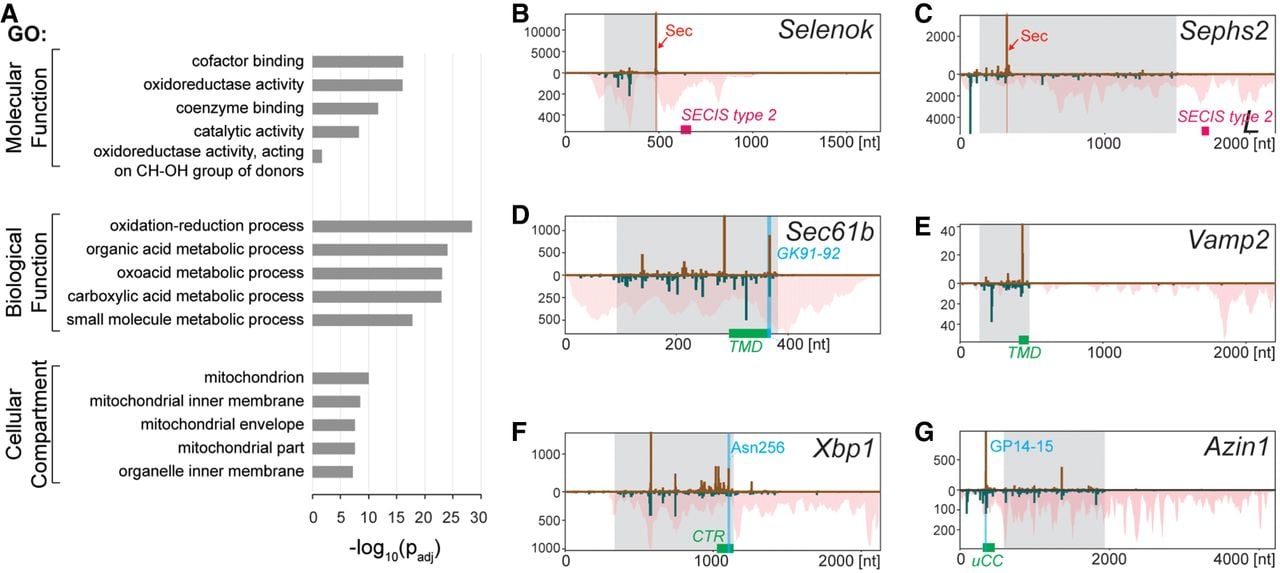
Disome sites are associated with specific pathways and with known pausing events. (A) Functional enrichment analysis of the top 200 genes from the prominent disome peak list. Five terms with the highest −log10(padj) values (horizontal bars) are shown from each Gene Ontology (GO) group: molecular function, cellular component, biological process. See Supplemental Table S4 for full analysis. (B–G) Distribution of normalized counts of monosome and disome footprints (per nt) and RNA (pileup) along selected transcripts, similar to Figure 2F–O. Selenok (B) and Sephs2 (C) show a strong disome peak on the selenocysteine codon (Sec, marked in pink). Position of the SECIS elements is indicated in pink. Sec61b (D) and Vamp2 (E) are tail-anchored proteins with a transmembrane domain (TMD, green). For Sec61b, a strong disome site is located on GK91-92 (marked in blue). Xbp1 (F) contains a C-terminal region (CTR, green) with several disome sites. The strong site on Asn256 is marked in blue; Azin1 (G) contains an upstream conserved coding region (uCC, green) that undergoes polyamine-dependent translational elongation. The main disome site is on a the uCC dipeptide GP14-15.