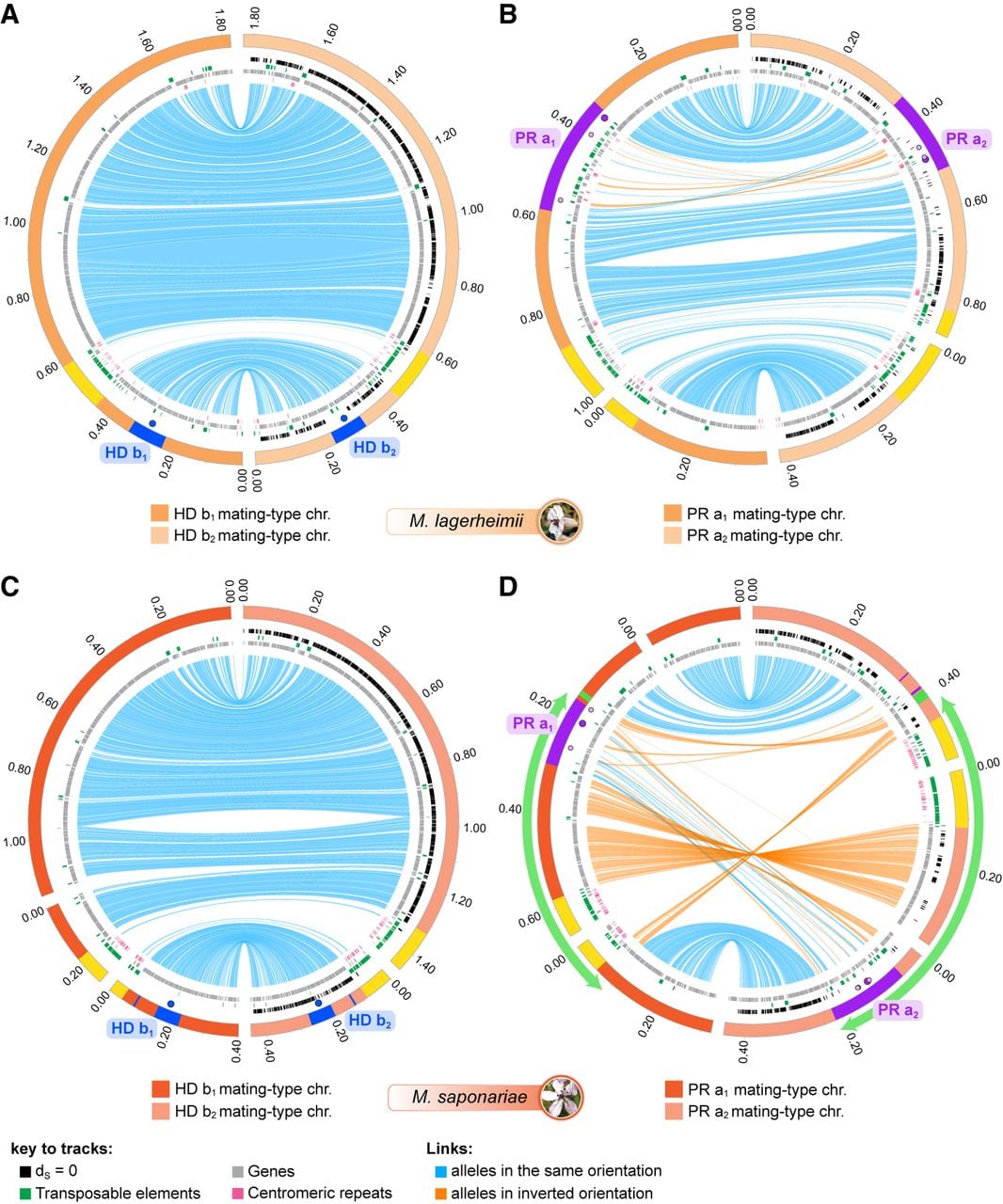
Intraspecific comparison of gene order between mating-type chromosomes. Comparison of gene order between HD and PR chromosome pairs in M. lagerheimii (A,B) and M. saponariae (C,D). The outer tracks represent contigs, staggered every 200 kb. The HD, PR, and pheromone genes are indicated by blue, dark purple, and small light purple circles, respectively. Blue and orange lines link alleles, the latter corresponding to inversions. The link width is proportional to the corresponding gene length. Yellow regions on the contig track indicate the centromeres (regions with low gene density, high TE density, and enriched in tandem-repeats marked in pink). The black marks along the right contigs track indicate genes that have no synonymous substitutions between a1 and a2 alleles within species (dS = 0). Green marks indicate transposable elements (TEs), and gray marks non-TE genes. The ancient regions of recombination suppression are indicated on the outer track in blue for the HD locus and in purple for the PR locus. (A) Comparison of the b1 (left, orange) and b2 (right, light orange) HD M. lagerheimii mating-type chromosomes. (B) Comparison of the a1 (left, orange) and a2 (right, light orange) PR M. lagerheimii mating-type chromosomes. (C) Comparison of the b1 (left, red) and b2 (right, light red) HD M. saponariae mating-type chromosomes. (D) Comparison of the a1 (left, red) and a2 (right, light red) PR M. saponariae mating-type chromosomes. The large green arrow indicates the large inversion between the two mating-type chromosomes encompassing the mating-type locus and the centromere. The green regions on the contig track of each mating-type chromosome indicate the small inversion that likely occurred after the large inversion linking the PR locus to the centromere, extending the region of suppressed recombination.