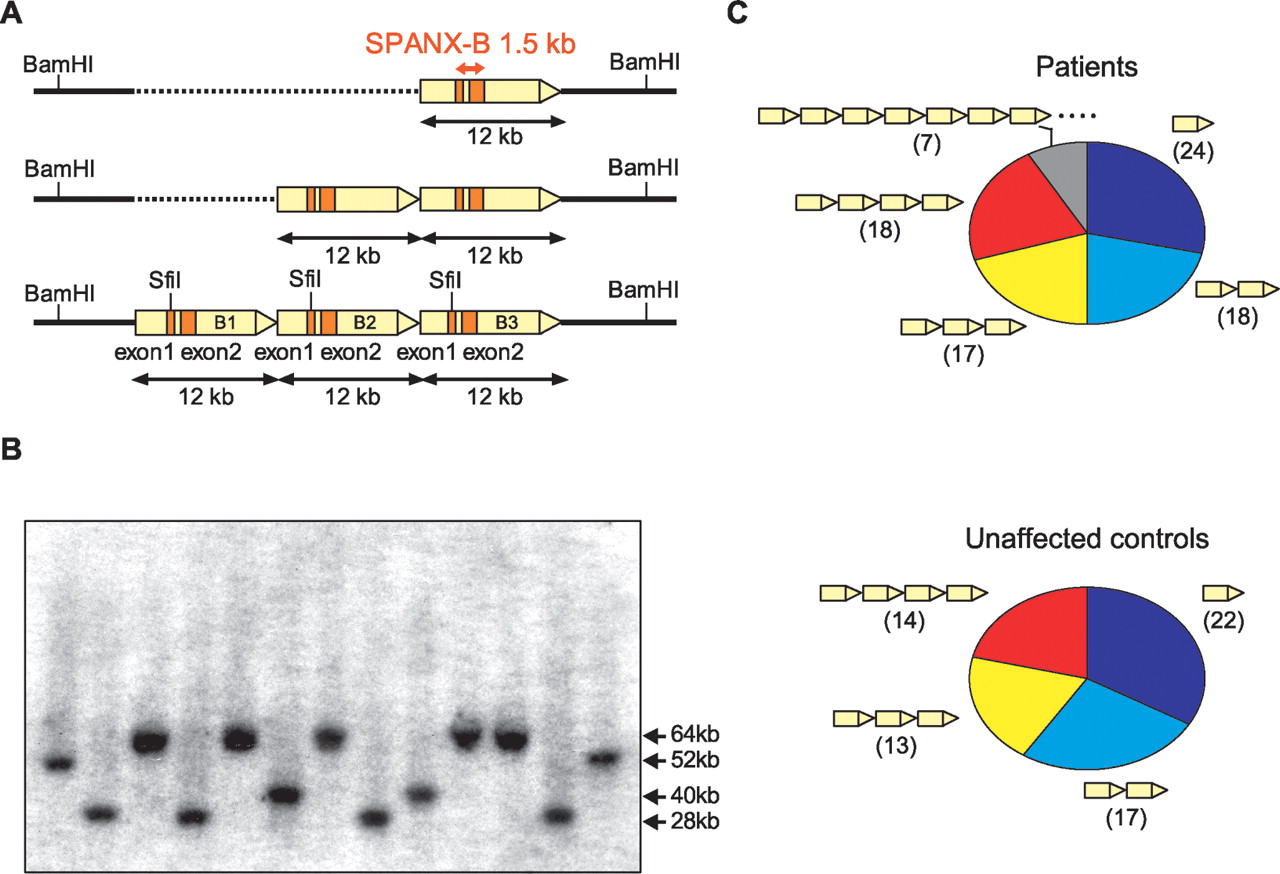
Copy number of the SPANX-B gene. (A) The scheme of the 12-kb tandem repeats in individuals containing one, two, or three copies of the SPANX-B gene. (B) Genomic DNA from 28 individuals (11 cases and 18 controls) was digested with BamHI, CHEF gel electrophoresis-separated, and blot-hybridized with a specific probe to reveal the presence of a 12-kb SPANX-B tandem repeat. The figure shows only 13 individuals. Lanes 1–4 correspond to four controls, C3, C2, C6, and C4. Lanes 5–13 correspond to nine patients (029–049, 018–014, 075–014, 086–013, 087–011, 194–004, 082–003, 076–008, 236–005). The fragments of the predicted size of 28 kb, 40 kb, 52 kb, and 64 kb correspond to one, two, three, and four copies of SPANX-B, respectively. (C) The scheme represents the proportion of affected (patients, top) and unaffected (controls, bottom) individuals with one, two, three, and more than four copies of the SPANX-B gene. Presented are the results from 66 unaffected controls and 84 patients with the hereditary prostate cancer. Note that prostate cancer pedigrees analysis did not reveal linkage of the cancer predisposition to HPCX in these patients. Eleven patients (086–017, 076–008, 087–011, 194–004, 236–005, 029–049, 075–014, 239–019, 082–003, 032–003, and 231–020) were checked both by real-time PCR and by blot hybridization. The numbers in parentheses correspond to the number of individuals with the given number of SPANX-B copies.