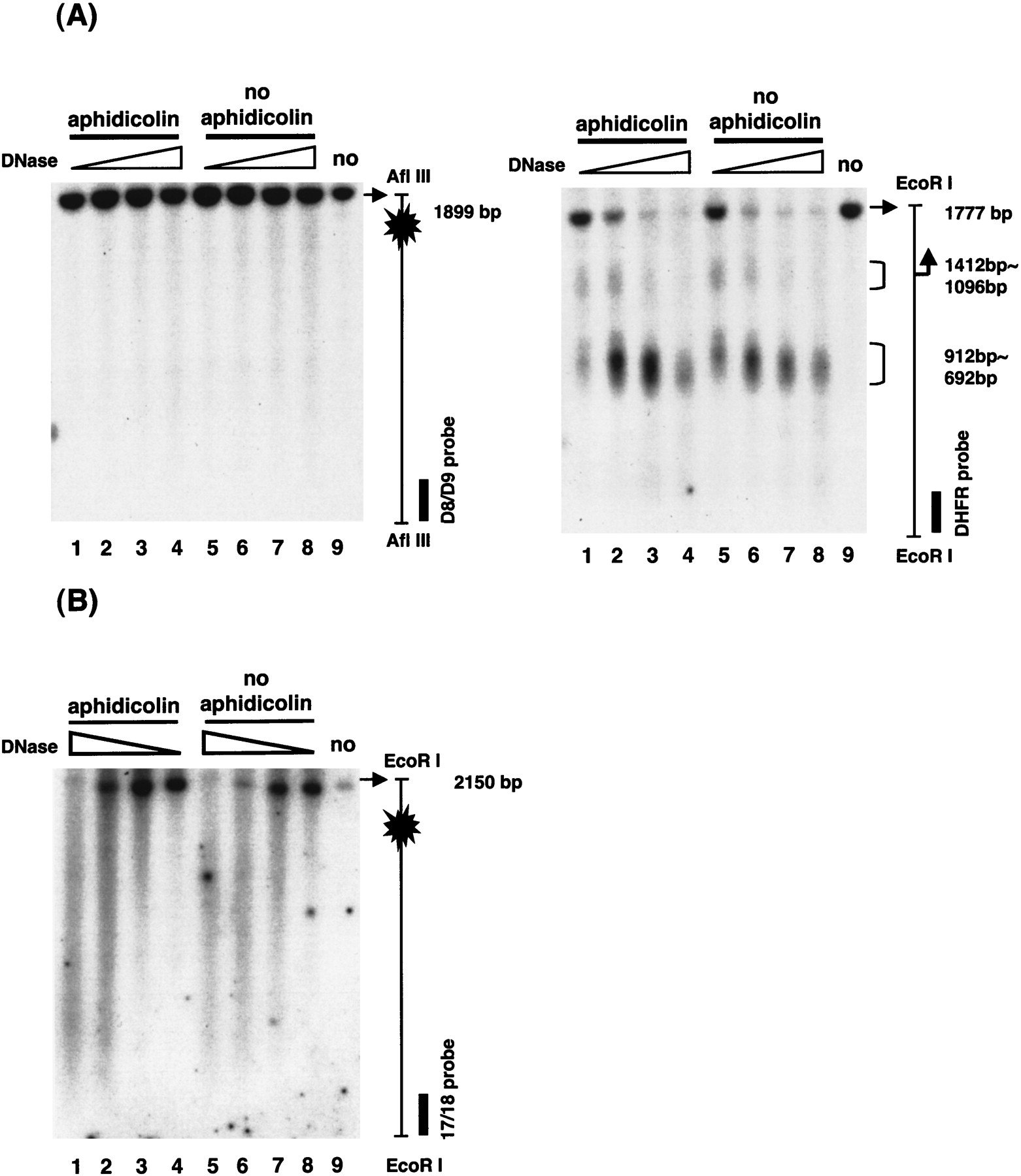
No DNase I hypersensitive sites in either breakpoint region of FRA3B. Nuclei were isolated from aphidicolin-treated and untreated cells and incubated with DNase I at 10, 25, 50, and 100 U/mL at 37°C for 5 min. Reactions were stopped by a solution containing EDTA and EGTA and DNA was extracted. (A) For probing the FRA3B distal breakpoint region, DNA was further digested with EcoRI and AflIII and hybridized with the D8/D9 probe to visualize a 1899-bp AflIII fragment of the distal breakpoint region (the 1899-bp AflIII fragment of FRA3B does not contain an internal EcoRI site). The blot was also hybridized with the C/I probe (see Fig. 1) to examine the same fragment from the other end (data not shown). As a control to insure the condition of DNase I digestion, the same blot was hybridized with the DHFR probe to visualize a 1777-bp EcoRI fragment of the DHFR promoter region (the 1777-bp EcoRI fragment of the DHFR gene does not contain an internal AflIII site). (B) For probing the proximal breakpoint region, DNase I-treated DNA was further digested with EcoRI and hybridized with the 17/18 probe to visualize a 2150-bp EcoRI fragment of the FRA3B proximal breakpoint region. The same blot was hybridized with the DHFR probe to visualize a 1777-bp EcoRI fragment of the DHFR promoter region (data not shown). The major breakpoint clusters are marked by blasts within the 1899-bp AflIII fragment of the distal region and the 2150-bp EcoRI fragment of the proximal region. The transcription initiation site of the DHFR gene is indicated by a right angle arrow.