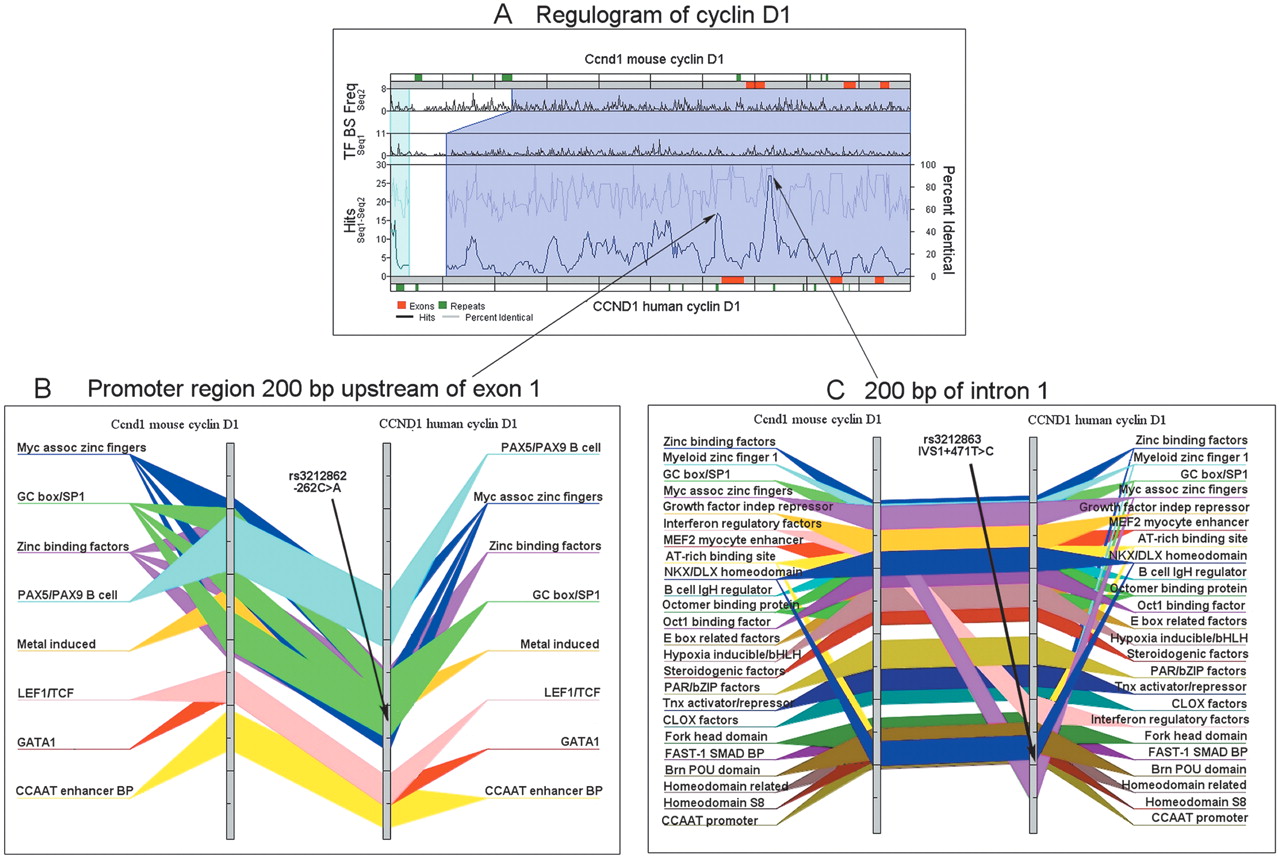
Conserved noncoding regions identified by Trafac for Cyclin D (CCND1). (A) The regulogram depicts shared cis-elements between human and mouse sequences in the context of their sequence similarity. By identifying conserved mouse-human regions with consensus cis-regulatory elements and mapping noncoding SNPs, Trafac can be used to predict the potential adverse affects of polymorphisms on the regulation of gene and expression. Mouse and human sequences are represented as horizontal bars at the top and bottom of the upper pane. The red-colored segments on these bars represent exons 1 through 3. The green-colored bars represent repeat elements. The frequencies of individual binding sites occurring in each of the sequences separately are shown as two running graphs in the top half of the pane. The percentage of sequence similarity, as determined by the BLASTZ algorithm, and the number of transcription factor-binding sites (TF BS) is represented as two separate line graphs in the lower pane. Two cis-element dense regions within the highly conserved promoter and first intronic regions are depicted as two peaks with high hit (shared cis-elements) count (indicated by the arrows). The promoter (B) and first intronic regions (C) of human and mouse CCND1 reveal a strong conservation of consensus TF-binding sites in relatively the same order of occurrence. The two gray vertical bars represent the CCND1 orthologs. The TF BS occurring in both the genes are highlighted as various colored bars drawn across the two genes. The SNPs identified in the promoter (rs3212862) and first intron (rs3212863) are indicated.