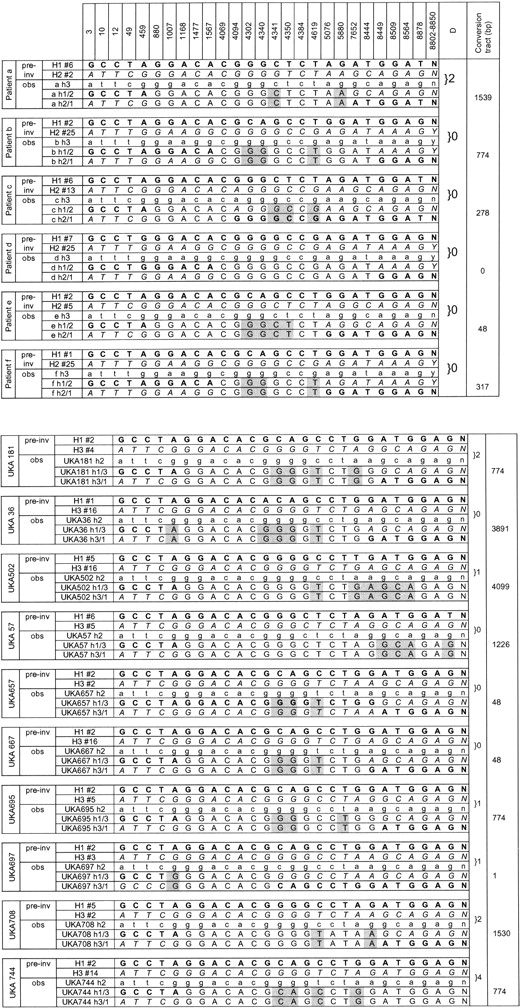
Observed and possible pre-inversion int22h haplotypes for patients with int22h-related inversions. For each patient a set of proposed pre-inversion haplotypes (pre-inv) are shown. The haplotype of the proposed pre-inversion proximal and distal int22h sequence are in bold and italics, respectively, and the haplotype number is indicated (e.g., H1#2 is haplotype 2 of int22h-1 and H3#23 is haplotype 23 of distal int22h). The observed haplotypes (obs) show the non-recombined int22h in lower case and the recombined haplotypes. The distribution of bold and italic characters in the latter two haplotypes shows how the pre-inversion haplotypes have rearranged. Standard capital letters indicate noninformative sites. Proposed gene conversions are highlighted gray. h1/3 and h1/2 are the recombined sequences at proximal location while h2/1 and h3/1 are those at distal location. Column “D” indicates number of differences between the patient's non-recombined int22h-2 or int22h-3 sequence and the distal int22h haplotype chosen to represent the pre-inversion distal int22h. The distance between the first and last allele that requires a gene conversion event to account for the observed recombined sequences is the gene conversion tract (last column).