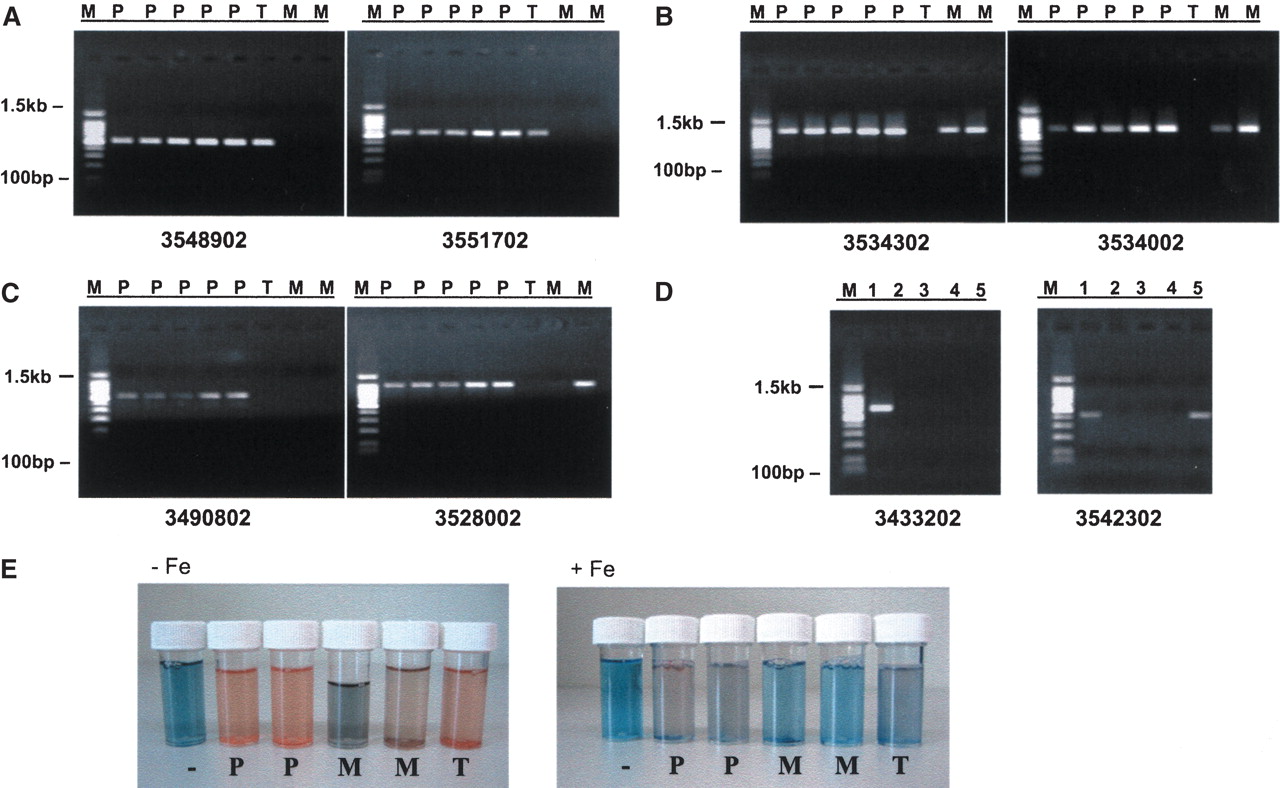
Experimental and phenotypic validation of array results. (A) Deletions in B. mallei. Lanes 1–8: B. pseudomallei K96243, #3, KHW22, ATCC15682, and ATCC23343 (P), B. thailandensis ATCC700388 (T), B. mallei ATCC10399 and ATCC23344 (M). Left gel shows the deletion of ORF 3548902 in both B. mallei isolates ATCC10399 and ATCC23344 only. Right gel shows deletion of ORF 3551702 in both B. mallei isolates. (B) Deletions in B. thailandensis.. Lanes 1–8: B. pseudomallei K96243, #3, KHW22, ATCC15682, and ATCC23343 (P), B. thailandensis ATCC700388 (T), B. mallei ATCC10399 and ATCC23344 (M). Left gel shows the deletion of the ORF 3534302 in B. thailandensis ATCC700388 only. Right gel shows deletion of ORF 3534002 in B. thailandensis isolate ATCC700388 only. (C) Deletions found in both B. mallei and B. thailandensis. Lanes 1–8: B. pseudomallei K96243, #3, KHW22, ATCC15682, and ATCC23343 (P), B. thailandensis ATCC700388 (T), B. mallei ATCC10399 and ATCC23344 (M). Left gel shows the deletion of ORF 3490802 in B. thailandensis ATCC700388 and both B. mallei isolates ATCC10399 and ATCC23344. Right gel shows deletion of ORF 3528002 in B. thailandensis ATCC700388 and B. mallei ATCC10399 only. (D) B. pseudomallei intraspecies variations. Lanes 1–5: B. pseudomallei K96243, #3, KHW22, ATCC15682, and ATCC23343. Left gel shows the deletion of ORF 3433202 in all four B. pseudomallei isolates except B. pseudomallei K96243. Right gel shows deletion of ORF 3542302 in B. pseudomallei isolates #3, KHW22, and ATCC15682 but not in K96243 and ATCC23343. (E) Iron metabolism in Burkholderia species. Siderophore production was assessed via CAS assays (27) for bacteria grown in iron-deprived (left, –Fe) and iron-supplemented (right, + Fe) media. From left to right: Control with CAS solution and growth media (–), B. pseudomallei strains (ATCC 23343 and ATCC 15682) (P), B. mallei strains (ATCC 23344 and ATCC 10399) (M), and B. thailandensis strain ATCC 700388 (T). Color changes from blue to orange/pink indicate the presence of siderophores. The strongest color changes are observed in B. pseudomallei followed by B. thailandensis, with B. mallei exhibiting comparatively weaker activity.