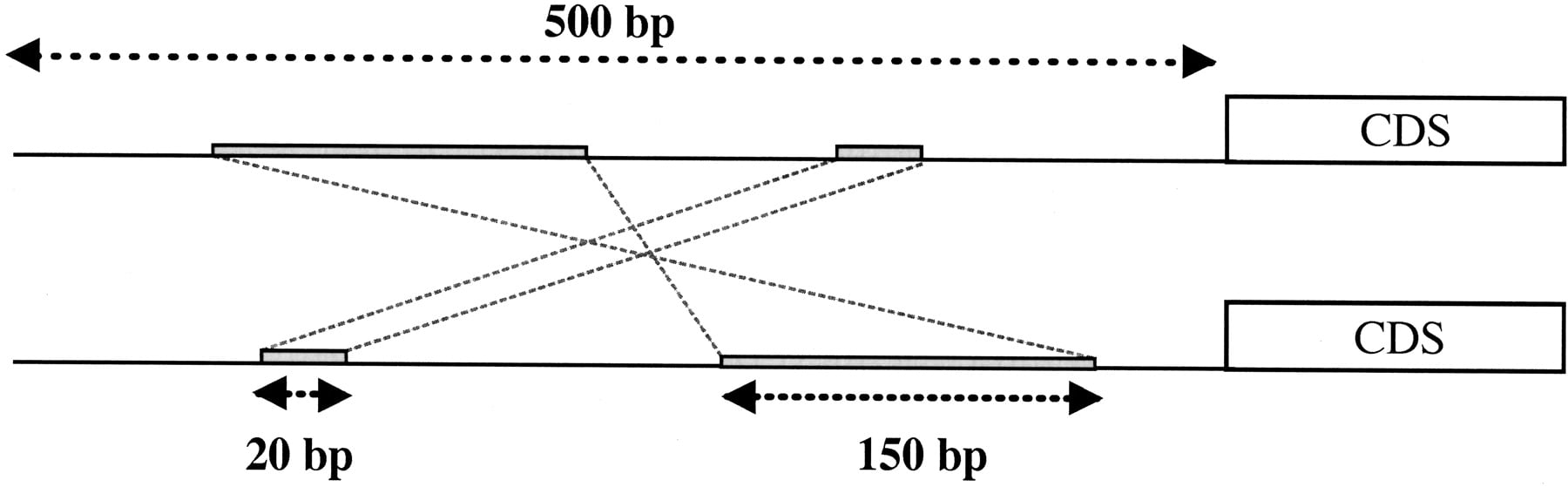
Illustration of the shared motif method (SMM). The SMM discovers regions of local similarity between DNA sequences without respect to their order, orientation, or spacing. In this example, two 500-bp noncoding sequences, upstream from homologous coding sequences (CDS), are compared. After iterative local alignment in both their native and inverted sequence orientations (Methods), two regions of significant local similarity between the sequences were discovered. One region is 150 bp long but has been inverted in one of the sequences. The other is 20 bp long but has been translocated. The fraction of “shared motifs” between these sequences is simply (20 + 150) / 500, or 0.34. We define shared motif divergence (dSM) as one minus this fraction, or 1 – 0.34 = 0.66. Shared motif divergence is thus the fraction of the two sequences that does not contain a region of significant local alignment without respect to order, orientation, or spacing. Note, this example is a simplified caricature. Real sequence comparisons often exhibit more complex patterns of shared motif conservation (Supplemental Fig. 1).