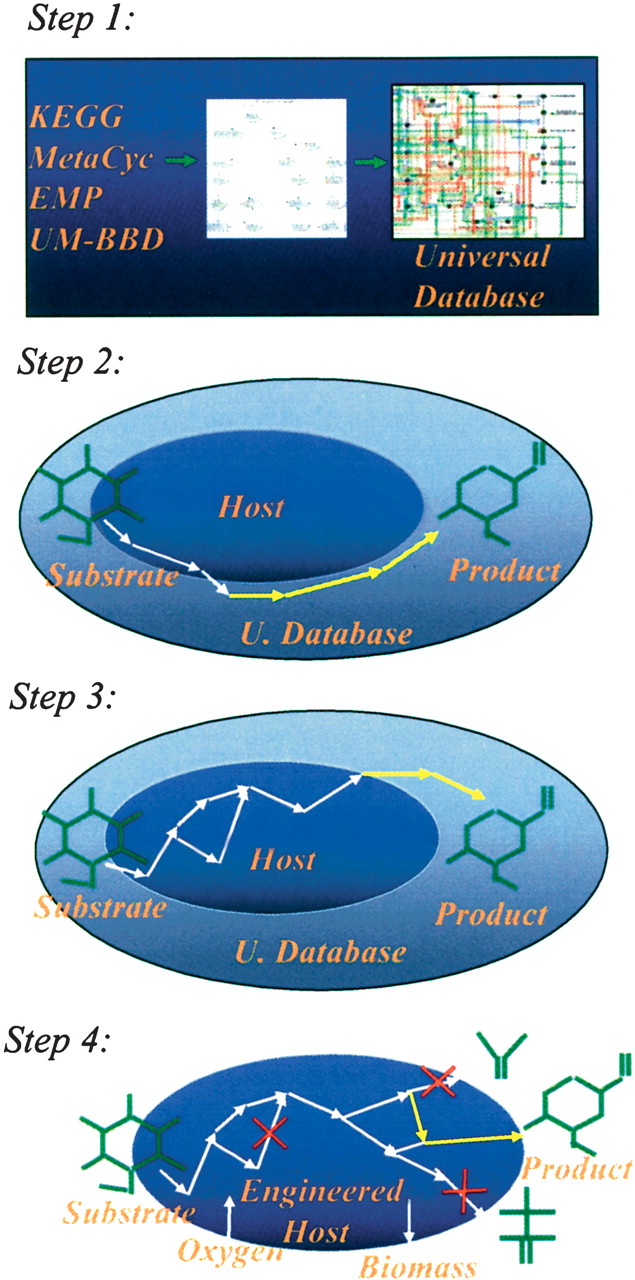
Pictorial representation of the OptStrain procedure. Step 1 involves the curation of database(s) of reactions to compile the Universal database, which comprises only elementally balanced reactions. Step 2 identifies a maximum-yield path enabling the desired biotransformation from a substrate (e.g., glucose, methanol, xylose) to product (e.g., hydrogen, vanillin) without any consideration for the origin of reactions. Note that the white arrows represent native reactions of the host and the yellow arrows denote non-native reactions. Step 3 minimizes the reliance on non-native reactions, and Step 4 incorporates the non-native functionalities into the microbial host's stoichiometric model and applies the OptKnock procedure to identify and eliminate reactions competing with the targeted product. The red ×s pinpoint the deleted reactions.