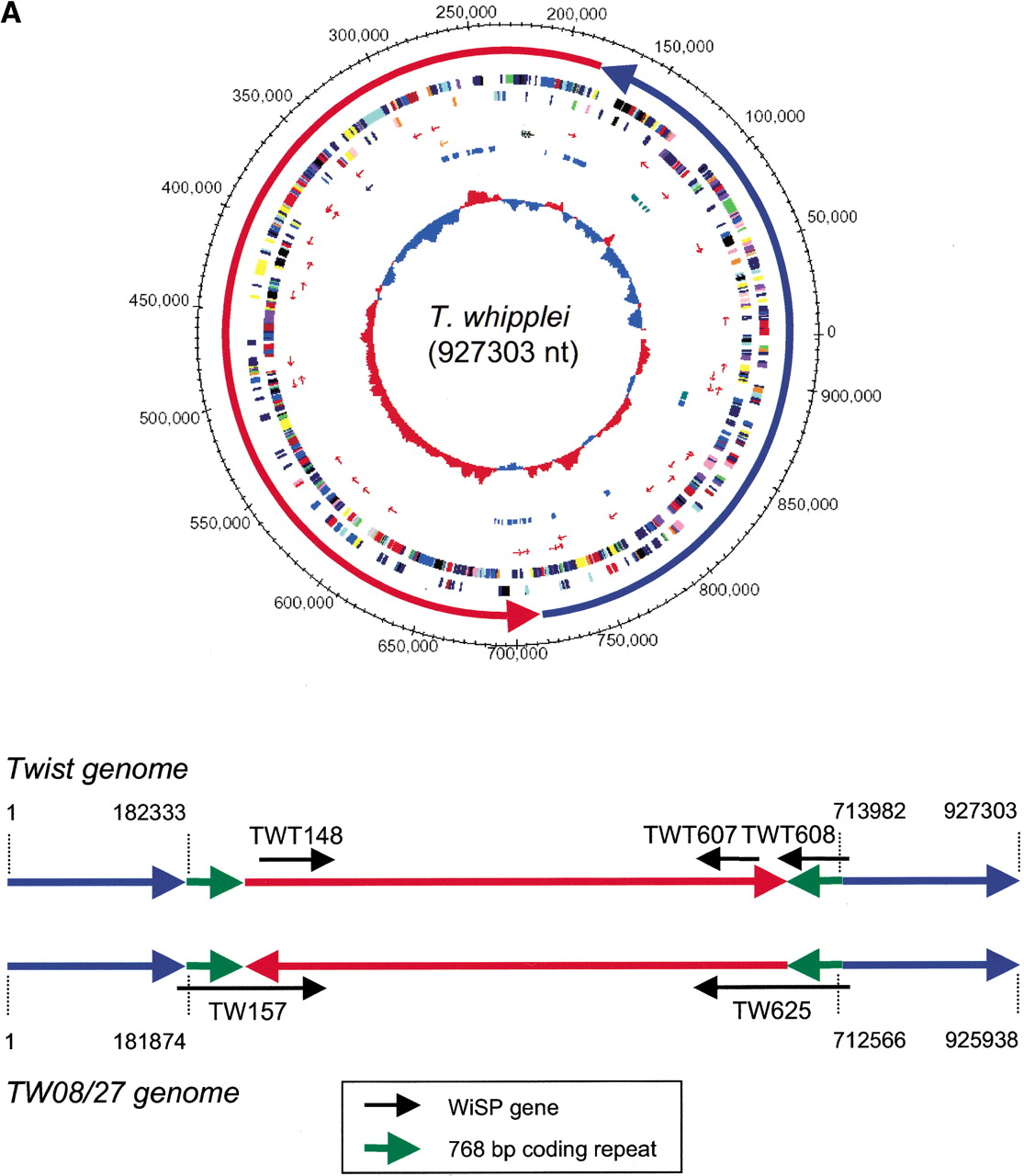
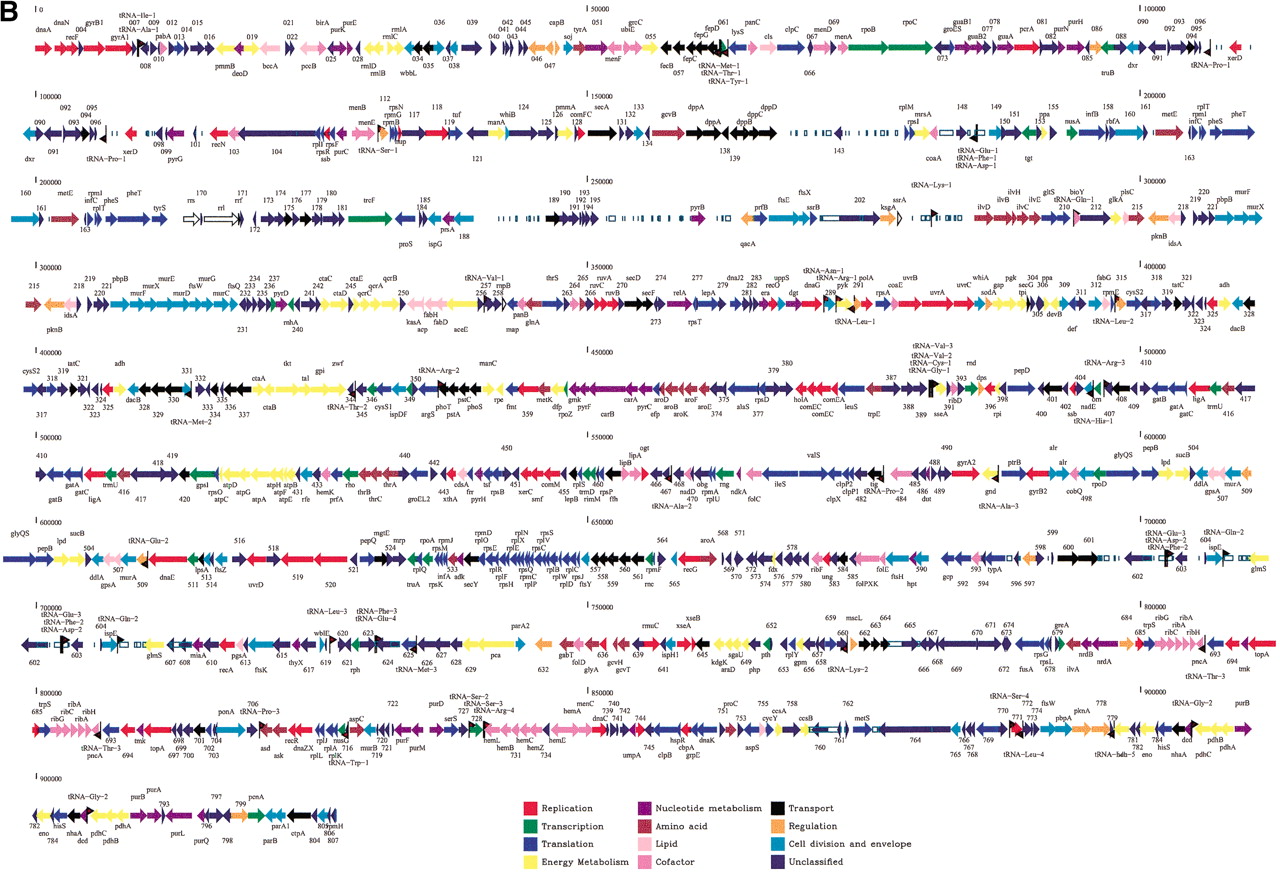
(A) Circular representation of the T. whipplei Twist genome (upper panel), and the alignment of the Twist and TW08/27 genomes (lower panel). The origin of replication was predicted to be near the dnaA gene, based on the conservation of dnaA-dnaN-recF gene cluster and the change of AT-skew signal. One leading strand displays a pronounced excess in T vs. A and a slight excess of G vs. C. The location of the oriC was verified by Southern-blot hybridization with a digoxigenin-labeled oriC probe onto the Not I restriction profile. In the upper panel, the outermost (1st) circle indicates the nucleotide positions. 2nd circle: The two chromosomal segments, one of which exhibits an inversion (see text). 3rd and 4th circles: The ORF locations on the plus and minus strands, respectively. Functional categories are color-coded (see Fig. 1B). 5th and 6th circles: tRNAs. 7th circle: The locations of three rRNAs are indicated by black arrows. 8th circle: The repeat locations for the two largest families. The most internal circle shows the AT skew (A-T/A+T) computed with a sliding window size of 10 kb. The lower panel shows the detailed structure of the chromosomal inversion (red arrows), flanked by repeated sequences coding for WND-domains (green arrows). Black arrows: WiSP protein-coding genes at the extremities of the inverted segments. (B) Linear view of the complete circular genome of T. whipplei. Arrows = genes, with color-coded functional categories; small red flags = TRNAs; open arrows = other RNAs; open boxes = repeats belonging to the two major categories.