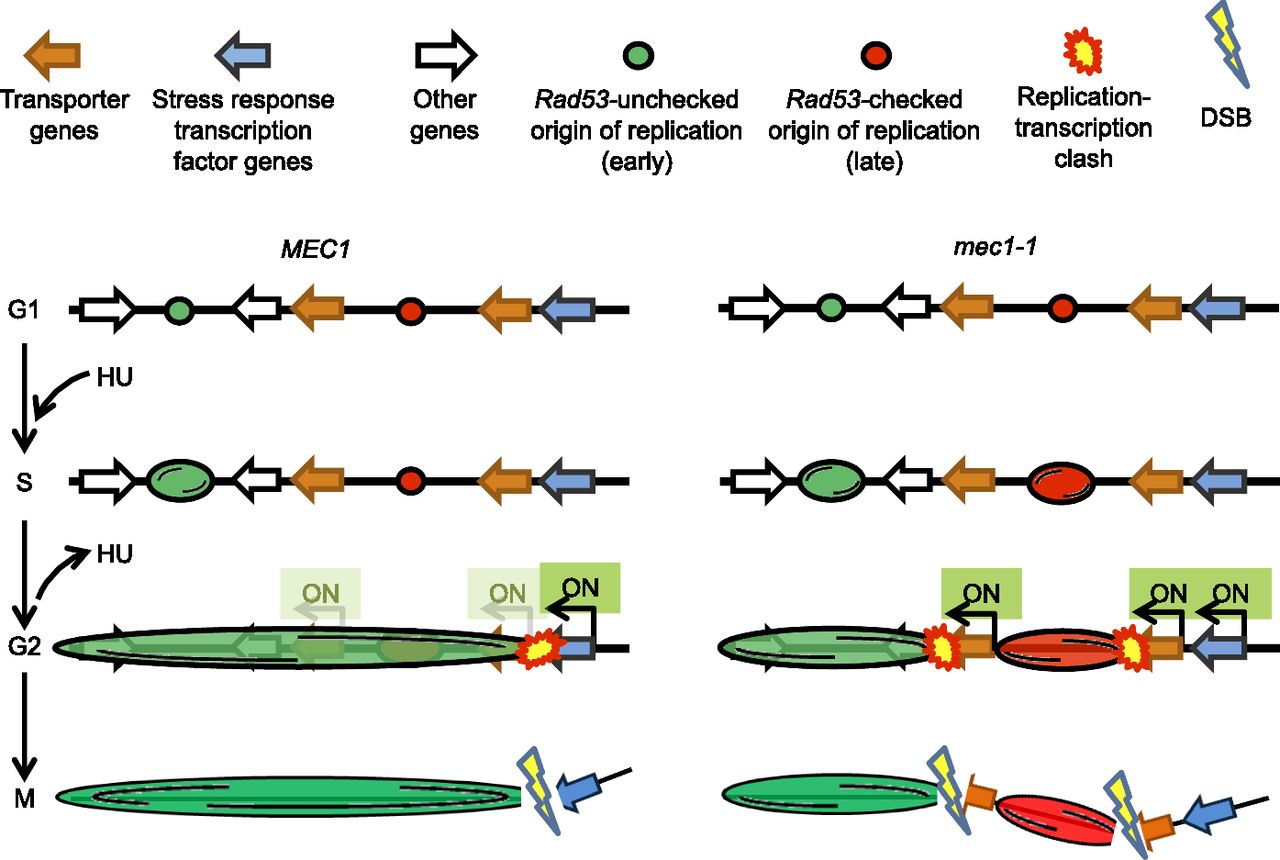
Model for chromosome fragility induced by HU as a result of unscheduled conflict between destabilized replication forks and increased gene transcription at HU-inducible genes in mec1 cells and MEC1 cells. In the presence of HU only those Rad53-unchecked origins (Feng et al. 2006) are activated in MEC1 cells and the replication forks travel a greater distance than those in the mec1 cells, thus reaching different locations in the genome. Therefore, during recovery from HU, the stalled replication forks in MEC1 and mec1 cells encounter the transcription induction of different subsets of HU-responsive genes. Collision between replication and transcription brings forth further destabilization of the ssDNA at the replication forks, causing DSBs. Note that although the replication forks in WT cells would have traversed through the HU-induced genes that are proximal to the origins observed in the mec1 cells, ssDNA is only formed at the replication fork at a more distal region, thus sparing these genes from DSBs.