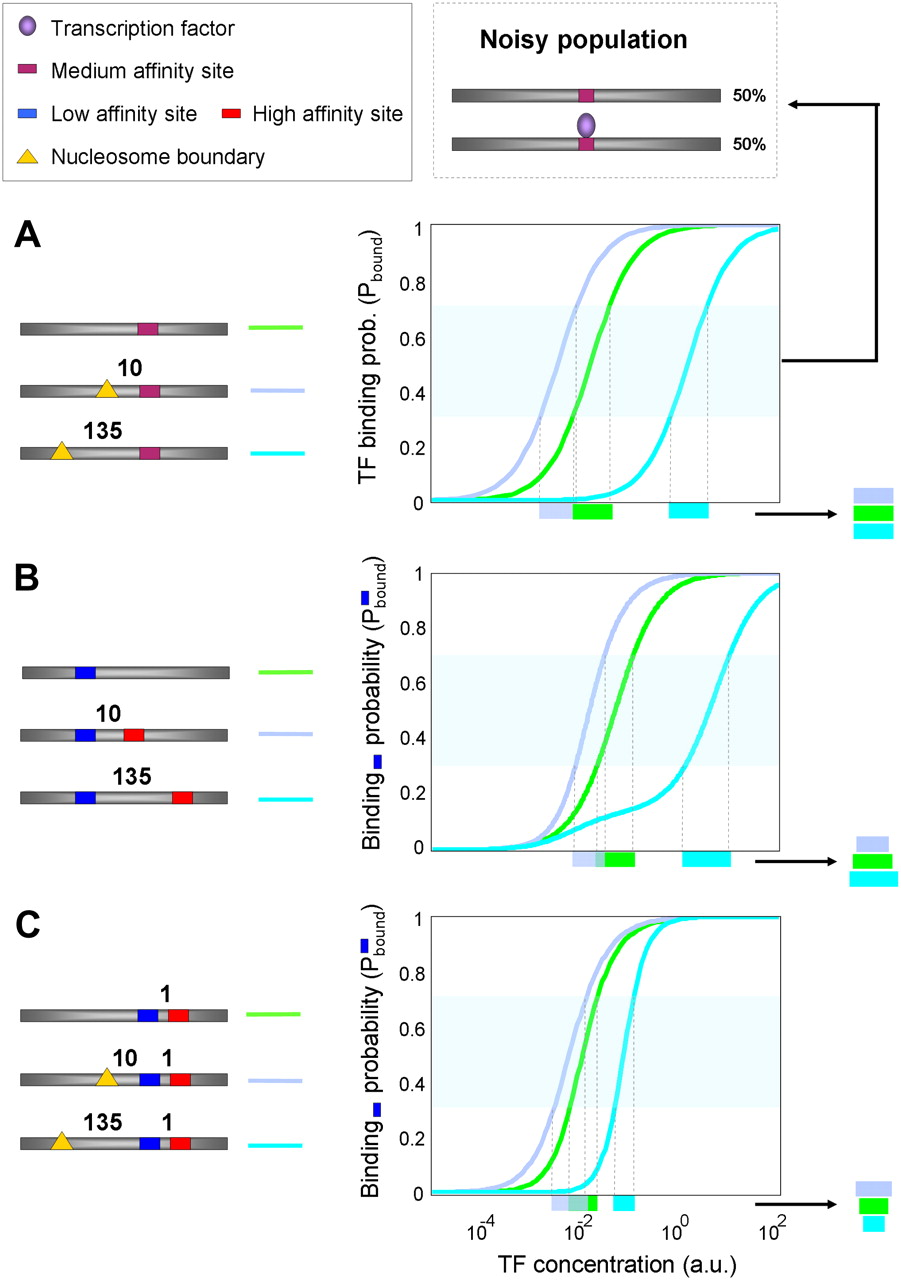
Nucleosomes as generators of distinct noise behaviors. Shown is the “noisy” regime of intermediate Pbound values (defined as 0.3–0.7) for the low-affinity (left) site in different promoters. These intermediate Pbound values correspond to a heterogeneous cell population where some cells exhibit one state of transcription factor binding, and others exhibit a different state. (A) Promoters (from Fig. 3C) with a single transcription factor site and a single boundary element, located at various distances from the site. Note that in all promoters the extent of the range of transcription factor concentrations responsible for “noisy” Pbound values is the same, but its location changes. (B) Promoters (from Fig. 5B) with high- and low-affinity sites for some transcription factor. Sites are located at various distances from each other. Note that both the location and the extent of the range of transcription factor concentrations responsible for “noisy” Pbound values are altered between promoters. When the sites are close together (10 bp), a cooperative effect is formed, and the extent of the range of concentrations responsible for the “noisy” regime is decreased. Conversely, when the sites are 135 bp apart, a destructive effect is observed, and the extent of the range of concentrations responsible for the noisy regime is increased. (C) Promoters (from Fig. 6B) with a high- and a low-affinity site for some transcription factor, located at various distances from a boundary element. The distance between the sites is set to 1 bp. Here, the boundary addition results in a change to both the location and the extent of the range of transcription factor concentrations responsible for “noisy” Pbound values. When the sites are close to the boundary (10 bp), the probability of a nucleosome covering the sites and generating a strong obligate cooperative effect is decreased, and thus the extent of the range of concentrations responsible for the noisy regime is increased. Conversely, when the sites are far from the boundary (135 bp), the probability of a nucleosome covering the sites and generating a strong obligate cooperative effect is increased, and, thus, the extent of the range of concentrations responsible for the noisy regime is decreased.