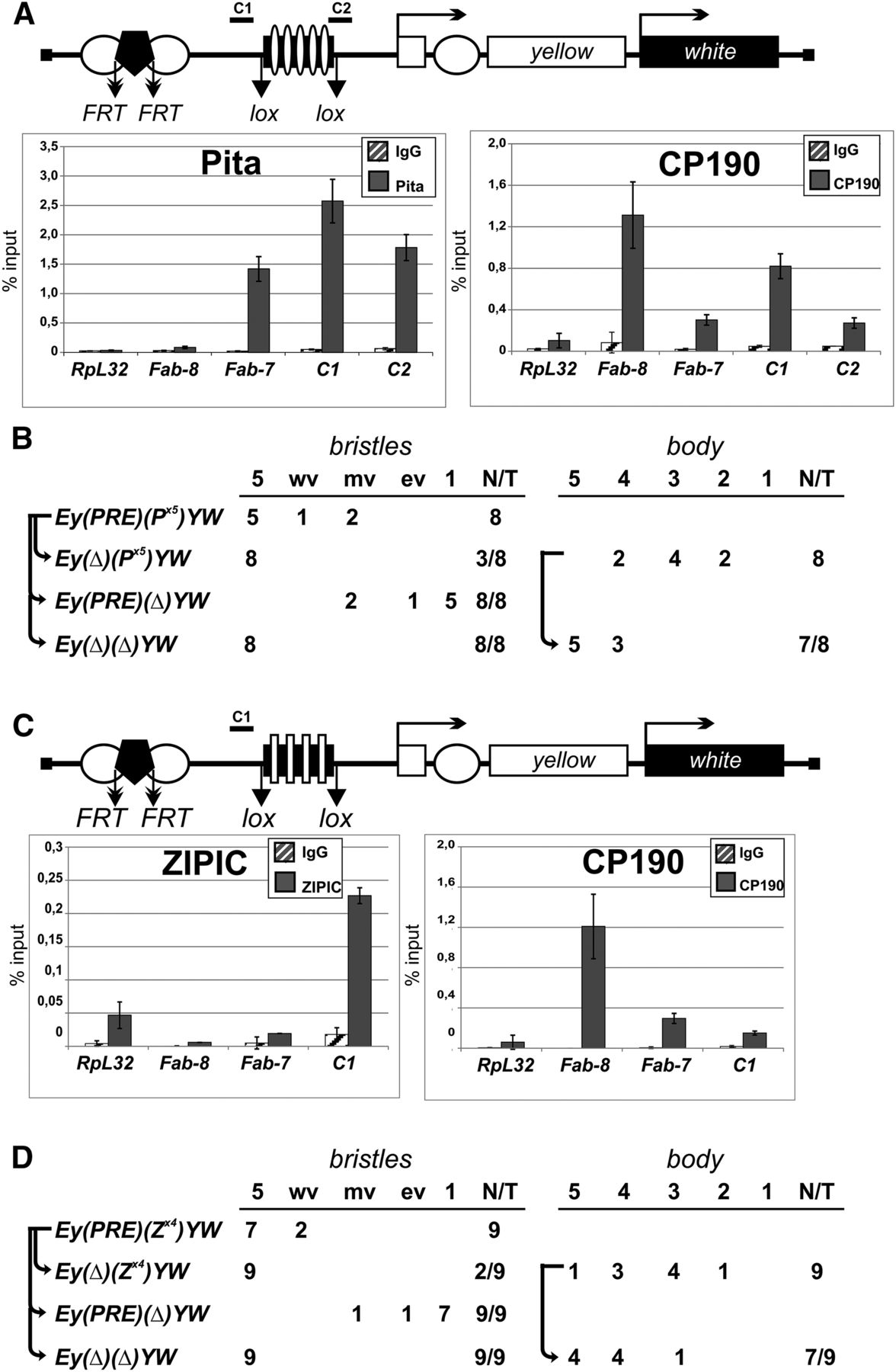
Testing Pita and ZIPIC binding sites for boundary and enhancer-blocking activities. (A,C) Reductive schemes of transgenic construct used to examine the boundary and enhancer-blocking activities of Pita (A) and ZIPIC (C) binding sites. The yellow and white genes are shown as boxes with arrows indicating the direction of their transcription. Downward arrows indicate target sites for Flp recombinase (FRT) or Cre recombinase (lox). The box with five white ovals (A) or four white rectangles (C) shows five Pita or four ZIPIC binding sites, respectively. White circles show the body and wing enhancers of the yellow gene; the black pentagon shows PRE from the Ubx gene. Histograms show the binding of (A) Pita and CP190 to Pita binding sites and (C) ZIPIC and CP190 to ZIPIC binding sites in the transgenic construct. Chromatin was isolated from transgenic flies carrying the construct and treated with antibodies to Pita, ZIPIC, and CP190. Nonspecific IgG was used as a negative control. The results of ChIP are presented as a percentage of input DNA. Relative locations of primers for ChIP are indicated at the construct scheme as C1 and C2. The RpL32 coding region (devoid of binding sites for the test proteins) was used as a negative control; Fab-8 and Fab-7 as CP190-binding regions and Fab-7 as a Pita-binding region were used as positive controls. Error bars indicate standard deviations of quadruplicate PCR measurements. (B,D) Experimental evidence that (B) Pita and (D) ZIPIC binding sites have an insulator activity. The “bristles” and “body” columns show the numbers of transgenic lines with different levels of pigmentation in corresponding cuticle structures. The “bristle” column shows degree of yellow expression in bristles of the thorax and head. The pigmentation was scored using a 5-point scale, where 1 denotes loss of pigmentation in all bristles on the thorax and head; (ev) extreme variegation (only 1–3 bristles on the thorax and head are partially pigmented); (mv) moderate variegation (about half of bristles are yellow); (wv) weak variegation (only 1–3 bristles on the thorax and head are yellow or partially pigmented); and (5) pigmentation of all bristles as in wild-type flies. The “body” column shows the numbers of transgenic lines with the yellow pigmentation level in the abdominal cuticle (reflecting the activity of the body enhancer); in most of the lines, the pigmentation level in wing blades (reflecting the activity of the wing enhancer) closely correlated with these scores. The level of pigmentation (i.e., of y expression) was estimated on an arbitrary five-grade scale, with wild-type expression and the absence of expression assigned scores 5 and 1, respectively (see Supplemental Fig. S10). In the N/T ratio, N is the number of transgenic lines in which flies acquired a new yellow phenotype after the deletion of a DNA fragment flanked by either FRT or lox sites, and T is the total number of examined transgenic lines.