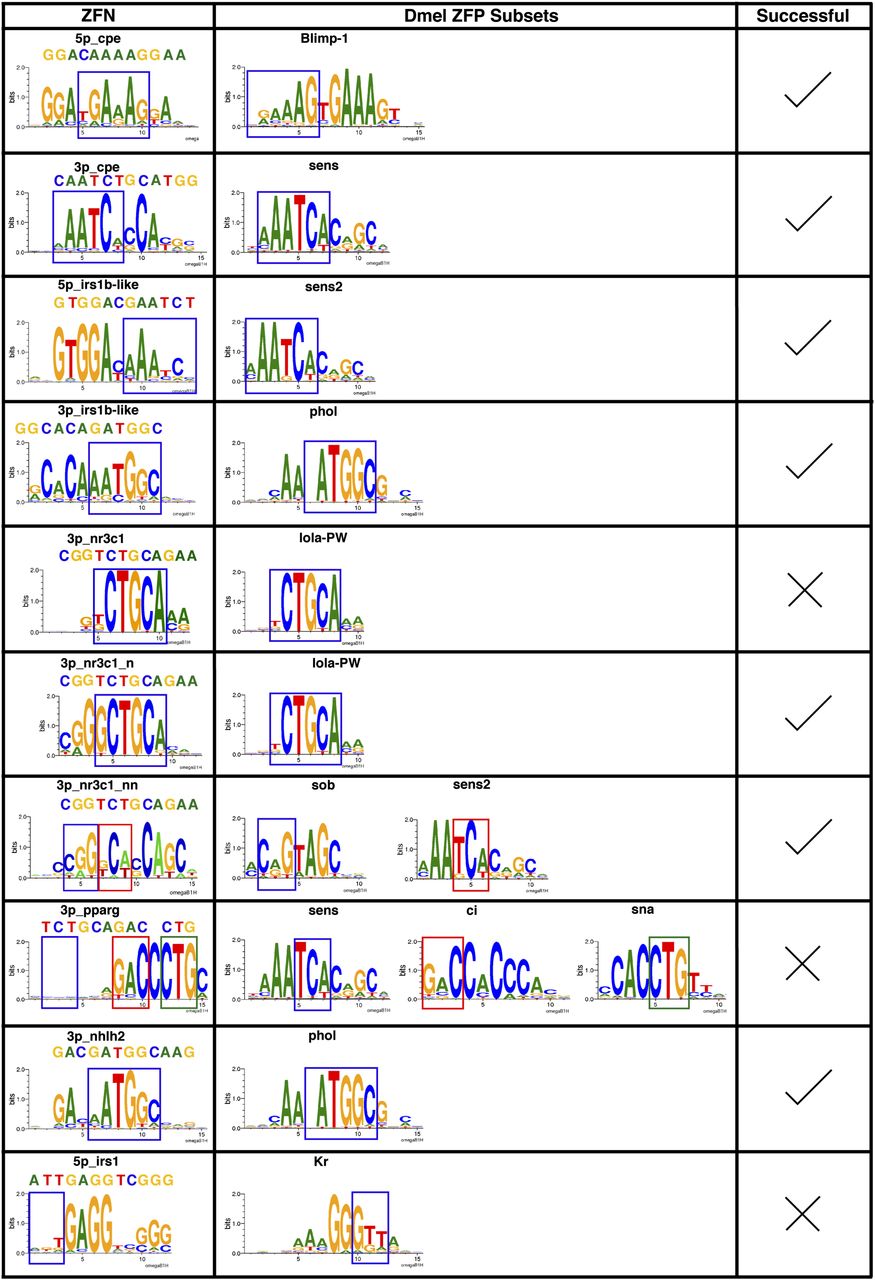
Drosophila finger sets maintain their specificity when incorporated into artificial arrays. The left column displays the B1H-determined recognition motif for each assembled ZFA. For each motif, the subsite recognized by the utilized fingers in the ZFA and Drosophila ZFP (middle column) is boxed, and where these are similar, the assembly was deemed a success (check; right column). In some cases fingers from more than one Drosophila ZFP were used in the artificial finger assembly. In the case of 3p_nr3c1, due to the initial failure (X), two additional variants were constructed (3p_nr3c1_n and 3p_nr3c1_nn) to achieve the desired DNA-binding specificity. The complements for some of these ZFN pairs are entirely artificial in construction and are thus shown in Supplemental Figure 15.