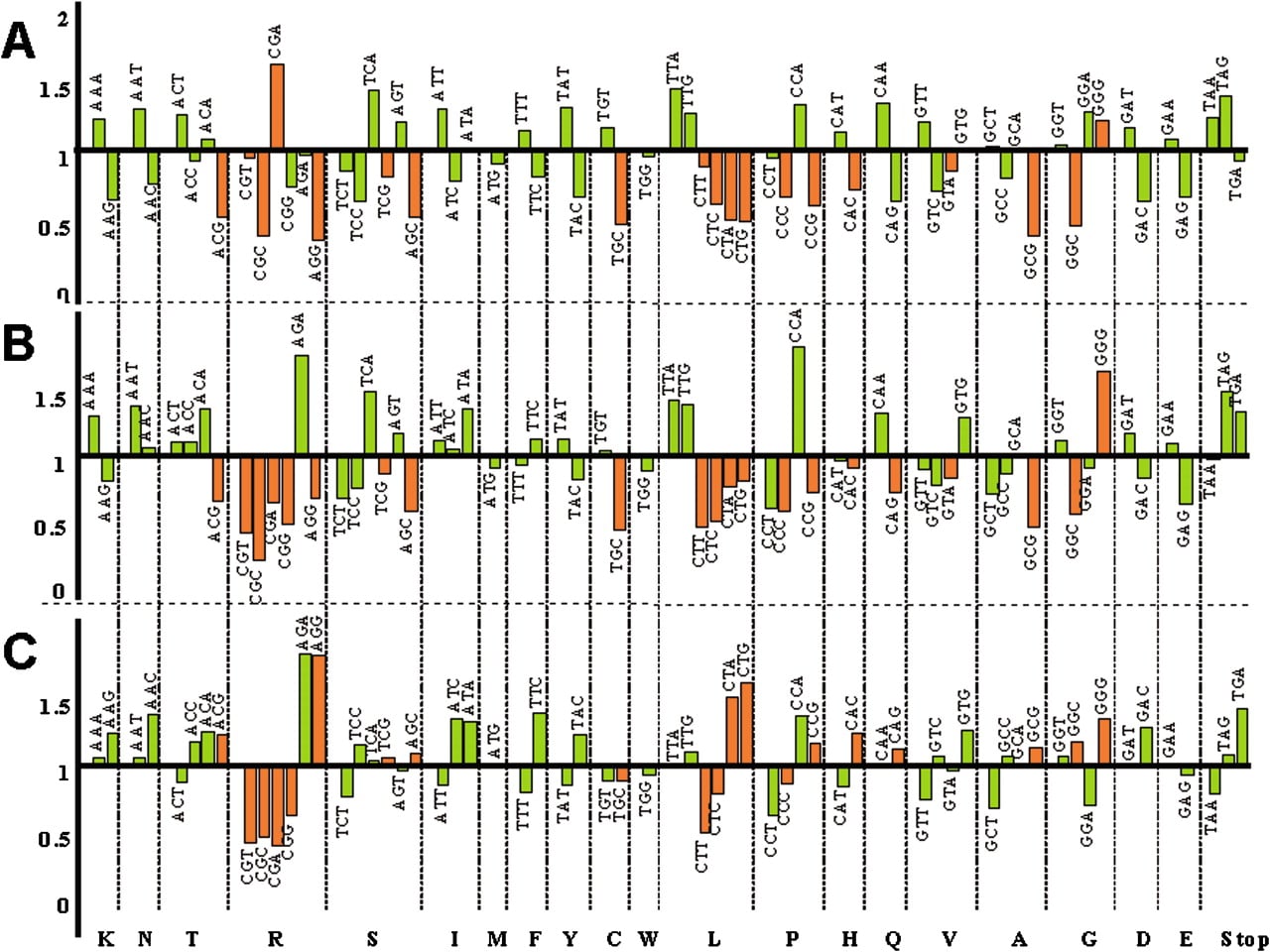
Candida albicans prefers A- and T-ending codons. Codon usage in C. albicans, Saccharomyces cerevisiae, andSchizosaccharomyces pombe was analyzed by counting the total number of codons for each species. To determine the codon preference between two species, the relative frequency of usage of each codon was divided by the corresponding value for the same codon in the other species. The codon usage ratios obtained for C. albicans/S. cerevisiae (A), C. albicans/S. pombe (B), and S. cerevisiae/S. pombe (C) were plotted as indicated in the graph, with ratio values above 1 (upper part in the graph) indicating the preferred codons in C. albicans in relation to the other two species (A and B) and inS. cerevisiae in relation to S. pombe (C). The C. albicans/S. cerevisiae codon ratios indicate that C. albicans prefers highly used codons (green bars) ending with A and T, with the exception of Leu-TTG and Gly-GGG. For theC. albicans/S. pombe pair, the preference for frequently used A- and T-ending codons is maintained, but four frequently used C-ending codons, Asn-AAC, Thr-ACC, Ile-ATC, Phe-TTC, and also the G-ending codons Leu-TTG, Val-GTG, and Gly-GGG, are preferred. Therefore, the data indicate that in C. albicansthe effect of AT pressure is more visible at the third codon position for highly used codons. That the CTG codon is used at low frequency inC. albicans implies that AT pressure was not the main force driving its reassignment to serine. Green and brown bars indicate highly and rarely used codons, respectively.