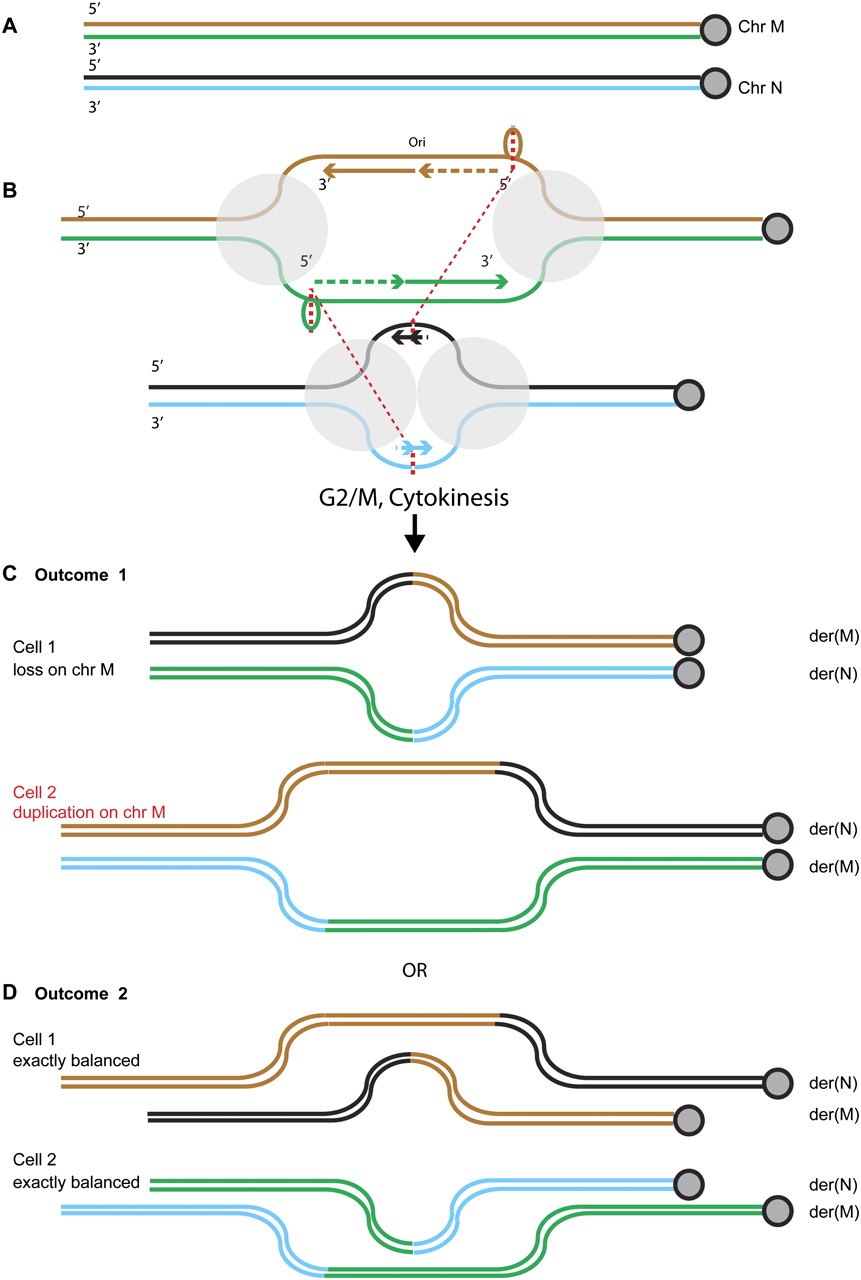
Replication bubbles as a source of duplications and deletions at reciprocal translocation junctions. (A) Two normal chromosomes, M and N. Each DNA strand is shown as a thin line, centromere shown to the right. (B) Replication bubbles form, with the new strands shown. The polymerase complexes are shown as gray circles, the trombone loops at the lagging strand polymerase as ovals. For simplicity, the bubble on chromosome N is shown before significant synthesis has occurred, but it could be like the bubble on chromosome M, in which case, there are four possible outcomes. Breaks or template switching occurs at the thicker dotted red lines, perhaps at the single-stranded trombone or primer loops adjacent to the lagging strand polymerases, and reciprocal joining, i.e., translocation, occurs as shown by the thinner dotted lines, between them and breaks on chromosome N. Replication proceeds and the chromatids separate to daughter cells. According to which chromatids end up in the same cell, two outcomes are possible. (C) Outcome 1: Daughter cell 1 inherits a translocation with loss of the segment of chromosome M between the two breakpoints. Daughter cell 2 inherits two copies of this segment, to give a duplication at the breakpoint. (D) Outcome 2: Both cells receive exactly balanced products.