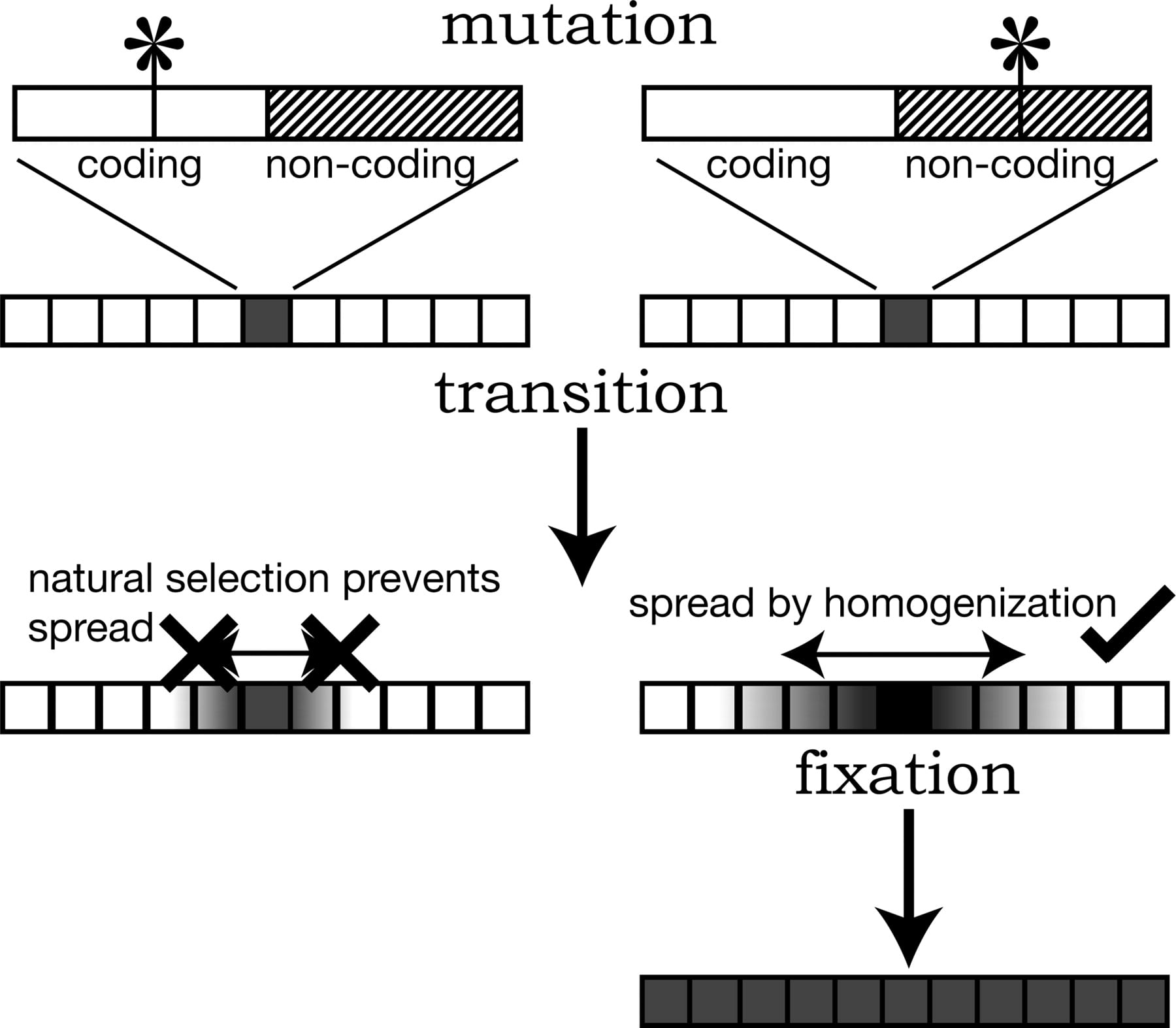
Three phases of repeat homogenization under a rapid homogenization model. First, a mutation occurs at either a selectively constrained (e.g., a coding part of the repeat), or a nonselectively constrained (e.g., a noncoding part of the repeat) site in a single unit from the stylized array. In the transition phase, only the unit with the nonselectively constrained mutation can increase to high copy number by homogenization. This mutation is able to sweep to fixation in the array. Thus, only mutations tolerated by selection can spread throughout the array, explaining why within the same repeat some regions are highly polymorphic while others are highly conserved, even though the entire repeat unit is subject to the identical homogenization process. See text for details.