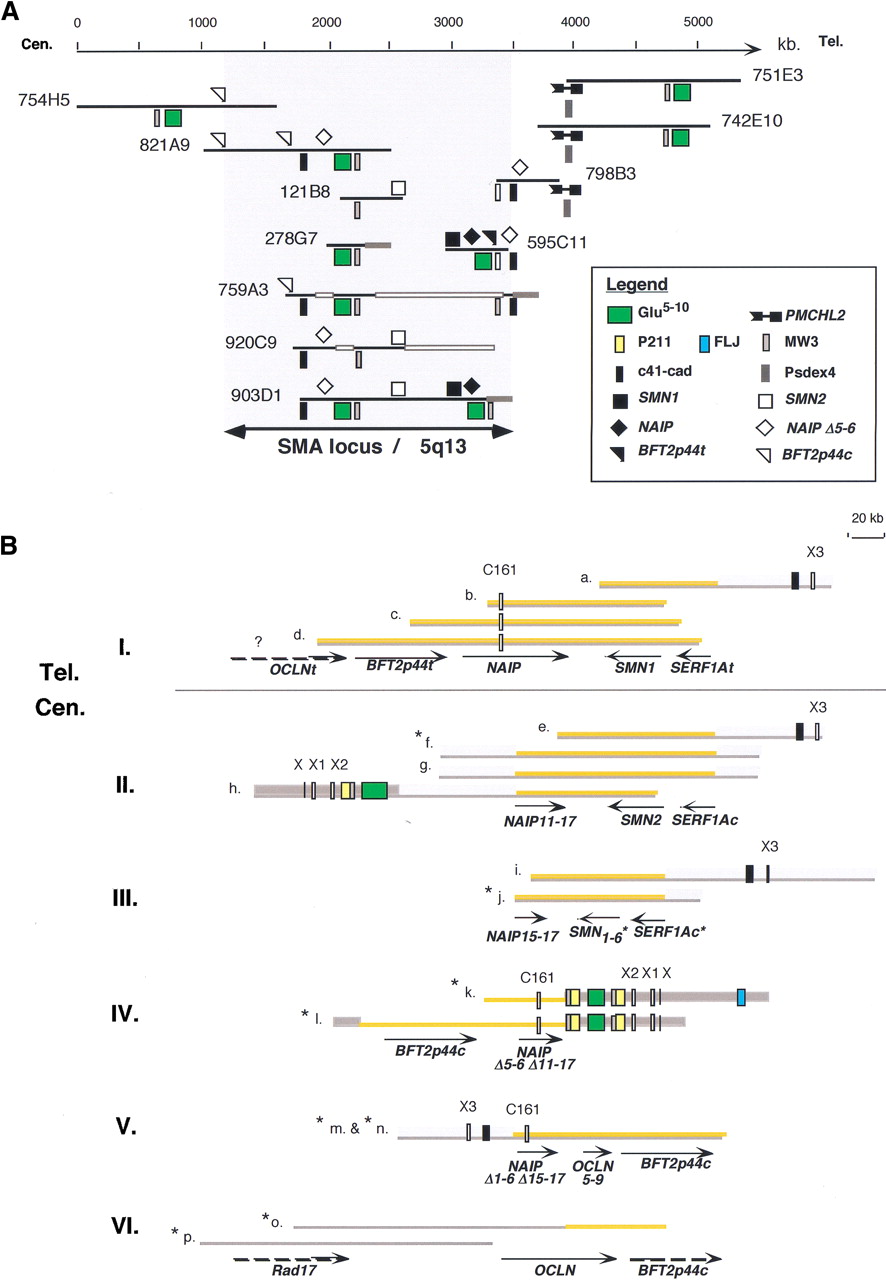
Genomic organization of the SMA locus on 5q13. (A) Consensus YAC contig spanning the SMA region. Genes of the locus (SMN,NAIP, and BFTp44) are symbolized on the black line representing the extent of the clones, and the PSVs underneath. Legend at right. Thick gray and white lines symbolize YAC chimerism and instability, respectively. (B) Genomic organization of the SMA locus established through sequence analysis of PAC/BAC clones (a–p). Despite the fact that critical pieces of information about this chromosomal region are still missing or unclear, we succeeded in reconstructing the sequence organization of six nonoverlapping genomic areas encompassing the disease locus (I. to VI.). Tel. and Cen. refer, respectively, to the telomeric and centromeric parts of the duplication as described in the literature. Sequences specific to this duplicon are highlighted in orange. Thick gray lines represent duplicons whose original locus is on 5p14; (1) thick light-gray lines represent areas paralogous to the 5p14 region, and (2) thick dark-gray lines represent paralogous sequences distributed among several loci on human chromosomes 5 and 6 (see Fig. 4). Arrows indicate the extent and the 5′–3′ orientation of the genes. The NAIPΔ represent deleted forms of the NAIP gene. SMN1-6, NAIP11-17, and OCLN5-9 are deleted forms of the SMN, NAIP, and OCLN genes, respectively. (C161) CATT1-G1/C161 dinucleotide repeat marker (Burghes et al. 1994). (X, X1, X2, X3, C161) Sequences paralogous to exons of the chimeric genes depicted in Figure 6. Gene symbols and PSVs are denoted according to the symbol used in Figures 4 and 5A. (a)AC016554/CTC-340H12; (b) AC005031/GSP13996; (c) U80017/125D9; (d)AC044797/RP11-195E2; (e) AC004999/D215P15; (f) AC022119/CTC-566F17; (g)AC010272/CTC-492P2; (h) AC010237/CTC-348J20; (i) AC010217/CTC-202F24; (j) AC093202/CTC-249C14; (k) AC044800/RP11-34J8; (l)AC011244/RP11-497H16; (m) AC012369/RP11-551B22; (n)AC110009/RP11-508M8; (o) AC010355/CTD-2027K22; (p) AC015470/RP11-2H18. (*) Clones in HTGS phase in GenBank—according to the June, 2002 freeze of the genome draft sequence.