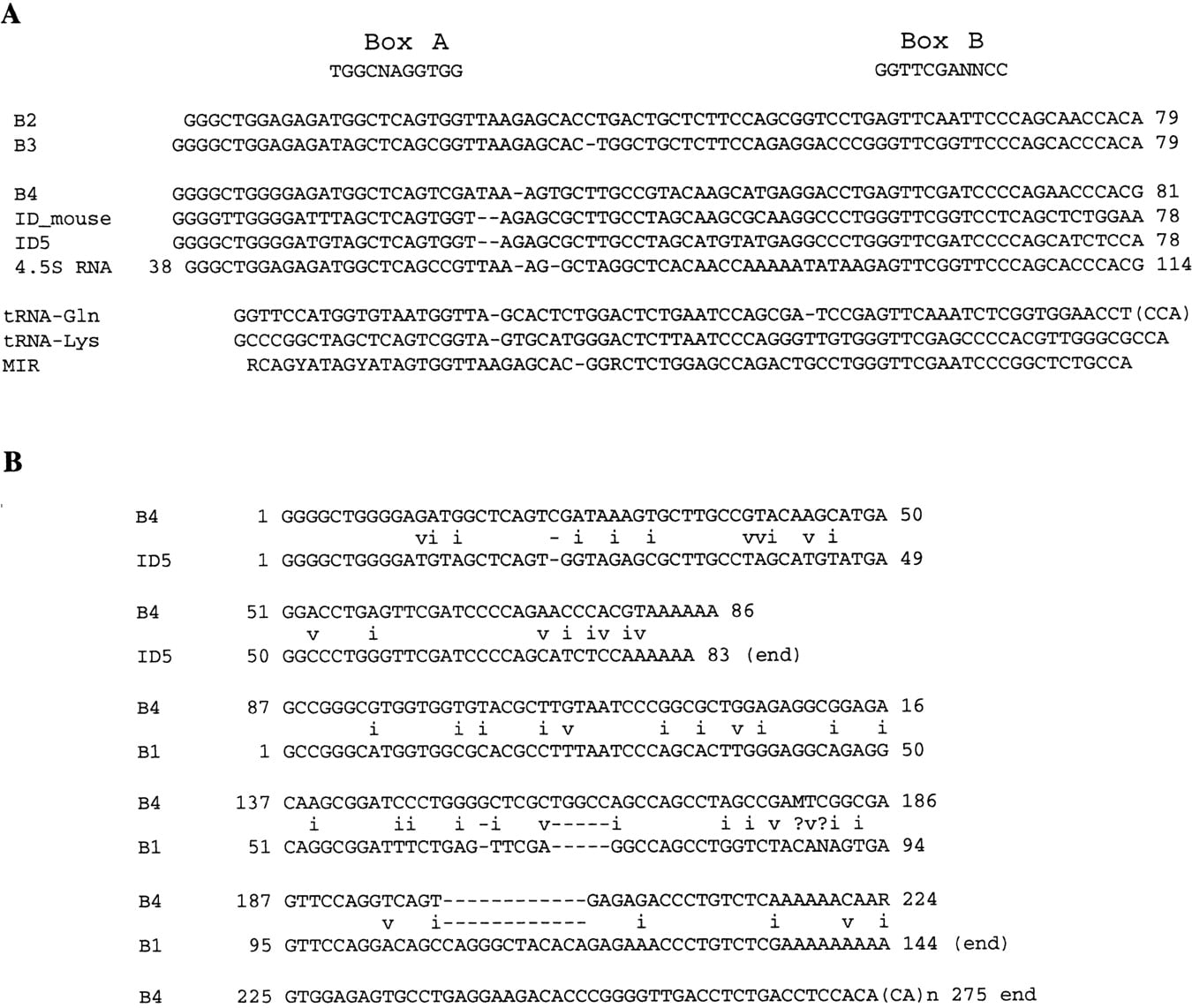
Two novel tRNA-derived SINEs in the rodent genome denoted B3 and B4. (A) Comparison of the tRNA-like region in rodent SINEs. It is noteworthy that the tRNA-like regions of five rodent SINEs are more closely related to each other and the mammalian-wide MIR SINE (Smit and Riggs 1995) than to any known tRNA. Similarity of the B3 to B2 elements stretches beyond the tRNA-like region. The first 135 bp of the B3 consensus sequence is 84% similar to bp 1–124 of the B2 element, but the terminal 93 bp is unrelated. (4.5s RNA) The rat gene for a small nuclear RNA in rodents that has produced many pseudogenes (Saba et al. 1985; Takeuchi and Harada 1986). Indicated above the alignments are the consensus polymerase III promoter A and B boxes. (B) The B4 element appears to be a fusion product of an ID element, a B1 element, and an unrelated flanking region. ID5 is a consensus sequence of one of six ID subfamilies identified in the mouse genome, where higher numbers indicate higher divergence and older age (ID2–ID6 are all present in both rat and mouse) (Smit et al. 1995). Mismatches in the alignment are indicated with i (transition) and v (transversion).