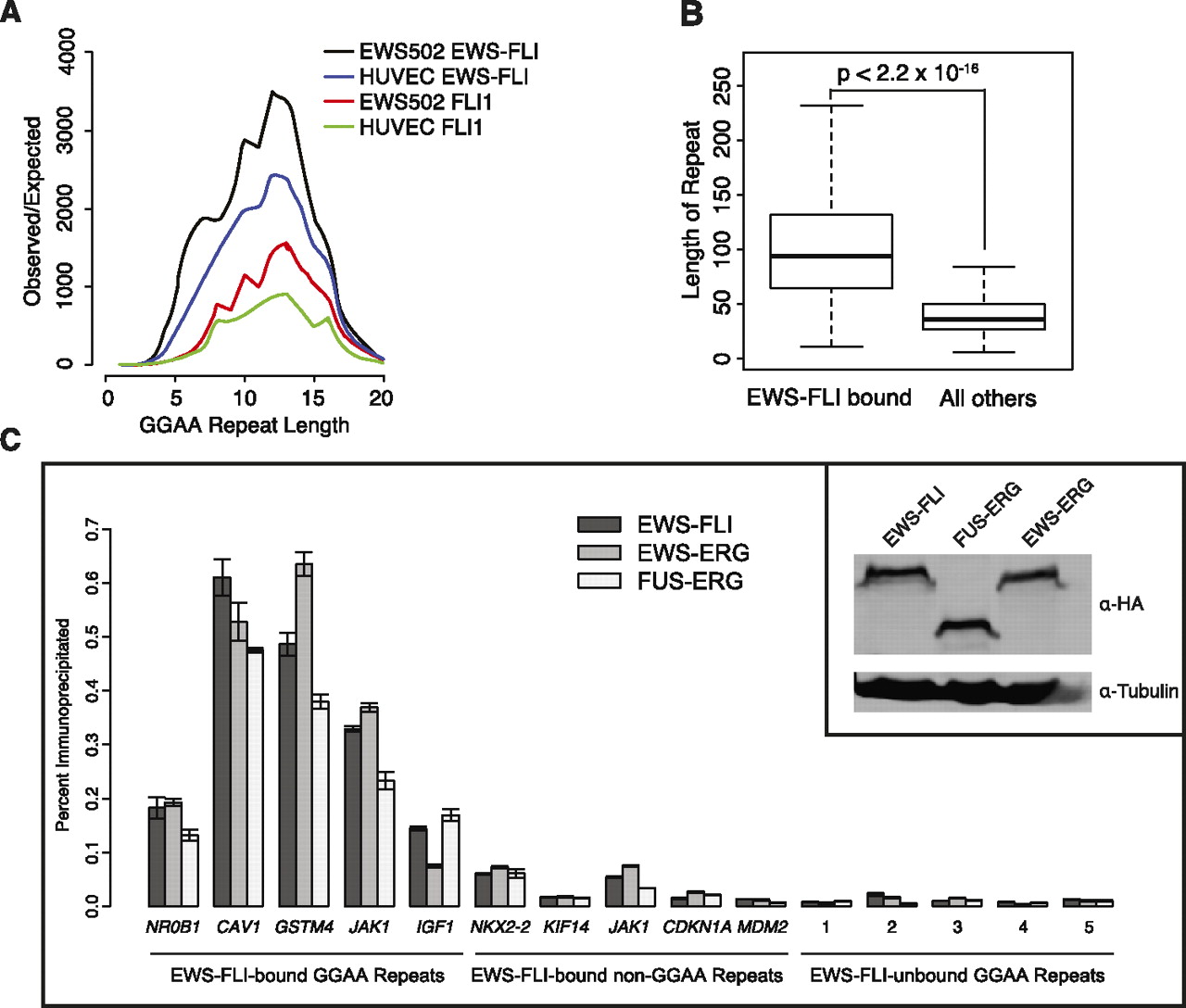
EWS–ETS fusions target GGAA-containing microsatellite repeats. (A) Tandem GGAA repeats identified in EWS–FLI and FLI1 binding sites in EWS502 and HUVEC were compared with those detected by 1000 permutations of the identical number of regions over the mappable genome, maintaining chromosomal distribution. All lengths exceeding one repeat were significant to P < 0.0001. To permit plotting lengths for which the permuted value was zero, 0.1 was added to each observed and expected value. (B) The lengths of repeat regions annotated by RepeatMasker bound by EWS–FLI in EWS502 were compared with those unbound in mappable regions of the genome. Regions bound by EWS–FLI contained significantly longer repeats as measured by a t-test. (C) ChIP–qPCR on chromatin isolated from EWS502 cells expressing the various Ewing Sarcoma fusions. Results are shown as a percent of input control. Overall, greater binding is identified at EWS–FLI-bound regions near differentially expressed genes that contained GGAA repeats (NR0B1, CAV1, GSTM4, JAK1, IGF1) compared with those that bound EWS–FLI but did not harbor a repeat (NKX2-2, KIF14, JAK1, CDKN1A, MDM2). Five control repeat-containing regions are included, and error bars represent the standard error of three replicates. (Inset) Western blot showing exogenous expression of HA–EWS–FLI, HA–FUS–ERG, and HA–EWS–ERG in EWS502 cells. Tubulin serves as a loading control.