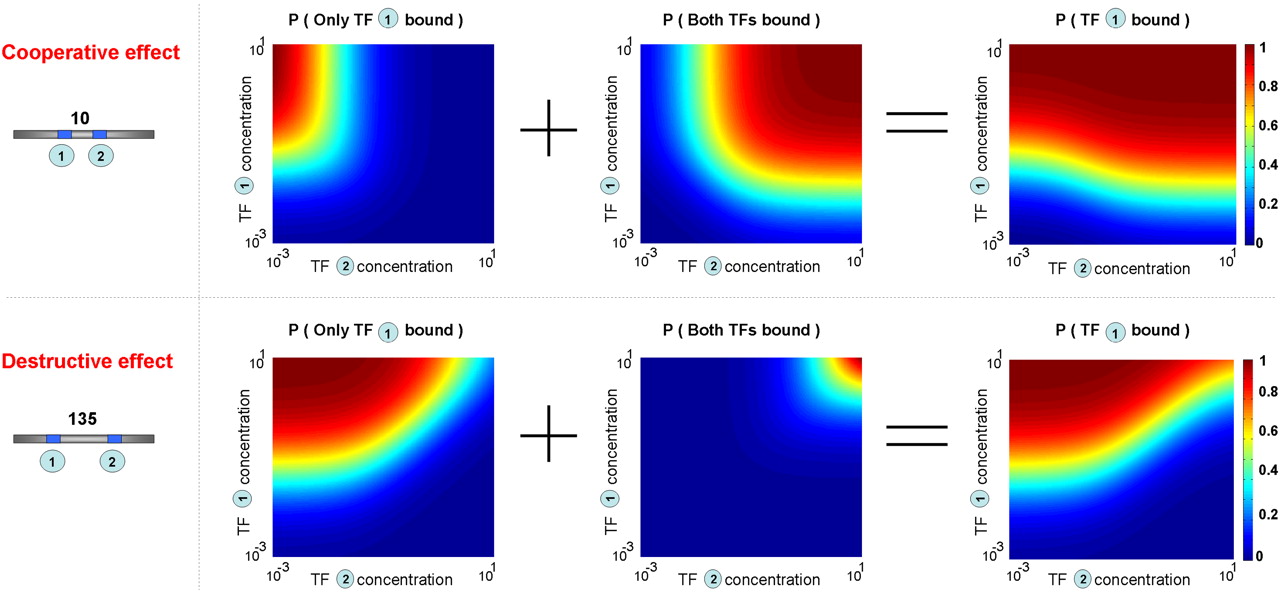
Obligate cooperative/destructive effects between transcription factor sites. For two promoters containing two sites for different transcription factors (marked as transcription factors 1 and 2) at different distances (10/135 bp), shown is the probability of binding for transcription factor 1 to its site (left site) for increasing concentrations of both transcription factors (right heat maps). This probability is, in fact, the sum of two probabilities: the probability that only transcription factor 1 is bound to its site while transcription factor 2 is not bound to its site (left heat maps), and the probability that both sites are occupied (middle heat maps). Note that when the sites are located at a distance of 10 bp from each other (top heat maps), a cooperative effect is observed—the binding of one transcription factor positively affects the probability of the other transcription factor to be bound, and thus the most prevalent configuration is one where both sites are occupied, even when the concentration of one of the transcription factors is relatively low. However, when the distance between the sites is 135 (bottom heat maps), a destructive effect is observed. The binding of one transcription factor negatively affects the probability of the other transcription factor to be bound, and thus the configuration where the two sites are occupied is rare and occurs only at extreme concentrations of both factors.