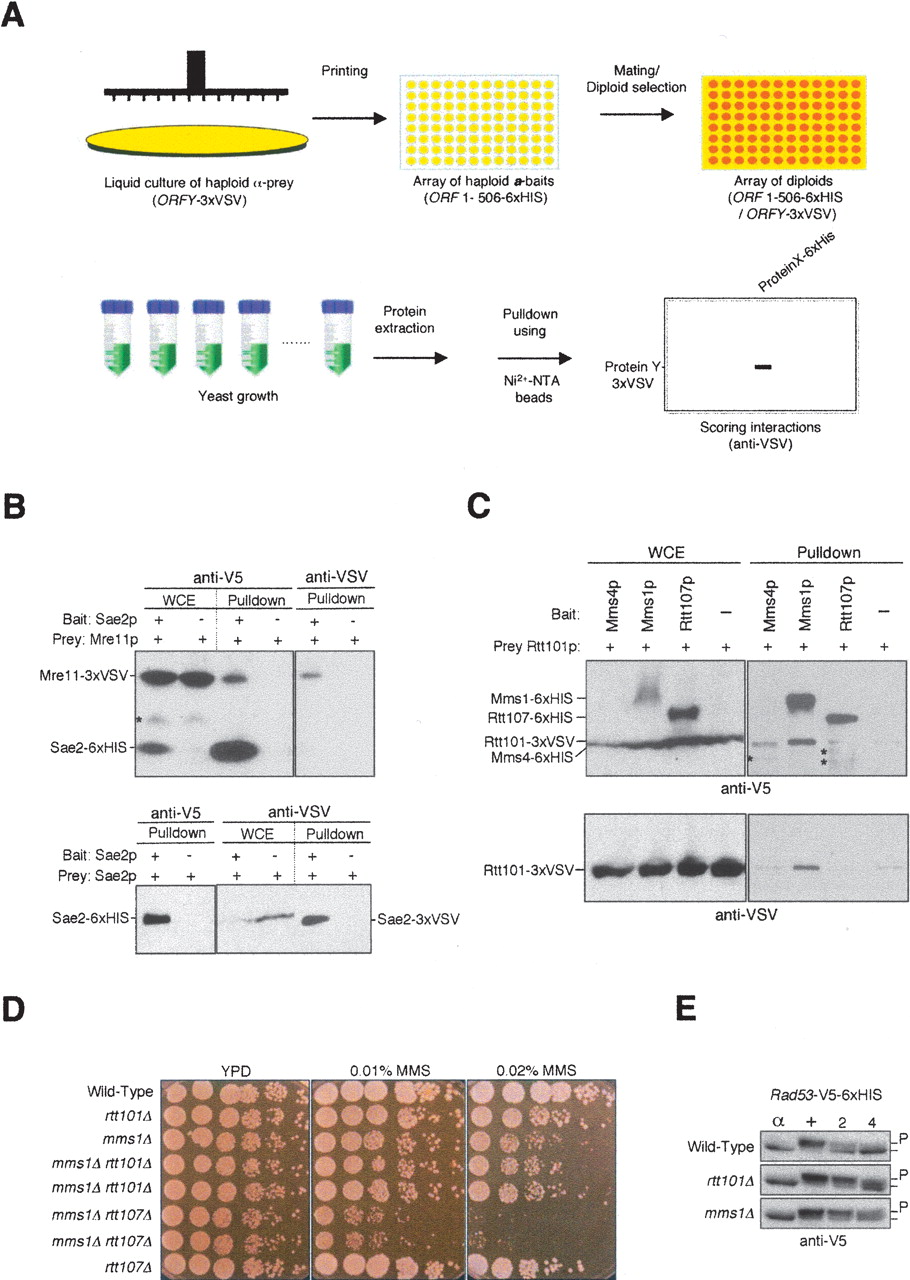
Using Cross-and-Capture to screen for novel PPIs. (A) Screening scheme. A strain containing a prey (ORFY–3×VSV) is combined with a set of different bait strains (ORF1-506–6×HIS) and diploids are selected. Extracts and Western blots are processed in parallel, and pulldowns of the prey protein are assessed. (B) Sae2p interacts with Mre11p and Sae2p. Pulldowns are from diploids expressing Mre11–3×VSV or Sae2–3×VSV as prey and Sae2–6×HIS as bait or no bait control (−). (C) Identification of the Rtt101p–Mms1p complex. Whole cell extracts (WCEs) and pulldowns probed with anti-V5 and anti-VSV antibodies are shown. Cells are treated with 0.02% MMS for 2 h before harvesting. Pulldowns are from diploids expressing Rtt101–3×VSV as prey and Mms1p, Mms4p, and Rtt107p as bait proteins (6×HIS) or no bait control (−). Nonspecific background signals in the Western blots are indicated (*). (D) Epistasis analysis for rtt101Δ and mms1Δ compared to rtt107Δ combined with mms1Δ. Cells are grown to mid-log phase and analyzed by spot assay in fivefold serial dilutions on YPD, YPD + 0.01% MMS, and YPD + 0.02% MMS. Pictures were taken after 2–3 d at 30°C. (E) Phosphorylation status of Rad53p (P) was determined by blotting Rad53–6×HIS from wild type, rtt101Δ, and mms1Δ strains with anti-V5 at indicated time points. Cells are arrested in G1 for 2 h with α-factor (α) and released into YPD containing 0.033% MMS for 2 h (+). Cells are then incubated with fresh YPD, and samples are collected after 2 and 4 h.