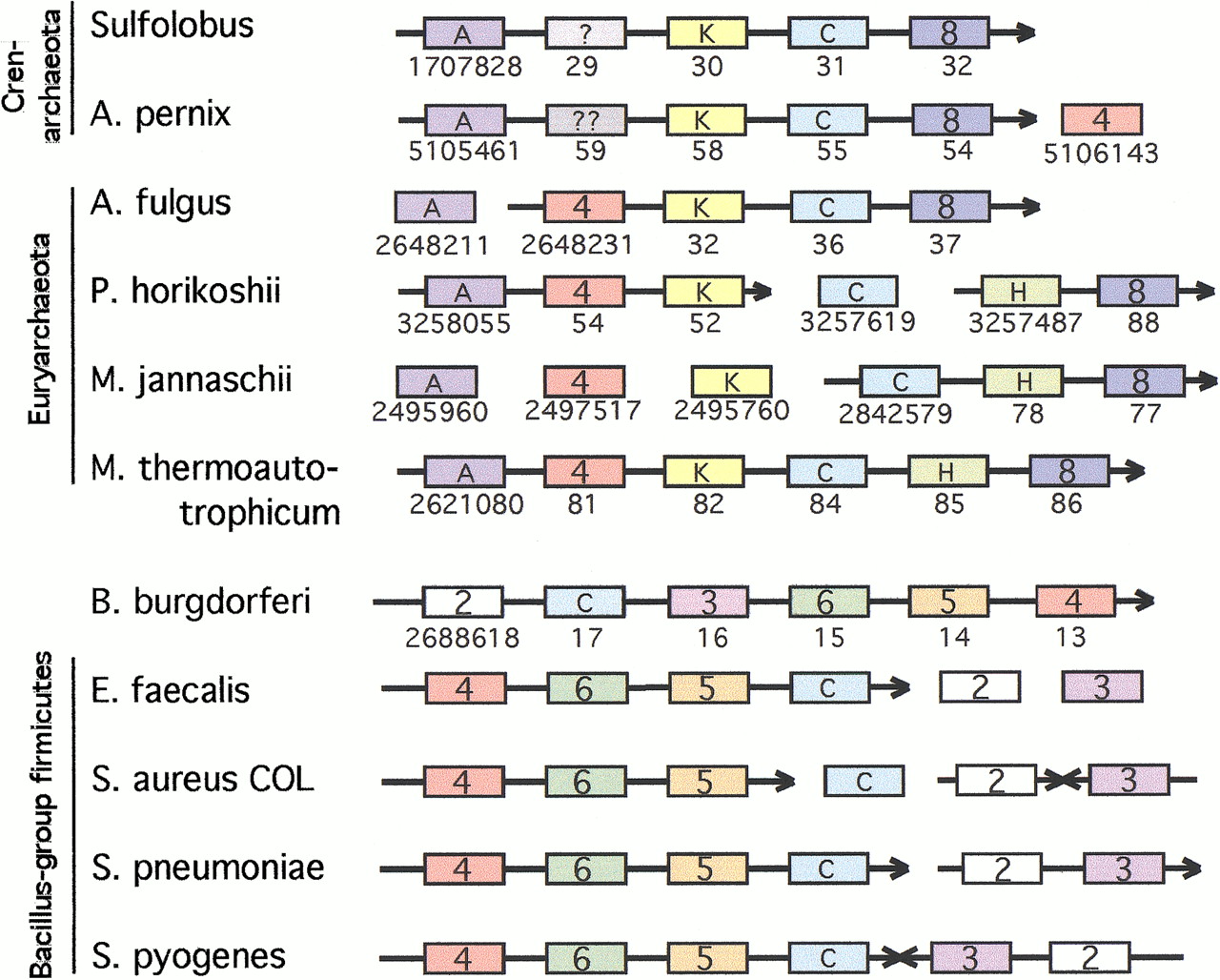
Conserved strings include genes of the mevalonate pathway in archaea and bacteria. Blocks connected by an arrow indicate neighboring genes with a common transcriptional orientation, possibly representing operons. Blocks containing numbers represent known mevalonate pathway genes, as in Figure 1. Blocks designated as 2 indicate hydroxy-3-methylglutaryl-CoA synthase; 3 indicates 3-hydroxy-3-methylglutaryl-CoA reductase; 4 indicates mevalonate kinase; 5 indicates yeast-like phosphomevalonate kinase; 6 indicates diphosphomevalonate decarboxylase; and 8 indicates octaprenyl-diphosphate synthase, a member of the geranyl pyrophosphate synthase family. Other designations: A indicates ancient conserved protein (COG #1355), K indicates putative kinase related to uridylate- and acetylglutamate kinases, Cindicatescarotenoid biosynthesis protein (flavin-dependent oxidoreductase), and H indicates putative metal-dependent hydrolase. Pyrococcus abyssi has the same structure as Pyrococcus horikoshii, with one gene insertion between ancient conserved protein and mevalonate kinase. InStreptococcus pyogenes, genes 2 and 3 are flanking the mevalonate kinase operon, but are transcribed in opposite orientation. The mevalonate kinase gene has not been sequenced yet inSulfolobus solfataricus. The putative metal-dependent hydrolase has no orthologs in Aeropyrum andArchaeoglobus. GenBank identification nos. are given below the boxes, where available. Apparently-missing GI numbers in strings correspond to overlapping genes, typically short open reading frames (ORFs) on the opposite strand.