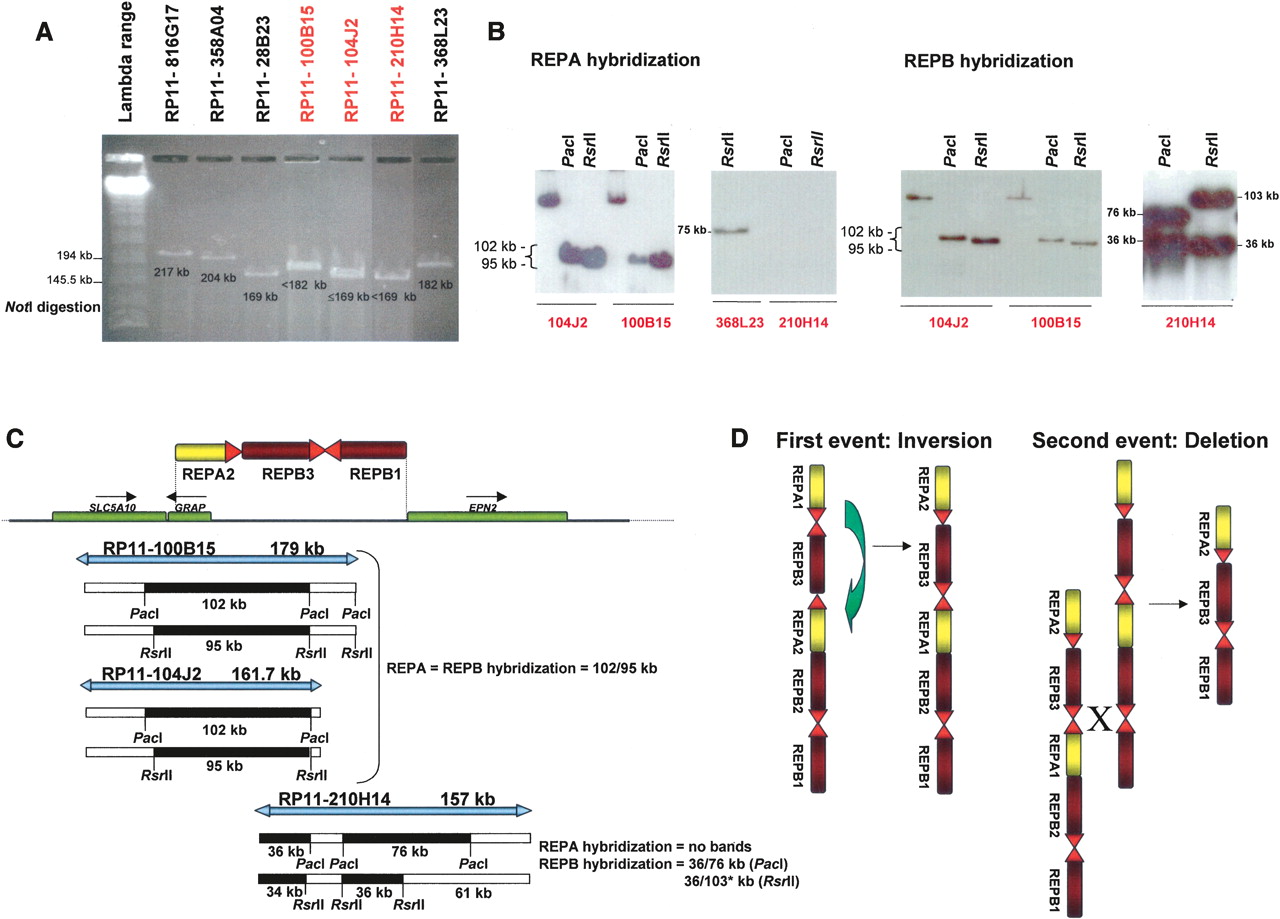
RPCI-11 library clones presenting a new REPA/B structure. (A) NotI digestion profile in 1% agarose gel of some of the RPCI-11 library clones spanning the REPA/REPB region. NotI enzyme has just one restriction endonuclease recognition site per clone, thus we were able to estimate their overall size (shown below each band). Clones with black type were used as reference clones for band sizing whereas clones in red presented an unexpected digested band, suggesting a different genomic content compared to the reference genome. (B) PacI and RsrII digestion followed by specific REPA and REPB hybridization of the clones RP11-104J2, RP11-100B15, and RP11-210H14. These results confirmed the presence of REPA and REPB at the selected clones but in an unexpected copy number. RP11-104J2 and RP11-100B15 have just one copy of REPA and one copy of REPB; RP11-210H14 has no copies of REPA but two copies of REPB. (C) (Top) alternative genomic structure of REPA/B based on forward and reverse clone end sequences, restriction enzyme digestion profiles, and REPA and REPB hybridization. (Bottom) PacI and RsrII restriction maps for each clone according to that new alternative structure. *103 kb size (34 kb + 61 kb) is expected as the bacterial sequence part of the cloning BAC has no RsrII restriction site. The expected digestion patterns for all clones are consistent with those observed in B, so we can conclude that the individual used to construct the RP11 BAC library carries two different REPA/REPB copy numbers. (D) Molecular mechanisms and proposed model for the generation of the new structure based on Barbouti et al. (2004) REPA/REPB structure background. First event should be a large inversion involving REPAs; the presence of two REPA copies with 99.8% identity in inverted orientation would favor the occurrence of NAHR and produces inversion of the whole segment within. The second event is a deletion of one REPA and one REPB. This can occur by interchromosomal, intrachromosomal, or intrachromatid mispairing between the highly similar SNORD3@ gene clusters at the REPA/REPB and REPB/REPB heads, leading to a deletion of two REPs elements by the NAHR mechanism.