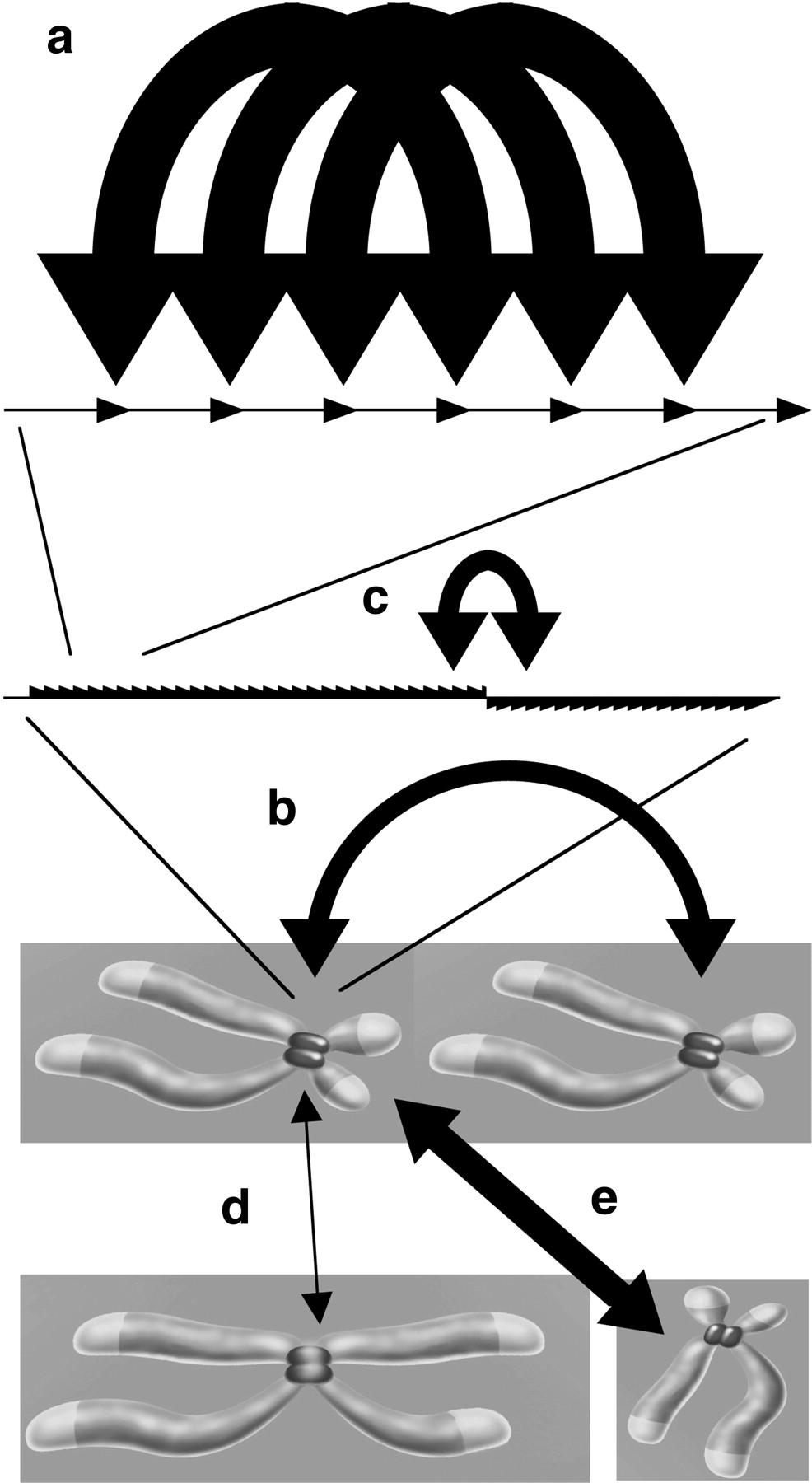
Schematic diagram of several possible trajectories of molecular drive. (a) Localized clustering of variants within neighboring higher-order repeats within highly homogeneous array segments must be the fastest ongoing molecular drive mechanism. The (efficient) interchromosome process, causing fixation in the population (b), is too slow to disintegrate the clusters. Intrachromosomal exchange between distinct array types is generally inefficient, allowing complete fixation of two or more homogeneous array types at a centromere. Sometimes, if closely related array types share sufficient sequence homology, intrachromosomal interarray exchange can be comparably fast evolutionarily (c), preceding complete fixation (Warburton and Willard 1995). Exchange between highly homogeneous (>97%), structurally indistinguishable array types on different chromosomes can be very efficient, as known from pairs of acrocentrics (Greig et al. 1993), or Chromosomes 5 and 19 (e). Any rare exchange between distinct arrays (d) is irrelevant for our mechanistic point of view, which concentrates on the ongoing homogenization within a single homogeneous array, but might well be relevant for the concerted evolution of all the loosely related α-satellite DNA families in general.