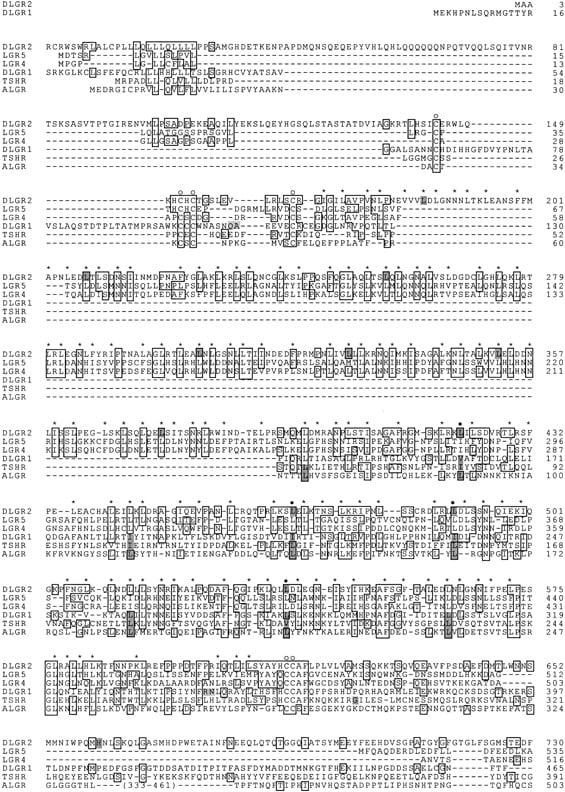
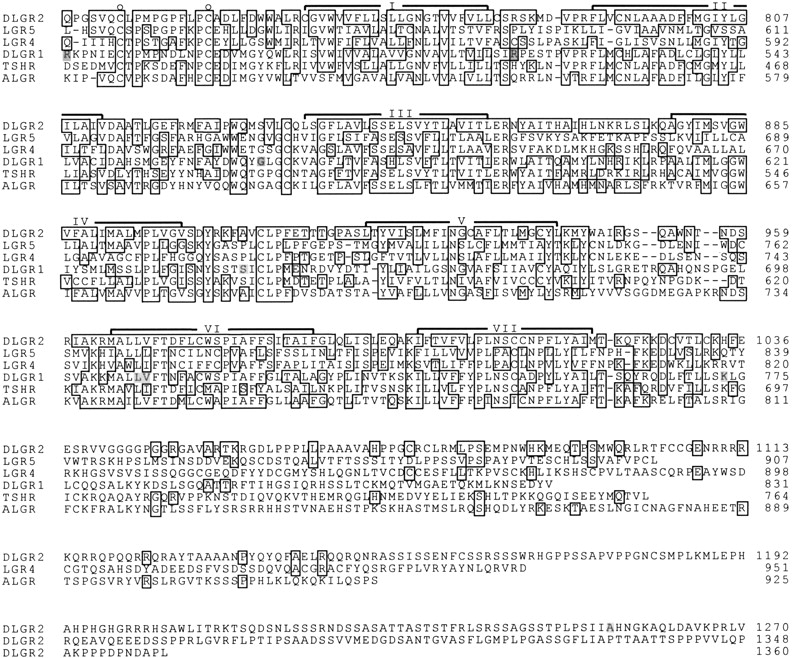
Amino acid sequence comparison between DLGR-2, LGR-5, LGR-4, DLGR-1, the human TSH receptor (TSHR), and the LGR from the sea anemoneAnthopleura elegantissima (ALGR). Broken lines represent spaces introduced to optimize alignment. The Gly-rich repeats of ALGR (Nothacker and Grimmelikhuijzen 1993) were omitted to facilitate alignment. Amino acid residues that are identical between DLGR-2 and at least one of the other receptors are boxed. Known intron–exon transitions in the genes coding for the receptors are shaded at the corresponding amino acid residues. The positons of the aliphatic and aromatic residues characteristic for the Leu-rich repeats in DGLR-2 are marked by asterisks (*) or solid circles (●). The solid circles also mark intron–exon transitions in the DGLR-2 gene that occur at the same positions and have the same intron phasing as in the DLGR-1, TSHR, and ALGR genes. The seven membrane-spanning domains are indicated by I–VII. The open circles (○) mark conserved cystein residues, flanking the region containing the Leu-rich repeats. The amino acid residue positions are given at right. The amino acid sequences of DLGR-1 and the mammalian and sea anemone receptors as well as the intron–exon positions in their genes are from Misrahi et al. (1990);Gross et al. (1991); Nothacker and Grimmelikhuijzen (1993); Hauser et al. (1997); Hsu et al. (1998); and Vibede et al. (1998).