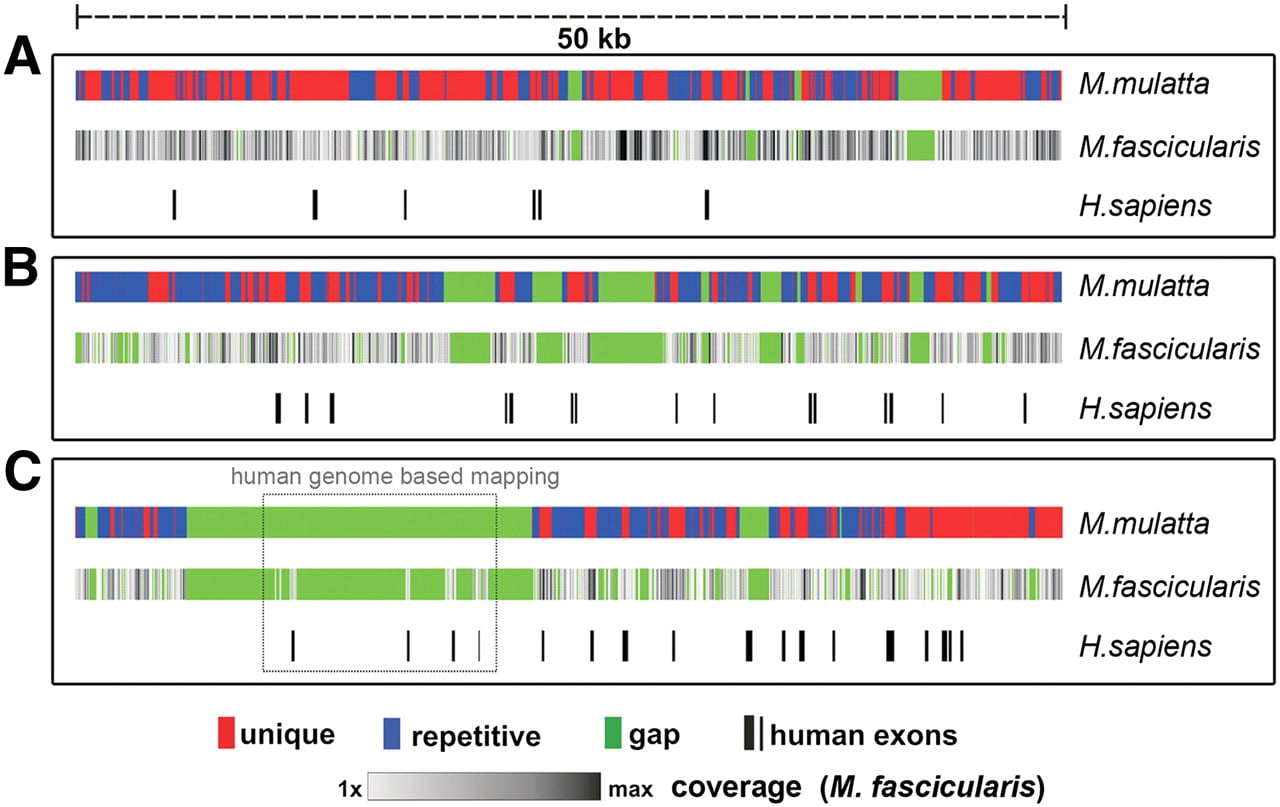
Representative examples of mapping efficiencies of M. fascicularis WGS reads to rhesus or human template genomes with different repeat and gap content. (A) Graphical comparison of a 50-kb fragment on chromosome 1 with low repeat and gap content. Unique sequences in rhesus in general have better coverage in M. fascicularis than repetitive segments, and gaps cannot be closed as an inherent feature of the WGS approach. For rhesus (top), unique stretches are shown in red, repetitive DNA in blue, and gaps in green. For the corresponding M. fascicularis section (middle) the local coverage is indicated from onefold (light gray) to ≥ sixfold (black), and gaps are shown in green. For human (bottom), only exons are shown as reference. (B) Display of a chromosome 1 region with increased gap and repeat content, where average coverage in M. fascicularis is significantly reduced due to ambiguous mapping. In some cases, the long 454 reads reduce gap size relative to rhesus. (C) Human genome-based identification of exons in a 20-kb rhesus genome gap based on homology and conservation of intron/exon boundaries in primates.