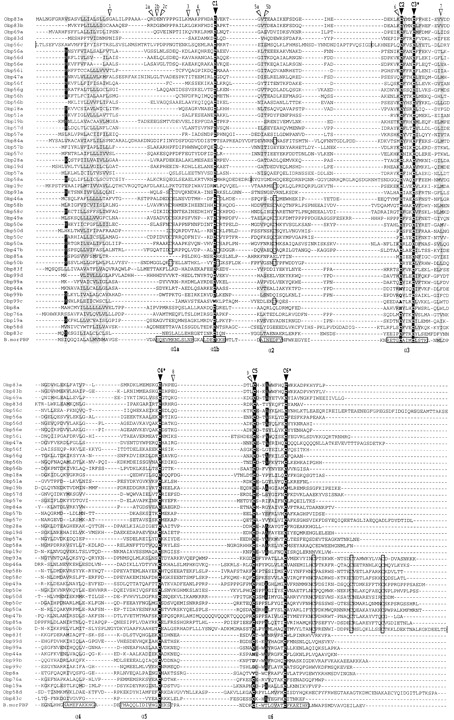
Amino acid alignment of the various Drosophila OBP family members. The alignment was produced using CLUSTAL X; the order is identical to that depicted in the phylogenetic tree (Fig. 3). The program BOXSHADE (K. Hofmann and M.D. Boron, unpubl.; available at http://ludwig-sunl.unil.ch:8080/software/Box_form. html) was used with a threshold of 0.5 to identify those residues either identical or similar to a consensus (shown as white on black background or black on gray background, respectively). Six cysteine residues (dark arrowheads) are highly conserved; C3, C4, and C6 (asterisks) are absolutely conserved. Dark boxes indicate conserved cysteine residues; open boxes indicate other notable cysteine conservations. Open arrowheads indicate highly conserved positions where introns are inserted (cf. Fig. 3): an arrowhead between two amino acids signifies that the intron occurs between the two corresponding codons, whereas an arrowhead over a particular amino acid signifies that the intron occurs within its codon. Bombyx moripheromone-binding protein (B. mor PBP, GenBank accession no. X94987) was shown by X-ray crystallography to carry seven α-helices (Sandler et al. 2000), indicated here by horizontal boxes (α1a–α6). Obp83e, which is composed of two tandem, in-frame OBP-like sequences, was omitted from the alignment. To simplify the presentation of the figure, four noninformative stretches present in single OBPs were omitted, as indicated by horizontal lines: At the N terminus, Obp56c contains the sequence [MYFRASLMALLC]-, and at the C terminus, Obp50b contains the sequence -[NGCGHIDSEGSNLLMACFLTLMIAKFISDH]. Between C1 and C2, Obp56c contains the sequence QSIGD-[VNNLGDLDFNGNSQMPYL]-DLKH, and Obp58a contains the sequence EDRG-[RGGQGRQGNGY]-EYGY, where the omitted sequence is contained within the brackets.