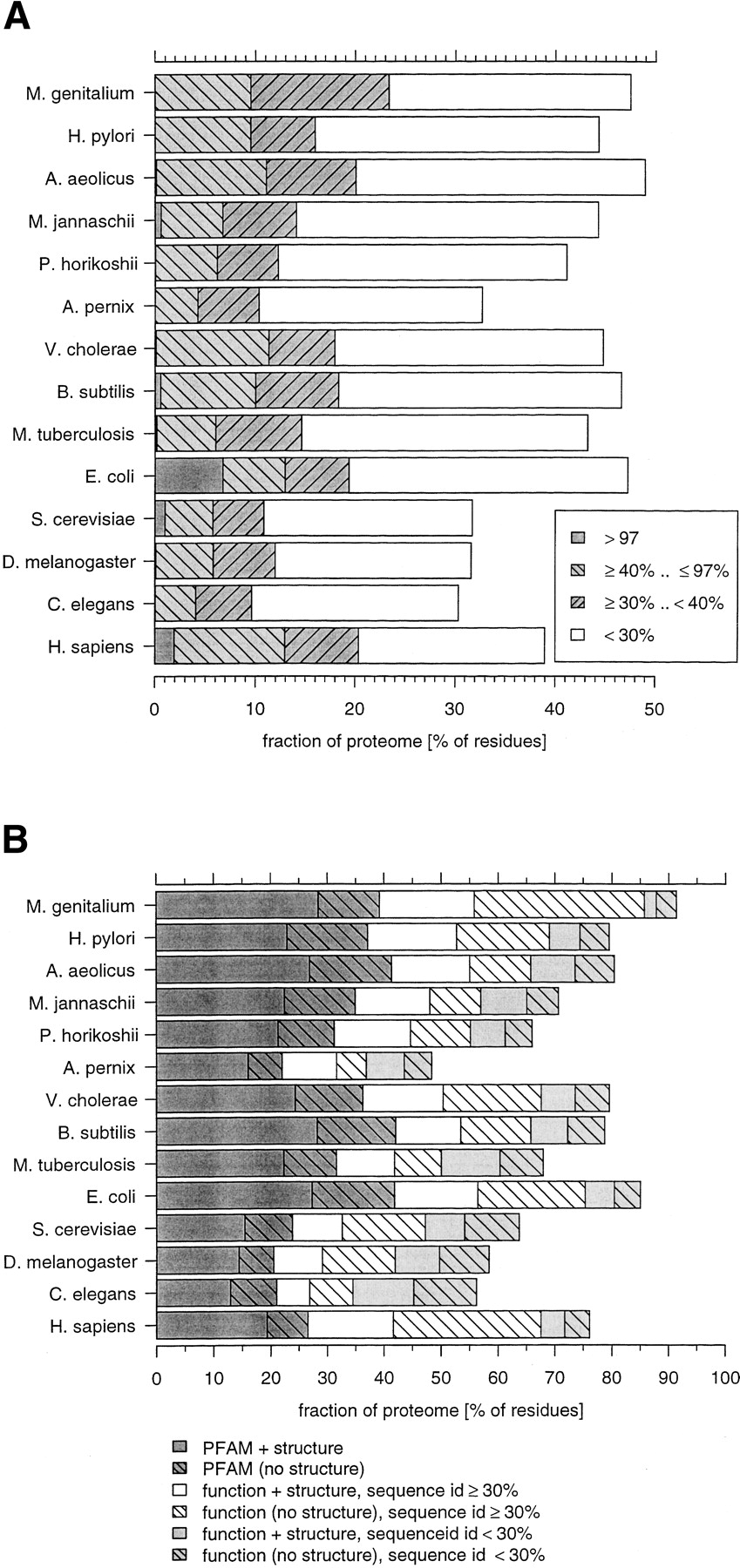
Reliability of annotation. (A) Reliability of structural annotation. Homologies are dissected into sequence similarity bands. The >97% identity effectively reports a match to an experimentally determined structure or to one that differs in only a few residues. Structures based on these annotations are accurate. The next band down to 40% denotes annotations for which models can be constructed that are expected to be reasonably accurate (Sanchez and Sali 1998; Bates and Sternberg 1999). Between 40% and 30% sequence identity automated modeling is difficult. Below 30% identity, the sequence alignment suggested by the annotation is expected to have many errors and the structural annotation primarily provides an indication of the 3-D fold. (B) Reliability of functional annotation. Functional annotation is distinguished between reliable (≥30% sequence identity) and “fuzzy” (<30% sequence identity). The fractions are cumulative, that is, regions that are assigned to a PFAM domain and a structure are counted first, then we count regions for which we have a PFAM domain but no structural assignment.