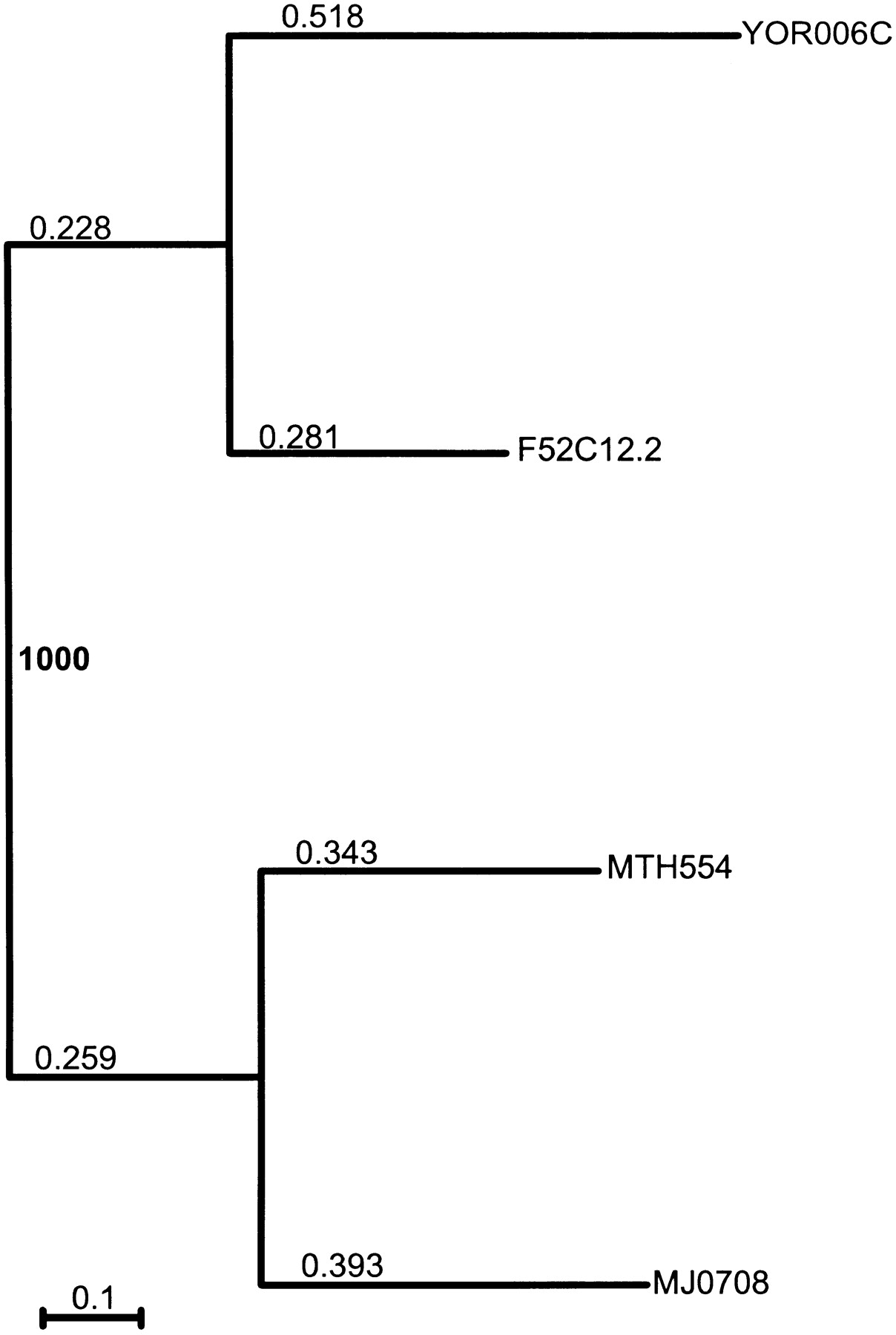
Phylogeny of MTH554 and its orthologs. The orthologous group is specific for the Archaea and the eukarya. Although the proteins are annotated as hypothetical, we find that it is homologous to a predicted rnase P component, and that it is conserved in an operon with rpl40 in three different species. It therefore probably has a function in translation/transcription. Despite its patchy species distribution, being in only the methanobacteria and the eukaryotes, the tree suggests simple vertical inheritance followed by gene loss inA. fulgidus, A. pernix, and the ancestor of the Pyrococci, rather than horizontal gene transfer. We propose these three losses because the gene phylogeny is consistent with the species phylogeny, and there is a long internal branch length separating the two groups, which is consistent with presence in the common ancestor of eukarya and Archaea. Moreover, any HGT explanation would contain unlikely events. When it would have taken place from a primitive eukaryote to an ancestor of methanobacteria, the receiving branch would be the very short branch separating the methanobacteria from the other Archaea. When alternatively it would have transferred from an ancestor of the methanobacteria to a primitive eukaryote, the donating branch would be the aforementioned (too) short branch.