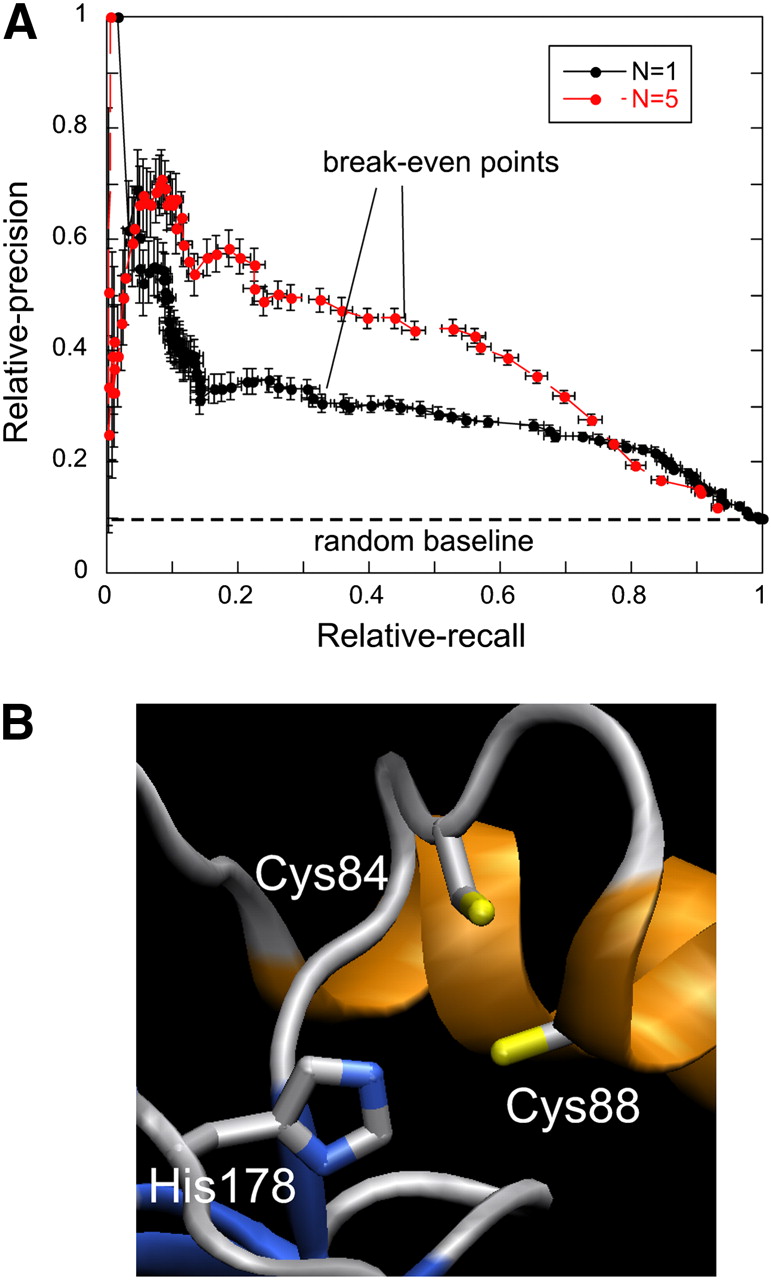
His and Cys metal binding predictions using the program MetalDetector (Passerini et al. 2006; Lippi et al. 2008). (A) Relative-precision–relative-recall curves for MetalDetector predictions. N is the number of His and Cys residues that have an mbss value exceeding a given TM threshold. N = 1 (black) and N = 5 (red). The random baseline is calculated as the fraction of all metalloproteins identified by HT-XAS divided by all proteins. Averages and standard errors are calculated using bootstrapping without resampling (Efron and Tibshirani 1993). (B) Putative metal-binding site in target 11211f formed by Cys84 (metal = 0.47; free = 0.2; disulf = 0.33), Cys88 (metal = 0.56; free = 0.09; disulf = 0.36), and His178 (metal = 0.41; free = 0.59). Model obtained with SWISS-MODEL in alignment mode (Kiefer et al. 2009). As a template, we used the Cu+-binding NMR structure of human SCO2 (PDB ID: 2RLI) (Banci et al. 2007), which shares 26% sequence identity with target 11211f (alignment length is 161, using three iterations of PSI-BLAST). VMD (Humphrey et al. 1996) was used for molecular graphics.