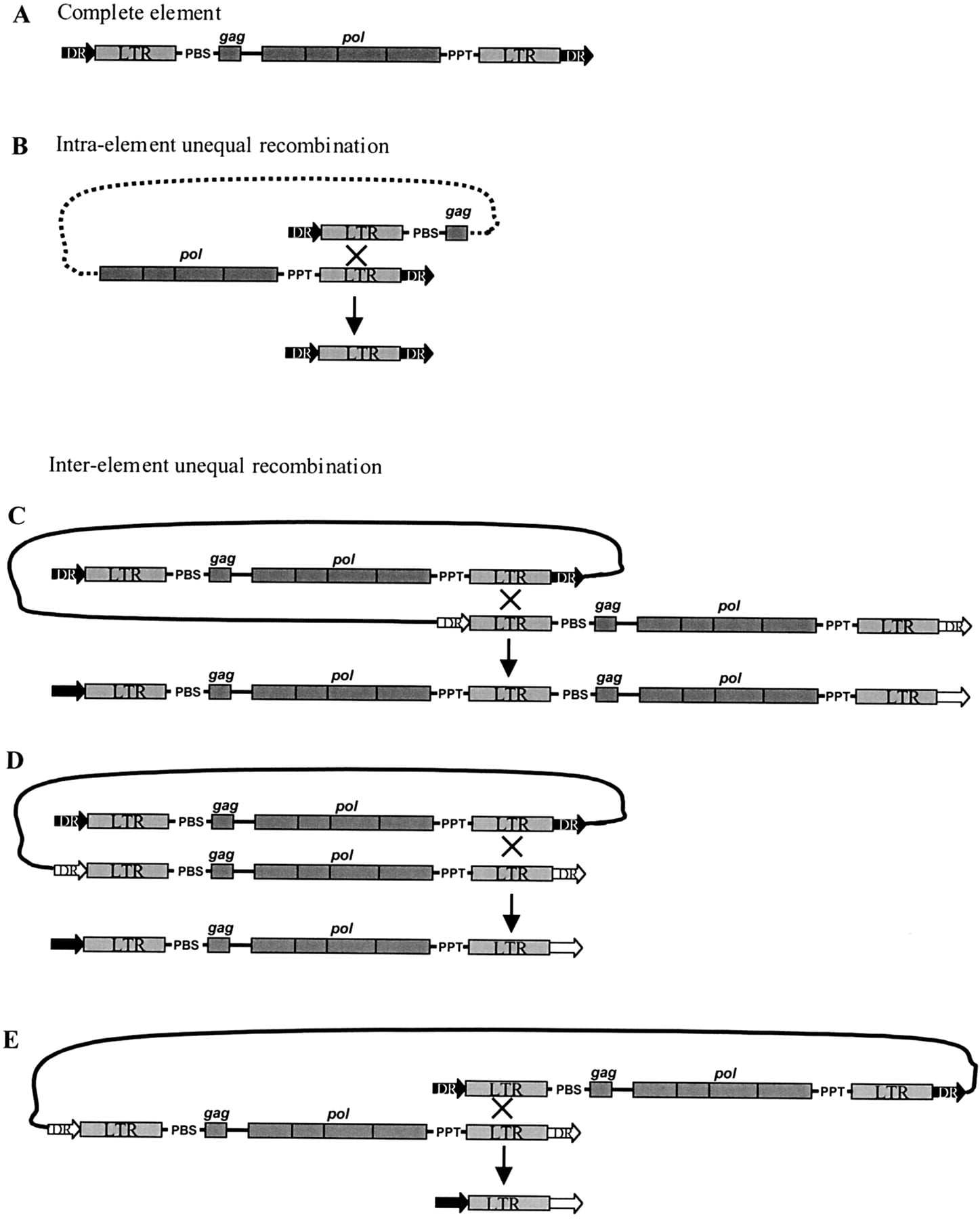
Unequal intrastrand recombination between LTR retrotransposons. (A) Structure of a complete element, with a direct repeat (DR) of flanking target-site DNA, two long terminal repeats (LTRs), a primer-binding site (PBS), and polypurine tract (PPT) needed for element replication and encoded gene products (gag, pol). (B) Solo LTR resulting from intra-element recombination. The dotted line is presented to facilitate depiction of the folding needed to accomplish this recombination and does not represent any significant stretch of DNA. (C) Recombinant element resulting from recombination between 5′ and 3′ LTRs of two adjacent elements. The solid black line represents sequences between the two LTR retrotransposons that are deleted via this intrastrand event. Note that the two flanking direct repeats are now different, because one is the 3′ target site of one element (black arrow) and the other is the 5′ target site from the adjacent element (white arrow). (D) “Complete” element without target-site duplication resulting from unequal recombination between two 5′ LTRs, two 3′ LTRs, or the internal regions of two elements. Once again, DNA between the two LTR retrotransposons is lost, along with one LTR-retrotransposon copy. (E) “Solo” LTR without target-site duplication resulting from recombination between 3′ and 5′ LTRs of two elements. As before, DNA between the two LTR retrotransposons (solid black line) is lost. In all cases shown, unequal intrastrand recombination only creates a deletion if the two participant retroelements are in direct orientation on the same chromosome arm.