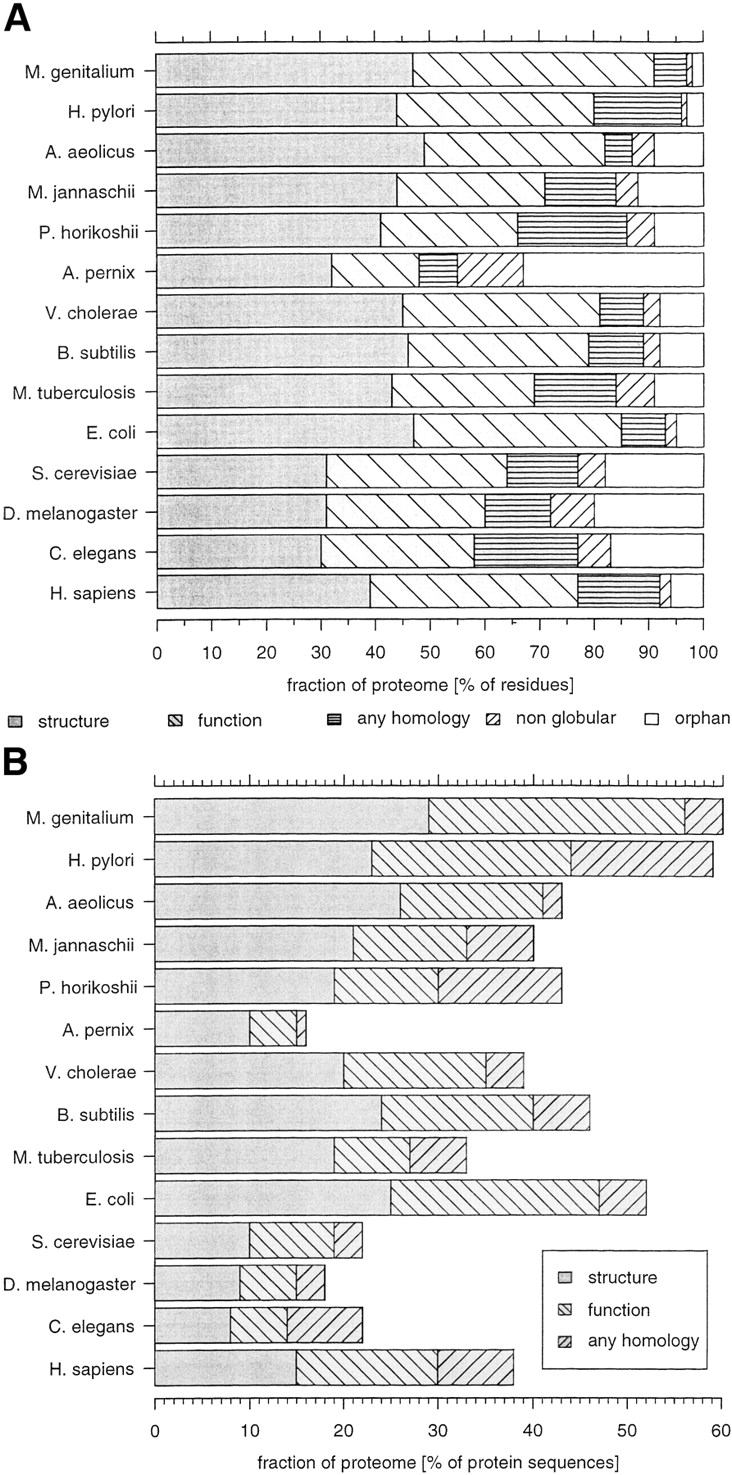
Structural and functional annotation of the proteomes. (A) Coverage for each species is reported as the fraction of the residues in the proteome that are annotated. This allows for partial coverage of any sequence. Structural annotation is a homology to a known structure. Functional annotation is when there is no structural annotation but there is a homology to an entry from SwissProt or PIR that has a description other than those that contain any of the following words: “hypothetical”, “probable”, “putative”, “predicted”. Any homology denotes a sequence similarity to a structurally or functionally unannotated protein, such as one described as hypothetical. Nonglobular denotes remaining sequence regions that were predicted as transmembrane, signal peptide, coiled-coils, or low-complexity. Remaining residues are classified as orphans. (B) Structural and functional annotations that cover the entire protein sequence. For structural annotation, we required that >95% of the sequence was structurally annotated and there was no unannotated segment of >30 residues. Functional annotation is evaluated after assigning structures and requires the same constraints. Finally, any homolog (including those of unknown function) is assigned to the remainder (with the same sequence length constraints).