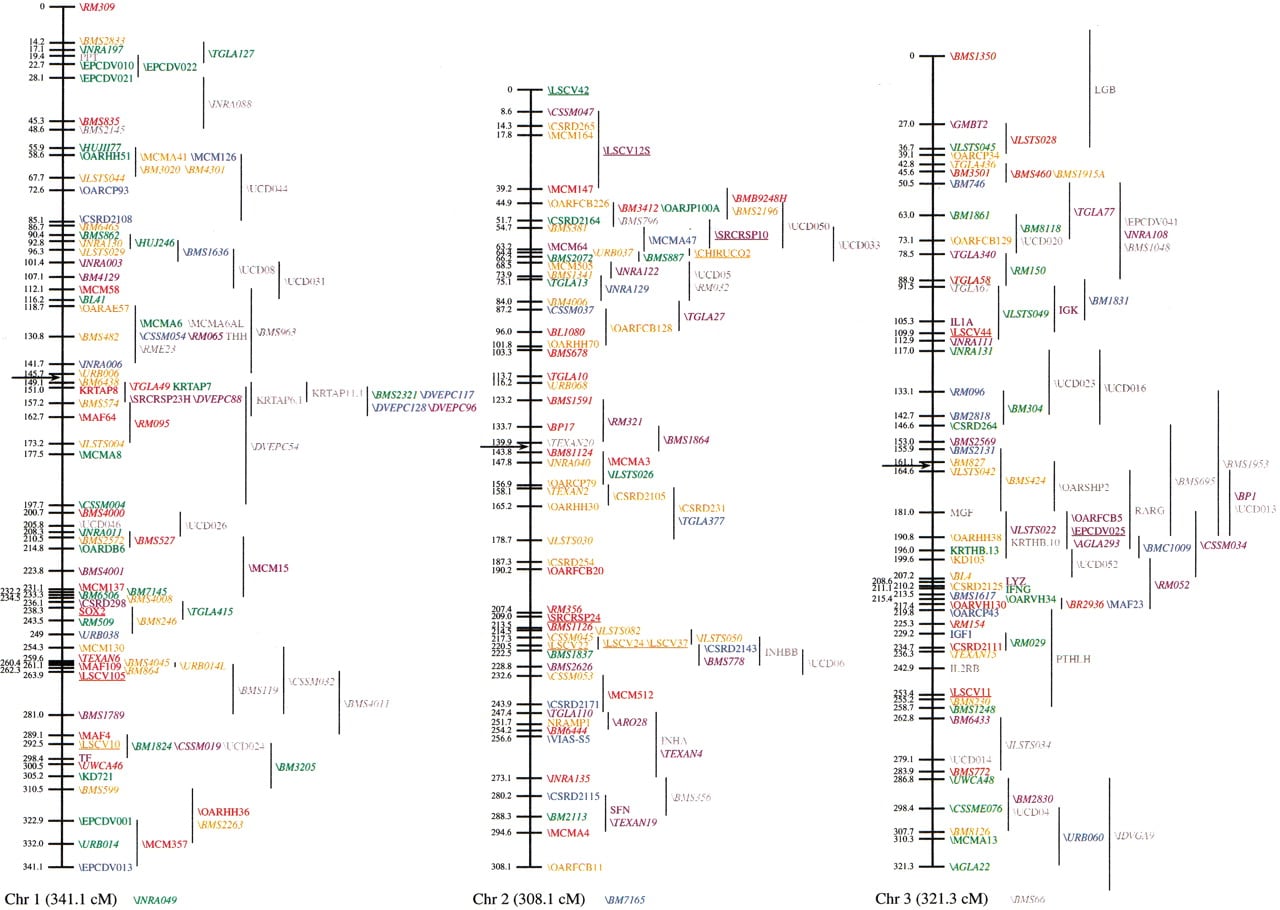
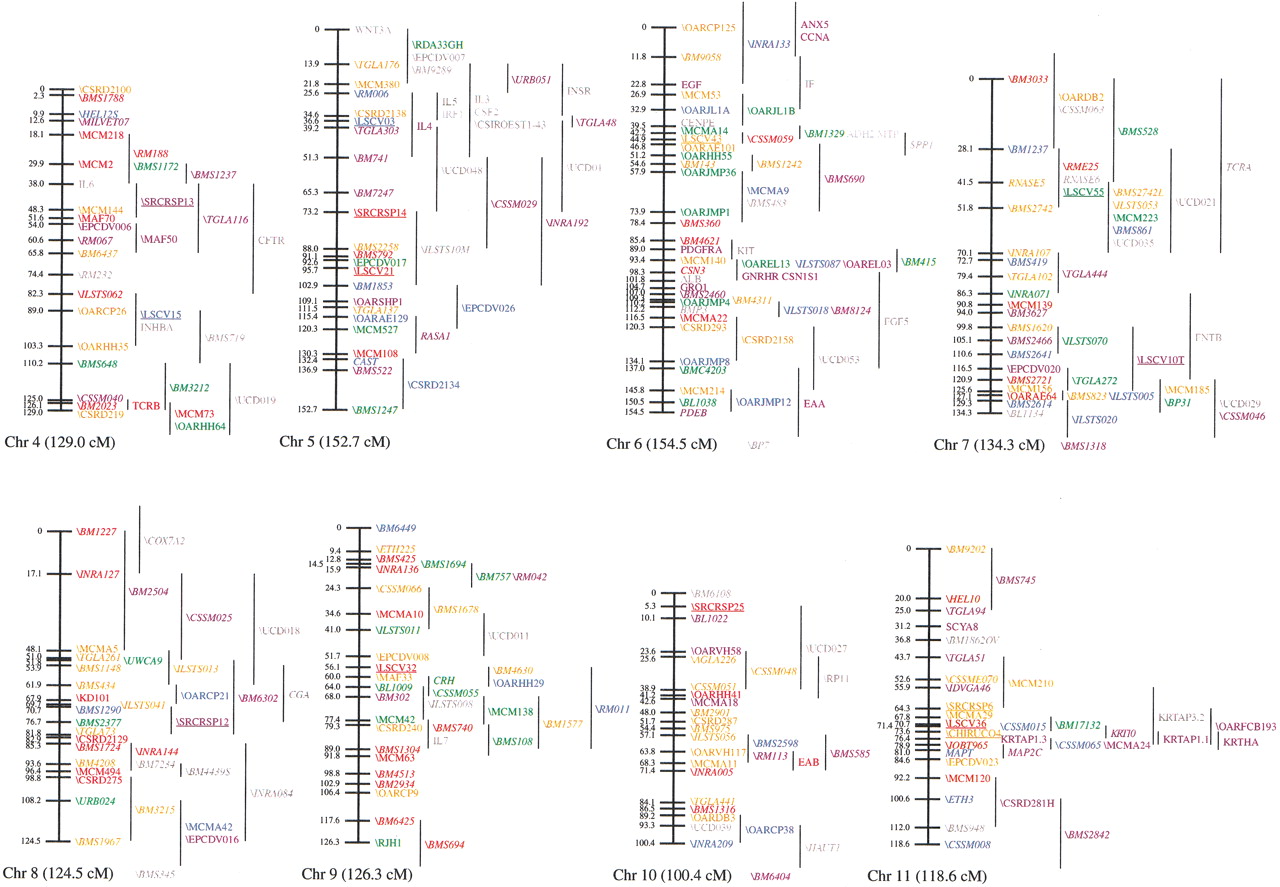
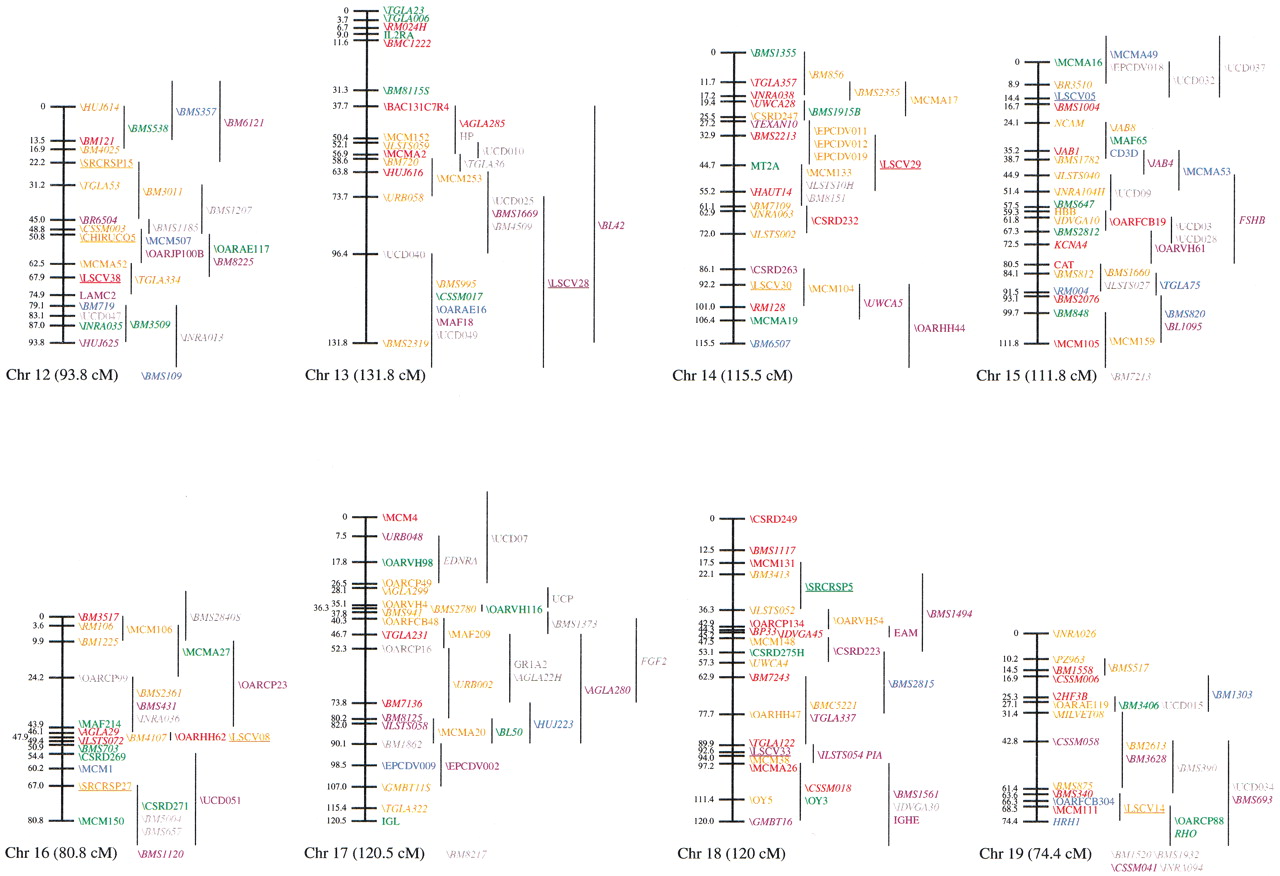
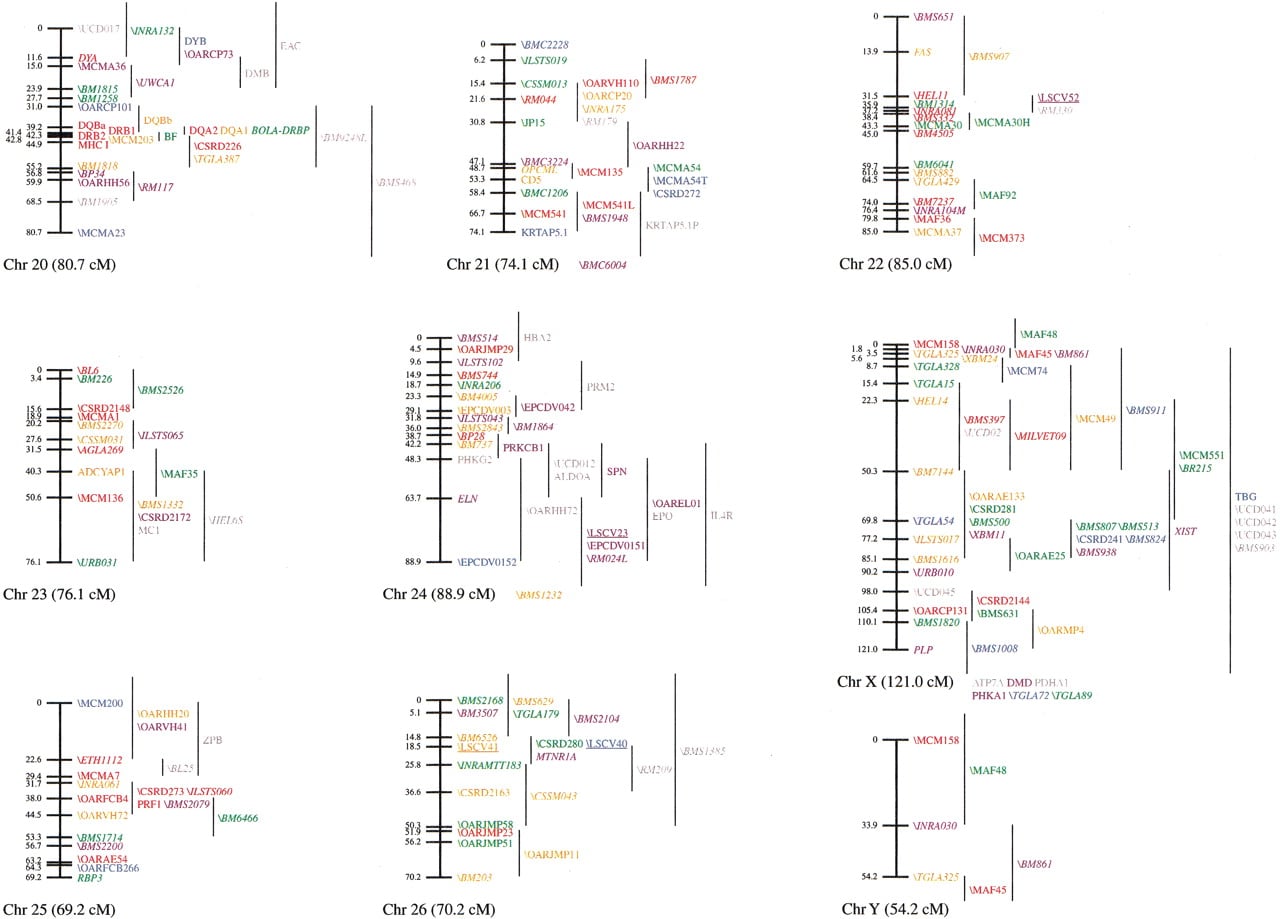
An updated genetic linkage map for the sheep. Loci shown on the main framework map were positioned with odds of >1000 : 1. Loci to the right of the main framework map were significantly linked to the region indicated by the vertical lines, but could not be positioned on the framework at odds of >1000 : 1. All the autosomal linkage maps are sex-averaged and map distances are estimated by use of the Kosambi mapping function. The X chromosome map shows female map distances, whereas the Y chromosome map shows male map distances. (Horizontal arrows) Likely positions of the centromeres for chromosomes 1, 2, and 3. The remaining chromosomes are oriented with the centromeres at the top. Loci present on the second-generation or X chromosome sheep linkage maps that have not been mapped on the IMF are indicated at the bottom of the relevant chromosomes. The species of origin of the marker(s) used to position a locus is indicated by plain text for sheep markers, italics for cattle markers, and underlined for goat markers. Anonymous loci are prefaced by a backslash. Loci are color-coded by the following system: (red) PIC 0.8 or higher, if no PIC, then 11 or more alleles; (orange) PIC between 0.7 and 0.79, if no PIC, then 8–10 alleles; (green) PIC between 0.6 and 0.69, if no PIC, then 6–7 alleles; (blue) PIC between 0.5 and 0.59, if no PIC, then 5 alleles; (purple) PIC between 0.3 and 0.49, if no PIC then 3–4 alleles; (dark grey) PIC below 0.3, if no PIC, then 2 alleles; (light grey) gene in close proximity to a mapped marker that is within, or closer to, another gene. (*) Although there are at least two DQB genes in sheep, the relationship between the ovine DQB PCR products andDQB genes is unresolved (van Oorschot et al. 1994).