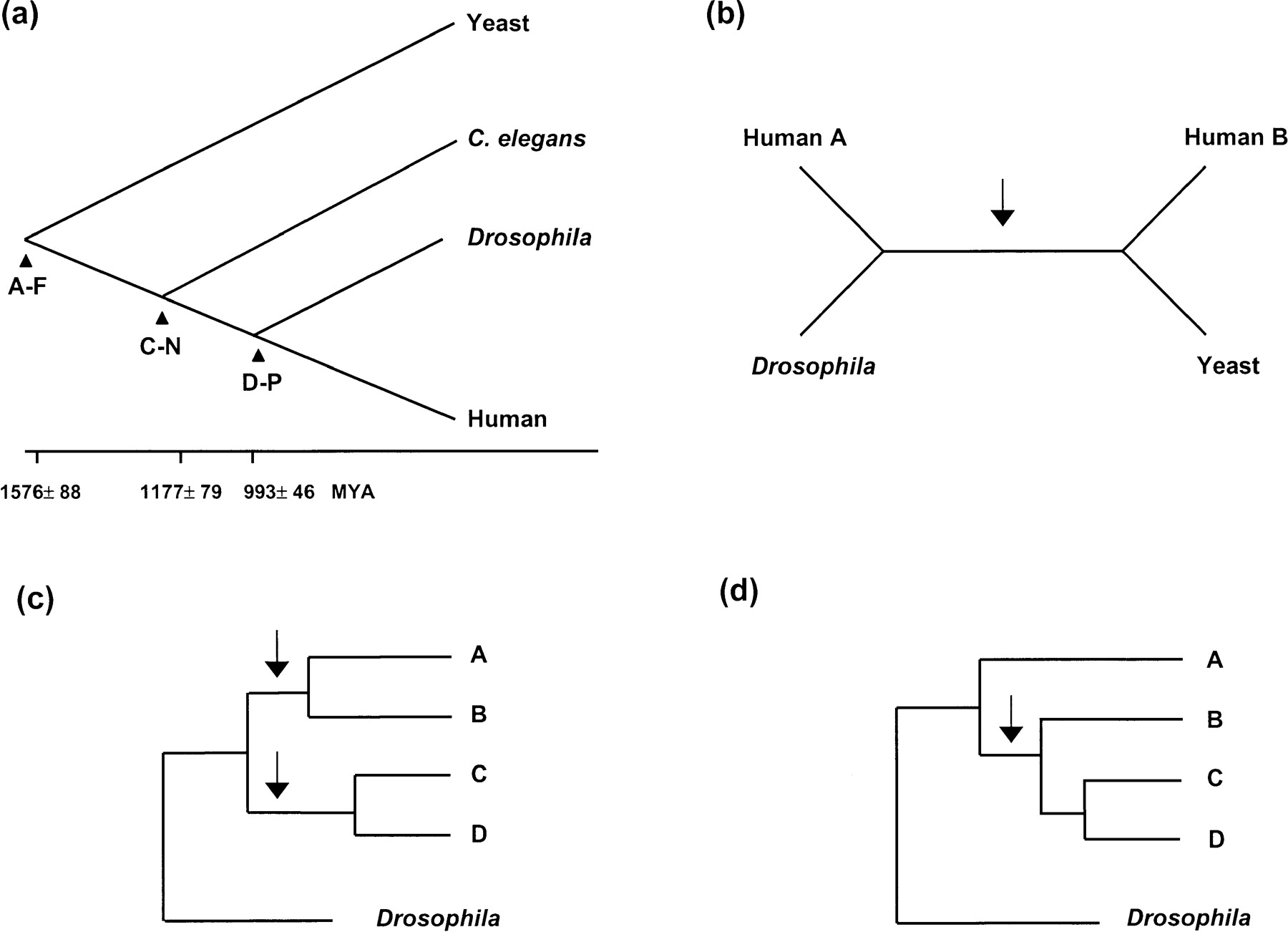
(a) Phylogenetic tree showing the major cladogenetic events used in timing gene duplications: (A–F) the animal–fungus divergence; (C–N), the coelomate–nematode divergence; (D–P), the deuterostome–protostome divergence. The topology of the tree and the divergence time estimates (±SE) are from Wang et al. (1999). However, gene duplications were timed relative to cladogenetic events independent of a molecular clock assumption. (b) Hypothetical gene family containing two human members (A and B). If the internal branch (indicated by arrow) is significantly supported, we can conclude (independent of the rooting of the tree) that A and B diverged prior to the deuterostome–protostome divergence. (c) Hypothetical four-member human gene family having a topology of the form (AB) (CD) consistent with the hypothesis of two rounds of genome duplication (the 2R hypothesis). (d) Hypothetical four-member human gene family having a topology of the form (A) (BD) inconsistent with the 2R hypothesis.