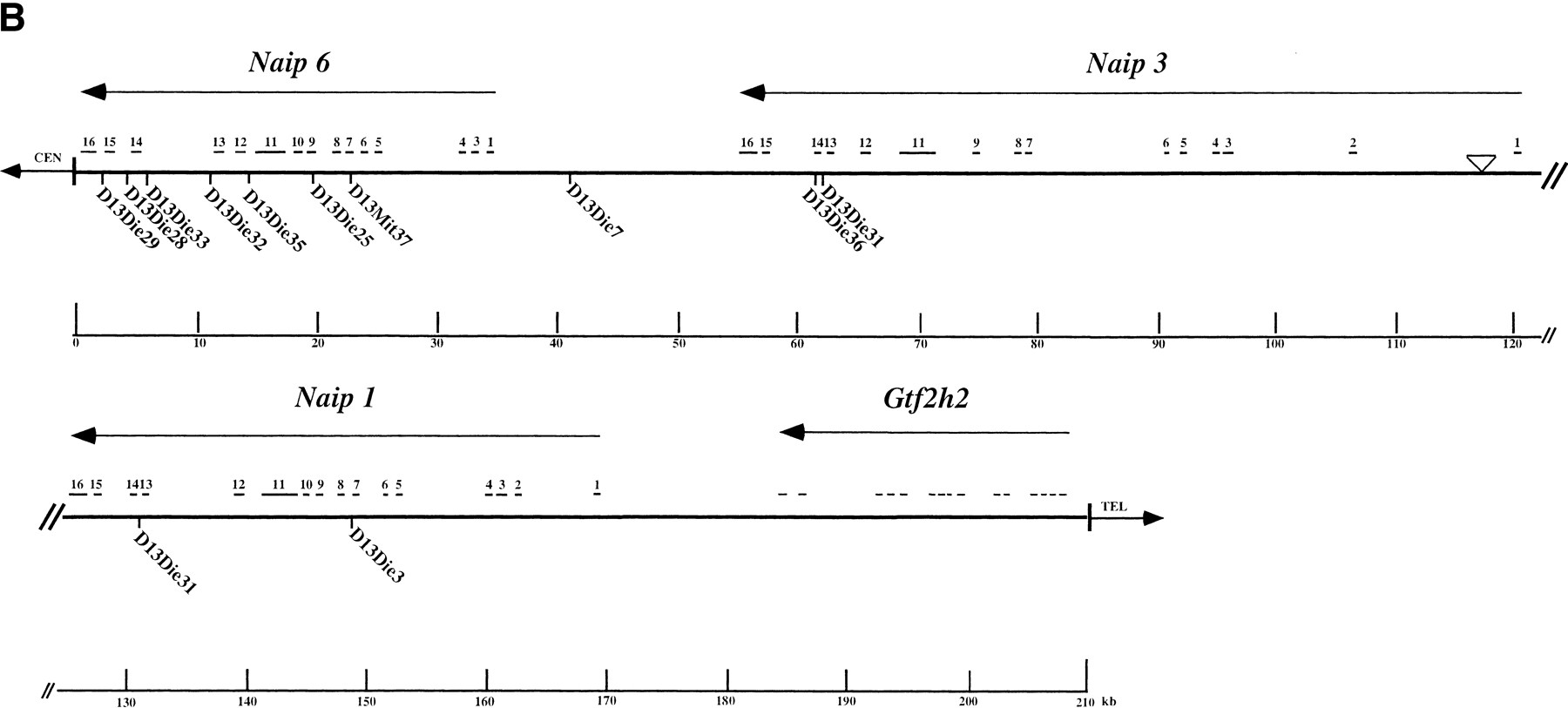
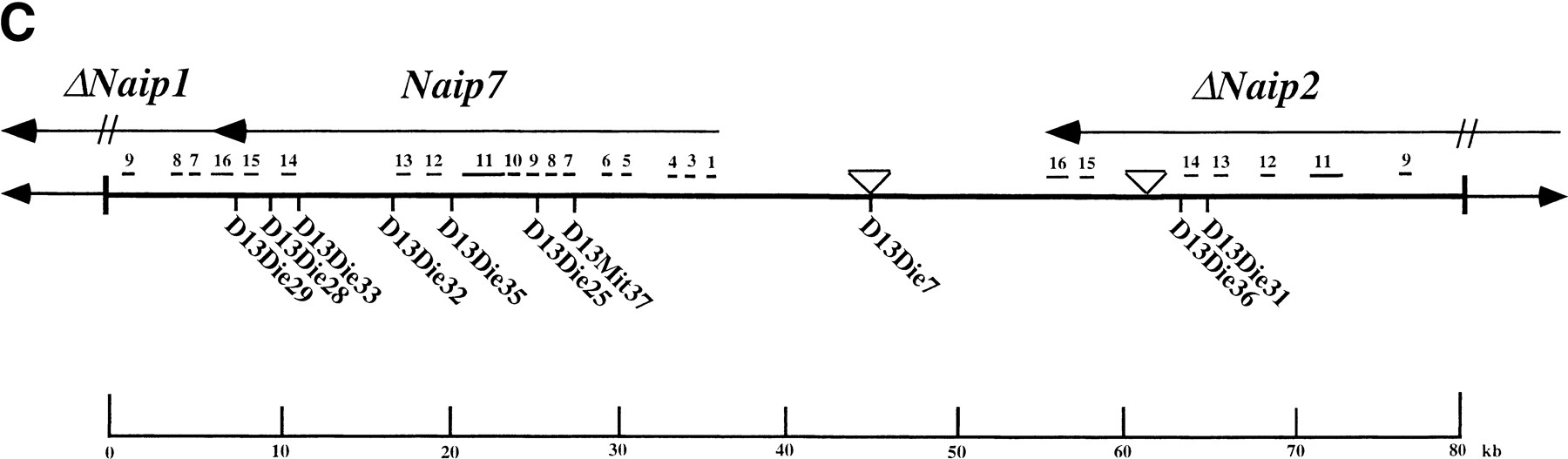
Map of the 129 mouse Naip array and annotation of the genomic sequences. (A) The map of the 129 mouse Naip array that was described previously in Growney et al. (2000) is indicated. The named arrows show the position and orientation of the Naipgene loci. The ΔNaip regions are pseudogenes that have been deleted for several of the 5′ terminal exons. The current critical interval for Lgn1 is indicated above the map (Growney and Dietrich, 2000). The positions of genomic clones with sequence reported in this work (9045 and 26f17) or elsewhere (149m19, Endrizzi et al. 1999) are indicated by bold lines beneath the gene map. The positions of other nearby genes are indicated to provide context for the map. For Fig. 1B,C, the identification and annotation of Naip gene sequences were obtained through simple alignments of knownNaip cDNA sequences to the genomic fragments (see Methods). The sequences were also analyzed using Genotator/Genotator Browser (see Methods). The relative orientations of named transcription units, gene exons, and markers in each clone are shown in these figures. The scale at the bottom is in kb. The arrows represent the direction of transcription of the genes and the position and size of exons from within the genes are shown by the small numbered lines, except in the case of Gtf2h2, which has its coding exons indicated, but its 5′ and 3′ untranslated-region sequences in the mouse are unknown. (B) Annotation of 26f17 (AF242431 and AF242432). The triangle indicates the position of an approximately 7-bp gap in the sequence that cannot be determined with certainty. (C) Annotation of 9045 (AF242433-AF242435). The triangles indicate the positions of two small gaps (each are ∼500 bp) in the sequence.