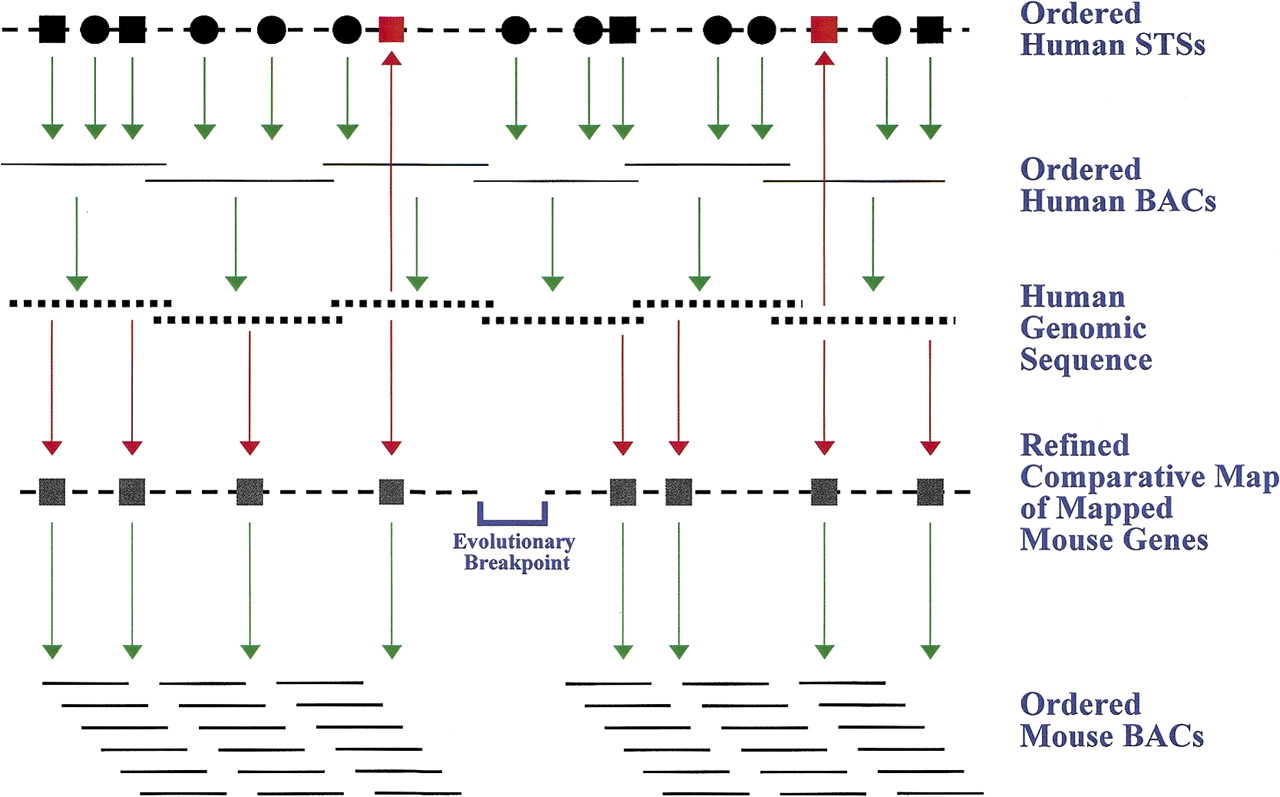
Overview of strategy for using human genomic sequence to facilitate human-mouse comparative mapping. Mapped and ordered human STSs (circles and squares correspond to random sequences and genes/ESTs, respectively) are used to isolate overlapping sets of human BACs, which in turn are sequenced. The resulting human genomic sequence can be readily aligned with the STS map by the electronic detection of mapped STSs. Also detected in the human sequence are previously unmapped sequences (e.g., genes/ESTs; depicted in red), thereby yielding an even more detailed STS map. Traditional comparative mapping can be enhanced with the human genomic sequence, specifically by the electronic detection of previously mapped mouse sequences (most often genes/ESTs). This allows refined comparative maps to be constructed that are more detailed than the starting human STS maps. The resulting linear order of markers on the comparative map allows more precise localization of evolutionary breakpoints at the ends of conserved segments. Finally, orthologous mouse sequences can be used to isolate corresponding mouse BACs and to assemble clone contigs. Red arrows reflect steps involving electronic analyses only, while green arrows reflect steps involving laboratory-based experimental analyses.